



There comes a point when “maybe one day” starts feeling like “why not now?”
For thousands of Brits, Australia is no longer just a holiday fantasy of beaches, barbecues and better weather. It has become a serious relocation option: a place to work, reset, raise a family, chase a better lifestyle, or finally escape the feeling that life in the UK has become too expensive, too grey or too stuck.
But moving to Australia from UK is not as simple as booking a flight and hoping the sunshine sorts everything out. Australia can be brilliant, but it can also be expensive, competitive and brutally unforgiving if you arrive without a plan.
This guide breaks down the real questions: which visa could suit you, where to live, what jobs are in demand, how much rent costs, what healthcare cover you may get, and what to sort before you pack your bags.
Australia is one of the most familiar overseas moves for British people. The UK-born population remains Australia’s largest migrant community, with more than 1.1 million UK-born people living in Australia at the end of June 2024.
So, yes — moving from the UK to Australia is still very achievable.
But the winners are the people who plan it properly.
Why Are So Many Brits Moving to Australia?
The dream has changed.
Twenty years ago, moving to Australia often meant “sunshine and surf.” Today, it is more practical. Brits are looking at Australia because they want:
- better weather
- outdoor living
- higher wages in some sectors
- stronger lifestyle balance
- more space
- a fresh start
- career opportunities
- a different future for their children
Recent UK migration data also shows British nationals have been leaving the UK in significant numbers, with the Office for National Statistics estimating negative net migration for British nationals in the year ending June 2025.
That does not mean Australia is automatically easier. It means more people are seriously weighing up whether the UK still gives them the life they want.
Australia offers opportunity, but it also demands preparation.
Can UK Citizens Move to Australia?
Yes, UK citizens can move to Australia, but they need the right visa.
Your best visa route depends on your age, occupation, qualifications, work experience, family situation and long-term plan.
For most UK citizens, the main pathways are:
| Visa route | Best for |
|---|---|
| Working Holiday visa | Younger Brits who want to live and work in Australia temporarily |
| Skilled Independent visa | Skilled workers who may qualify for permanent residency |
| Skilled Nominated visa | Skilled workers nominated by an Australian state or territory |
| Skilled Regional visa | People open to living in regional Australia |
| Employer sponsored visa | Workers with an Australian employer willing to sponsor them |
| Partner visa | People in a genuine relationship with an Australian citizen or eligible resident |
| Student visa | People studying in Australia |
| National Innovation visa | Exceptional high-achievers in eligible fields |
The smartest first step is not asking “How do I move to Australia?” but asking:
Which visa pathway matches my age, skills and end goal?
That one question saves months of wasted effort.
Working Holiday Visa for UK Citizens
For younger Brits, the Working Holiday visa is one of the easiest ways to experience Australia before making a permanent decision.
UK passport holders can apply for an Australian Working Holiday visa between the ages of 18 and 35 inclusive. From 1 July 2024, UK passport holders can also be granted up to three separate Working Holiday visas without meeting the old specified work requirement.
That is a big deal.
It means eligible UK citizens can potentially spend up to three years in Australia on Working Holiday visas without needing to complete farm work or other specified regional work just to extend their stay.
This route is best for people who want to:
- test life in Australia
- work casually or temporarily
- explore different cities
- build local experience
- decide whether permanent migration is worth pursuing
But be careful. A Working Holiday visa is not the same as permanent migration. It can be a brilliant entry point, but if your real goal is to stay long term, you should think early about skilled visas, sponsorship or partner options.
Skilled Visas for UK Citizens
If you have a trade, profession or qualification Australia needs, a skilled visa may be your strongest route.
Australia’s skilled migration program is designed to bring in workers with skills needed in the Australian economy.
The common skilled visa options include:
Skilled Independent Visa Subclass 189
The Skilled Independent visa is for invited workers with skills Australia needs. It can allow successful applicants to live and work permanently anywhere in Australia.
This is attractive because it does not require employer sponsorship or state nomination, but it is competitive.
Skilled Nominated Visa Subclass 190
The Skilled Nominated visa lets nominated skilled workers live and work in Australia as permanent residents.
This route involves state or territory nomination, so your occupation and points score need to match what a specific Australian state or territory is looking for.
Skilled Work Regional Visa Subclass 491
The 491 visa allows skilled workers to live, work and study in a designated regional area of Australia for up to five years.
This can be a strong pathway if you are open to cities and regions outside Sydney, Melbourne and Brisbane.
Skills in Demand Visa Subclass 482
The Skills in Demand visa allows an Australian employer to sponsor a suitably skilled worker when they cannot find an appropriately skilled Australian worker for the role.
This is often the practical route for people who already have a job offer or work in an industry where employers regularly sponsor overseas workers.
How the Points System Works
For points-tested skilled visas such as the 189, 190 and 491, you generally need to submit an Expression of Interest through SkillSelect.
The Department of Home Affairs says these visas are points based and applicants need to meet or exceed the points threshold of 65 to be invited to apply. Points can come from factors such as age, English ability, qualifications and work experience.
But here is the hard truth: 65 points is the minimum, not a guarantee.
In competitive occupations, successful applicants may need much higher scores. That is why many UK applicants improve their chances by:
- getting a skills assessment early
- improving English test scores
- gaining extra work experience
- considering state nomination
- considering regional Australia
- checking whether their occupation is genuinely in demand
Do not guess your eligibility. Map it properly.
See Also: Moving to Australia From Philippines: Visa, Jobs and Cost of Living Guide
Jobs in Australia for UK Citizens
Australia can be a good job market for UK citizens, especially if your skills match shortage areas.
Jobs and Skills Australia maintains an Occupation Shortage List showing occupations in shortage across Australia and by state or territory.
Strong sectors often include:
- healthcare
- aged care
- construction
- engineering
- teaching
- early childhood education
- technology
- trades
- mining and resources
- infrastructure
- regional services
- hospitality and tourism
The Australian labour market has remained relatively stable. In March 2026, the Australian unemployment rate was 4.3%, with employment increasing to more than 14.7 million people.
That does not mean every Brit will walk into a job. Australian employers usually want local relevance. Even if your UK experience is strong, you may need to adapt your CV, understand Australian licensing rules, and build contacts before you land the right role.
For trades, healthcare and regulated professions, check whether your UK qualification transfers cleanly. Some roles require Australian registration, licensing or additional assessment.
Best Australian Cities for Brits
There is no single “best city” in Australia. There is only the best city for your budget, visa, job and lifestyle.
Sydney
Sydney is the obvious choice for many newcomers. It offers finance, tech, media, professional services, beaches and big-city energy.
But it is expensive.
Sydney is best if you have strong income potential, a job lined up, or a clear reason to be there.
Melbourne
Melbourne is popular with Brits who want culture, sport, food, arts and a slightly more European city feel.
It can be more affordable than Sydney in some areas, but rent is still a serious cost.
Brisbane
Brisbane has become one of Australia’s most attractive relocation cities thanks to warmer weather, strong population growth and lifestyle appeal.
It suits people who want a major city without Sydney prices, although rents have risen sharply in recent years.
Perth
Perth is ideal for mining, resources, engineering, construction and people who want space, beaches and a more independent city.
It is far from the east coast, but many Brits love the lifestyle once they settle in.
Adelaide
Adelaide can be a strong choice for families and skilled migrants who want lower costs, good schools, wine regions and a calmer lifestyle.
It is smaller, but that can be the point.
Canberra
Canberra suits public sector, defense, policy, education and professional roles.
It is clean, organised and highly liveable, but not cheap.
Regional Australia
Do not ignore regional Australia. Some skilled visa pathways favour regional areas, and lifestyle can be excellent if you choose well.
Regional does not always mean remote. It can mean places like Gold Coast, Sunshine Coast, Geelong, Newcastle, Wollongong, Ballarat, Bendigo, Toowoomba or Townsville.
Cost of Living in Australia vs UK
This is where many relocation dreams get real.
Australia can offer higher wages, but it also has high housing, transport, insurance and grocery costs.
Inflation is still a major factor. The Australian Bureau of Statistics reported that CPI rose 4.6% in the 12 months to March 2026, with housing, transport and food among the largest contributors.
That means you should not move with a “holiday budget.” You need a relocation budget.
As a rough planning mindset:
- rent will likely be your biggest cost
- groceries may feel expensive
- eating out is not cheap
- car ownership can be costly
- private health cover may be worth considering
- childcare can be expensive
- moving between cities is costly because Australia is huge
The people who struggle most are usually not the ones who move to Australia. They are the ones who move to Australia without enough cash buffer.
Rent in Australia: What UK Movers Need to Know
Australia’s rental market is tight.
Domain’s March 2026 Rental Report described the national rental market as under pressure, with vacancy rates falling to a record low of 0.7% nationally.
That matters because rental competition can be fierce, especially in popular suburbs close to jobs, beaches, transport and schools.
Domain reported the following median weekly rents for March 2026:
| City | Houses | Units |
|---|---|---|
| Sydney | $800 | $750 |
| Melbourne | $590 | $600 |
| Brisbane | $680 | $660 |
| Adelaide | $640 | $550 |
| Canberra | $700 | $580 |
| Perth | $740 | $695 |
| Hobart | $620 | $500 |
| Darwin | $720 | $600 |
These figures show the reality clearly: Australia is not a cheap-rent destination.
Before you move, prepare:
- proof of income
- employment contract if available
- rental references
- bank statements
- ID documents
- savings evidence
- short-term accommodation for your first few weeks
- flexibility on suburb choice
Do not arrive expecting to secure the dream rental in week one. Give yourself time.
How Much Money Should You Bring?
The right amount depends on your visa, city, family size and whether you already have a job.
As a practical guide, a single person should aim for enough to cover:
- flights
- visa costs
- health checks and documents
- shipping or baggage
- temporary accommodation
- rental bond
- first month’s rent
- furniture and household basics
- transport
- emergency fund
A couple or family needs significantly more.
For many movers, a sensible starting buffer is at least several months of living costs. If you are arriving without work, double the caution.
Moving to Australia is exciting. Running out of money in month two is not.
Wages and Work Rights in Australia
Australia has a formal minimum wage system. From 1 July 2025, the National Minimum Wage is $24.95 per hour or $948 per week before tax for adult employees not covered by an award or enterprise agreement. Casual employees covered by the National Minimum Wage also receive a 25% casual loading.
Many jobs are covered by awards, which set minimum pay and conditions for specific industries.
This is one area where UK movers need to adjust quickly. Australia has different rules around:
- casual loading
- penalty rates
- superannuation
- awards
- tax file numbers
- payslips
- work rights
- licensing
- probation periods
Before accepting a job, check the pay against Australian standards. Do not assume a salary is good just because the number looks higher than a UK salary.
Tax File Number and Banking
If you are moving to Australia to work, apply for a Tax File Number once you are in Australia and eligible.
The Australian Taxation Office says permanent migrants and temporary visitors in Australia with a valid work rights visa can apply for a TFN online.
Without a TFN, your employer may need to withhold tax at a higher rate.
You should also open an Australian bank account early. Many banks allow new arrivals to start the process before landing, then verify ID after arrival.
Your first admin jobs should be:
- Australian SIM card
- bank account
- TFN
- Medicare enrolment if eligible
- rental documents
- job applications
- local driving/licence checks
Get the boring admin done quickly. It makes everything else easier.
People Also Love: Moving to Australia From Africa: Visa, Jobs and Cost of Living Guide
Healthcare for UK Citizens in Australia
UK citizens may be eligible for some medical care under Australia’s Reciprocal Health Care Agreement.
Services Australia says UK visitors may be eligible for medical care under Medicare while in Australia, provided they meet the conditions, including having lived in the UK before arriving.
However, reciprocal healthcare is not the same as full private health cover, and it may not cover everything you expect.
Consider private health insurance if:
- your visa requires it
- you want broader cover
- you have ongoing health needs
- you are bringing children
- you want extras like dental or optical
- you want more hospital choice
Healthcare is one of those areas where assumptions get expensive. Check your exact visa requirements before you arrive.
Moving With Children
Australia can be a fantastic place to raise children, but families need to plan more carefully than solo movers.
Think about:
- school catchment areas
- school fees for temporary visa holders
- childcare availability
- rental location
- commute times
- healthcare
- family support
- visa conditions for dependants
- whether your partner can work
Some public schools may charge fees for temporary residents depending on the state or territory and visa type. This can change your budget dramatically.
Do not choose a suburb only because it looks nice online. Choose it based on schools, work access, rent, transport and whether you can actually secure a lease there.
Shipping Your Belongings
Most UK movers overestimate what they need to bring.
Australia has furniture, clothes, electronics and homeware. Shipping everything you own can be slow and expensive.
Bring:
- important documents
- work certificates
- qualification records
- medical records
- prescription information
- sentimental items
- high-value essentials
- clothes suitable for your destination climate
Think twice before shipping:
- old furniture
- cheap appliances
- excess winter clothing
- items that may create customs issues
- anything easily replaced in Australia
Australia also has strict biosecurity rules. Clean outdoor equipment, shoes, camping gear and anything that may carry soil or plant material.
The Best Way to Plan Your Move
Here is the simple version.
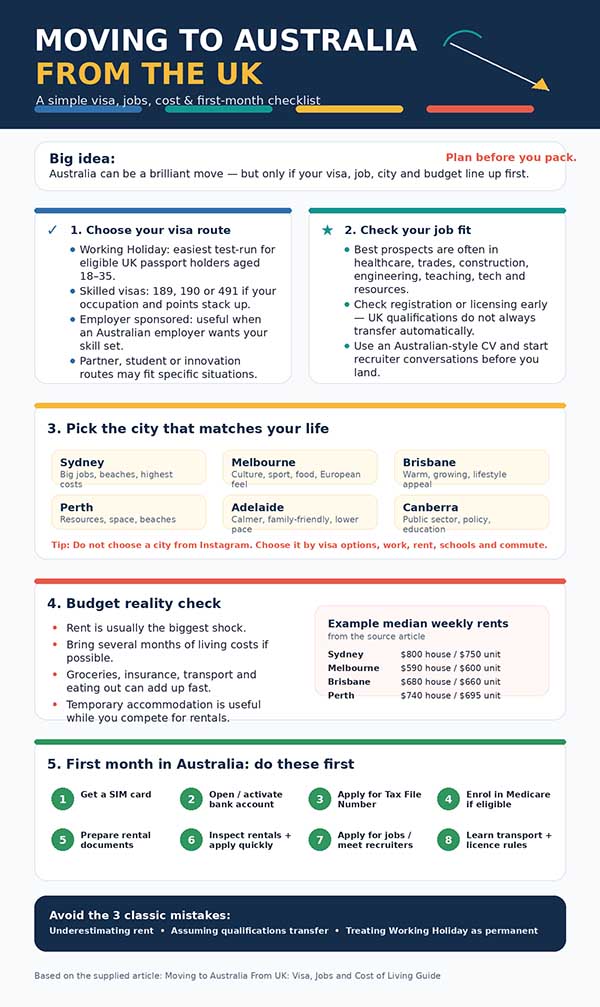
12 Months Before Moving
- research visa options
- check skills assessment requirements
- compare cities
- estimate relocation costs
- review your occupation demand
- begin saving aggressively
6 Months Before Moving
- apply for or progress your visa
- prepare CV in Australian format
- contact recruiters
- gather documents
- research suburbs
- review healthcare needs
- decide what to sell, store or ship
3 Months Before Moving
- book flights if visa is granted
- arrange temporary accommodation
- prepare rental documents
- open or research Australian bank account
- organise travel insurance
- notify UK providers
- scan all key documents
First Month in Australia
- get a SIM card
- open or activate bank account
- apply for TFN
- enrol in Medicare if eligible
- inspect rentals
- apply for jobs
- learn local transport
- build a local network
Your first month is not about living the Instagram version of Australia.
It is about building the foundation.
Biggest Mistakes Brits Make When Moving to Australia
1. Underestimating Rent
Rent is often the biggest shock. Budget higher than you think.
2. Choosing the Wrong City
Sydney is not automatically best. Melbourne, Brisbane, Perth, Adelaide and regional cities may suit you better.
3. Arriving Without Enough Savings
A visa gets you into the country. Savings keep you stable.
4. Assuming UK Qualifications Automatically Transfer
Some do. Some do not. Check early.
5. Treating the Working Holiday Visa Like a Permanent Plan
It can be a stepping stone, but you need a long-term strategy if you want to stay.
6. Ignoring Regional Australia
Regional areas can offer lifestyle, jobs and visa advantages.
7. Moving for Weather Alone
Weather helps. It does not pay rent.
Is Moving to Australia From UK Worth It?
For the right person, yes.
Australia can offer a superb lifestyle: outdoor living, strong cities, good career pathways, space, beaches, sport, nature and a sense of possibility that many Brits feel they have lost at home.
But Australia is not a magic fix.
It is expensive. It is far away. Housing is competitive. Visas can be complex. The job market rewards preparation. And the emotional reality of leaving family, friends and familiarity should not be underestimated.
The move is worth it when you are not running away blindly, but moving towards something clearly.
A better job.
A better lifestyle.
A better climate.
A better future.
A better version of yourself.
That is when Australia makes sense.
Final Checklist: Moving to Australia From UK
Before you go, make sure you have:
- checked your visa pathway
- confirmed work rights
- researched your occupation demand
- prepared an Australian-style CV
- saved enough money
- compared cities properly
- researched rental costs
- gathered rental references
- checked healthcare eligibility
- applied for documents early
- reviewed tax and superannuation basics
- planned temporary accommodation
- prepared emotionally for the distance
Moving to Australia from UK is one of the biggest decisions you can make.
Done badly, it becomes an expensive adventure.
Done properly, it can be the start of a completely different life.
FAQ
Can I move to Australia from the UK permanently?
Yes, but you need the right visa. Many permanent routes are based on skilled migration, employer sponsorship, state nomination, partner eligibility or exceptional talent. The best pathway depends on your age, skills, occupation, qualifications and family situation.
Is it easy for UK citizens to move to Australia?
It can be easier for some UK citizens than for applicants from other countries, especially younger people using the Working Holiday visa. However, permanent migration is still competitive and usually requires a strong match between your skills and Australia’s migration needs.
How much money do I need to move to Australia from the UK?
There is no single amount, but you should budget for visa costs, flights, temporary accommodation, rental bond, first month’s rent, transport, furniture, insurance and several months of living expenses. Families need a much larger buffer than single applicants.
What is the best city in Australia for UK expats?
Sydney, Melbourne, Brisbane, Perth and Adelaide are all popular with UK expats. Sydney offers big career opportunities but high costs. Melbourne has culture and lifestyle. Brisbane offers warm weather and growth. Perth suits resources and outdoor living. Adelaide can suit families seeking a calmer pace.
Can UK citizens get Medicare in Australia?
UK visitors may be eligible for medically necessary care under Australia’s Reciprocal Health Care Agreement, but this is not the same as full private health insurance. Always check your visa conditions and healthcare needs before relocating.
Another Must-Read: Moving to Australia From Pakistan: Visa, Jobs and Cost of Living Guide