




Dingleberries: A problem no one wants to discuss, yet many have quietly negotiated with
Every society has its silent struggles.
Some are political.
Some are spiritual.
Some are economic.
And some are dangling quietly in a place where no committee wishes to look.
Today, with great courage and absolutely no dignity, we address one of the least glamorous realities of human maintenance: dingleberries.
A dingleberry is an unwanted rear-end remnant that clings to hair, skin, or surrounding terrain after bathroom activity. It is not invited. It is not respected. It is not part of the official exit strategy. Yet, against all odds, it sometimes remains.
This guide will examine the major types of dingleberries with the seriousness of a military report, the emotional maturity of a playground, and the scientific precision of someone holding a wet wipe like a sword.
Let us proceed carefully.
There may be resistance.
What are dingleberries?
Dingleberries are small bits of waste, lint, toilet paper, or other debris that become trapped around the buttocks, often in body hair or skin folds.
In plain terms: something left the building, but one employee stayed behind.
Dingleberries are most commonly associated with:
- Butt hair
- Rushed wiping
- Sweating
- Poor visibility
- Digestive chaos
- Low-quality toilet paper
- A general lack of rear-end project management
They are not usually dangerous, but they are deeply disrespectful.
They are the body’s way of saying, “You thought this was over?”
It was not over.
The main types of dingleberries
Not all dingleberries are the same. Like rare birds, questionable mushrooms, or men with podcasts, they come in many varieties.
Below is the official unofficial field guide.
1. The Sneaky Clinger
The Sneaky Clinger is the classic beginner-level dingleberry.
Small. Quiet. Patient.
It does not announce itself immediately. It waits. It hides. It survives the first wipe and sometimes even the second. You may leave the bathroom feeling confident, only to later realise that negotiations were incomplete.
The Sneaky Clinger is dangerous because it relies on false confidence.
It whispers, “You’re clean.”
It lies.
Common habitat
The Sneaky Clinger is usually found in light butt hair, skin folds, or just outside the official danger zone.
Risk level
Moderate.
Not catastrophic, but enough to ruin trust between you and your underwear.
Official field note
If bathroom confidence appears too early, investigate further. Peace is rarely achieved after one wipe.
2. The Wrecking Ball
The Wrecking Ball is not subtle.
It arrives with presence.
It has mass.
It has opinions.
This type of dingleberry is larger than expected and often attached with the confidence of a medieval weapon. It does not cling. It occupies.
The Wrecking Ball usually appears when digestion has been dramatic, wiping has been rushed, or the rear landscape includes enough hair to support small wildlife.
It is not a dingleberry. It is a statement.
Common habitat
Dense hair zones, post-emergency bathroom situations, and moments when time management has failed the human body.
Risk level
High.
This is not a “maybe later” problem. This is a “return to base immediately” situation.
Official field note
When weight is detected where no weight should be, do not panic. Mobilise.
3. The Phantom
The Phantom is psychologically cruel.
You cannot see it.
You cannot confirm it.
But you know.
Something is wrong.
There is a sensation. A suspicion. A disturbance in the force. You check. Nothing obvious. You wipe. Nothing dramatic. You stand. The feeling returns.
The Phantom may be a tiny remnant, a trapped piece of toilet paper, a rogue hair movement, or your nervous system simply being an unhelpful little goblin.
It is the ghost story of butt hygiene.
Common habitat
Deep uncertainty.
Risk level
Emotionally severe.
Physically mild, but mentally devastating.
Official field note
Sometimes the greatest dingleberry is the one you cannot prove.
4. The Velcro Goblin
The Velcro Goblin is the overachiever.
It attaches itself with unreasonable commitment, usually to butt hair, and refuses to leave without formal eviction proceedings.
This is the dingleberry that makes people reconsider every life choice that led to having hair in difficult terrain.
The Velcro Goblin does not merely cling. It forms a bond.
A partnership.
A toxic relationship.
Common habitat
Hairy regions, especially where friction and poor wiping technique combine into a tragic little craft project.
Risk level
Very high.
This may require water, patience, and possibly a new understanding of adulthood.
Official field note
Do not yank wildly. That path leads only to pain, panic, and sudden prayer.
5. The Surprise Passenger
The Surprise Passenger is discovered too late.
You thought the journey was complete.
You went about your day.
You lived.
You laughed.
You bent over slightly.
Then reality revealed itself.
The Surprise Passenger is not always large, but its timing is unforgivable. It often appears during clothes changing, showering, or the catastrophic moment when underwear becomes a witness.
Common habitat
Underwear, post-bathroom blind spots, and the emotional gap between confidence and truth.
Risk level
Socially catastrophic if discovered under the wrong circumstances.
Official field note
Always check the cargo before departure.
6. The Apocalypse Cluster
The Apocalypse Cluster is not one dingleberry.
It is a family.
A village.
A small democratic settlement.
This occurs when multiple fragments gather together, usually after poor wiping, significant butt hair, stomach trouble, or a complete failure of sanitation diplomacy.
At this stage, you are no longer dealing with a hygiene issue.
You are dealing with an uprising.
Common habitat
Dense rear forestry, post-diarrhoea aftermath, camping trips, festivals, long travel days, and cursed mornings.
Risk level
Severe.
Do not negotiate. Do not delay. Do not pretend you can walk this off.
Official field note
When the cluster forms, civilisation has already fallen.
7. The Paper Traitor
Not every dingleberry is made of waste.
Sometimes the enemy is toilet paper.
The Paper Traitor occurs when cheap, weak, overly fluffy, or aggressively disintegrating toilet paper leaves fragments behind. You entered the bathroom seeking cleanliness. The paper promised support. Then it abandoned troops behind enemy lines.
This is betrayal at the fibre level.
Common habitat
Low-quality toilet paper, excessive wiping, damp conditions, and panic-based bathroom strategy.
Risk level
Medium.
Less offensive than other types, but still not ideal. Nobody wants confetti in the valley.
Official field note
If your toilet paper falls apart under pressure, it was never your ally.
See Also: How to Quiet a Squeaky Bed Frame Without Tools
8. The Sweat-Activated Return
Some dingleberries are not immediately obvious. They wait until heat and movement reactivate the situation.
Walking, exercise, hot weather, tight underwear, or sitting for a long time may awaken what seemed like a resolved matter.
This type is especially cruel because it suggests the original cleanup was incomplete, but only reveals the truth once you are far from help.
Common habitat
Gyms, summer, public transport, long shifts, and trousers with limited forgiveness.
Risk level
High discomfort. High regret.
Official field note
Moisture is the enemy of unfinished business.
9. The Emergency Meeting
The Emergency Meeting is not one type of dingleberry, but a situation.
It is the moment when your body, underwear, and dignity all gather around a conference table and ask:
“What the hell happened here?”
This usually follows digestive instability, bad timing, poor wiping conditions, or a bathroom with toilet paper so thin it may legally be a rumour.
Common habitat
Service stations, office bathrooms, pubs, airports, camping sites, and anywhere with one-ply toilet paper.
Risk level
Immediate action required.
Official field note
Some meetings should have been emails. This one should have been a shower.
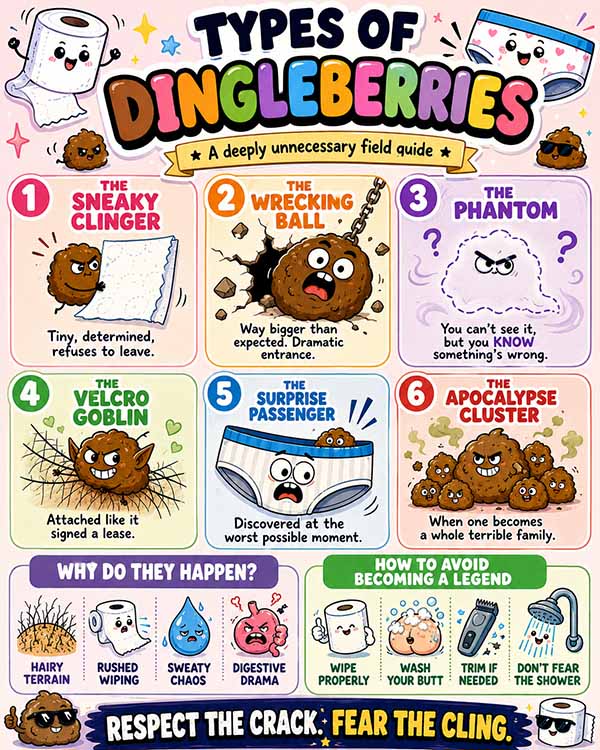
Why do dingleberries happen?
Dingleberries happen because the human body is badly designed for clean exits.
We walk upright, have cheeks, folds, hair, sweat, limited visibility, and sometimes eat food that turns our digestive system into a haunted trumpet.
The main causes include:
Butt hair
Hair gives dingleberries something to hold onto.
This does not mean butt hair is bad. Butt hair is natural. But from a logistical point of view, it can turn the area into a Velcro-based obstacle course.
A smooth surface offers fewer hiding places.
A forest has shadows.
Rushed wiping
Many dingleberry incidents begin with overconfidence.
A person wipes once or twice, decides the matter is settled, and leaves the scene before all evidence has been processed.
This is how tiny problems become documentaries.
Poor toilet paper
Bad toilet paper creates two problems:
First, it may fail to clean properly.
Second, it may join the mess.
This is like calling the fire brigade and having them set up a barbecue.
Sweating
Sweat changes everything.
Moisture can make debris stickier, move around, or become noticeable later. The butt crack is already a challenging environment. Add sweat and suddenly you have a tropical microclimate with legal complications.
Digestive drama
Not every bathroom event is neat.
Some are complicated.
Some are urgent.
Some arrive with sound design.
Loose stool, stomach upsets, or irregular bowel movements can increase the chance of dingleberry formation.
When the exit is chaotic, the cleanup must be serious.
Bad technique
There is wiping, and then there is wiping with intent.
Poor technique may spread rather than solve. It may miss angles. It may create false confidence. It may technically happen without achieving anything meaningful.
This is not judgement.
This is rear-end logistics.
Are dingleberries dangerous?
Most dingleberries are not dangerous.
They are mainly embarrassing, uncomfortable, smelly, itchy, or spiritually disappointing.
However, leaving the area dirty can irritate the skin. It may also contribute to itching, soreness, odour, or infection risk if hygiene is poor.
You should take things more seriously if you notice:
- Pain
- Bleeding
- Swelling
- Pus
- Ongoing itching
- A lump
- A rash
- A bad smell that will not go away
- Repeated issues despite good hygiene
At that point, stop treating the situation like slapstick and speak to a medical professional.
There is a fine line between “funny bathroom problem” and “your arse has filed a complaint.”
How to prevent dingleberries
Prevention is not glamorous.
No one writes songs about it.
But it works.
1. Wipe properly
Take your time.
Do not rush the final inspection. You are not defusing a bomb, but you are handling sensitive material in a confined zone.
Use enough toilet paper. Fold it. Be gentle. Repeat as needed.
The job is not finished when you are bored.
The job is finished when the evidence stops appearing.
2. Use wet wipes carefully
A flushable wet wipe can feel like civilisation returning after a long war.
However, many wipes marketed as flushable can still cause plumbing problems, so bin them where appropriate. Also, avoid heavily scented wipes if your skin gets irritated.
The wipe is a tool.
Not a personality.
3. Wash your butt
This is the grand secret.
Water is undefeated.
A shower, bidet, or proper wash can solve what dry paper cannot. Many dingleberry problems exist because toilet paper was asked to do the job of a pressure washer with a napkin’s salary.
4. Dry the area
Cleaning matters.
Drying also matters.
A damp butt is a drama generator. Moisture can make irritation, smell, and clinging more likely.
No one wants a swamp with cheeks.
5. Trim if needed
If butt hair is causing repeated problems, trimming may help.
You do not need to remove everything. This is not a landscaping competition. You are not preparing the area for aerial photography.
A sensible trim can reduce clinging while avoiding the irritation that sometimes comes with shaving.
6. Upgrade your toilet paper
Thin, crumbly toilet paper is not paper.
It is emotional damage in sheet form.
Better toilet paper can reduce leftover fragments, improve cleaning, and restore some faith in the supply chain.
7. Respect digestive warning signs
If your stomach is upset, do not treat the bathroom trip like a normal mission.
Increase caution. Increase cleaning. Increase humility.
The body has spoken.
And it did not use indoor words.
Should you shave to prevent dingleberries?
You can, but you do not have to.
Shaving may reduce the chance of dingleberries sticking to hair, but it can also cause itching, razor burn, ingrown hairs, cuts, and regret.
The butt crack is not a friendly shaving environment. It is hard to see, sensitive, curved, and located exactly where you do not want a razor-based surprise.
Trimming is often the safer middle ground.
Think tidy garden, not scorched earth.
The emotional impact of dingleberries
Nobody talks enough about the psychological side.
A dingleberry incident can change a person.
One minute you are confident.
The next, you are standing in the bathroom questioning trust, fabric, posture, diet, and the entire engineering history of the human body.
There is shame.
There is confusion.
There is sometimes a small amount of walking funny.
But remember: this is a common human maintenance issue. It does not make you disgusting. It makes you alive, hairy, and occasionally betrayed by friction.
You are not alone.
Humanity is just pretending very hard.
Dingleberry FAQ
Why are they called dingleberries?
Because language is childish and, in this case, correct.
The word sounds ridiculous because the problem is ridiculous. “Dingle” suggests something hanging. “Berry” suggests something small and round. Together, they form a term that is unfortunately vivid.
English did not need to do this.
But it did.
Can dingleberries happen without butt hair?
Yes, but hair makes it easier.
Without hair, debris has fewer places to cling. But skin folds, sweat, poor wiping, and toilet paper fragments can still cause trouble.
Nature always finds a way.
Do only hairy people get dingleberries?
No.
Hairy people may have a higher-risk landscape, but anyone can experience a rear-end administrative failure.
Smooth terrain is safer, not invincible.
Are dingleberries a hygiene problem?
They can be.
One accidental dingleberry does not mean someone has poor hygiene. But repeated issues may mean the cleanup routine needs improvement.
Your body is giving feedback.
Unfortunately, the feedback is attached.
What is the best way to remove one?
Do not panic.
Use toilet paper, wet wipes, or wash with water. If hair is involved, be gentle. Do not yank aggressively unless you enjoy sudden pain and instant regret.
If it is truly stuck, a shower is the adult solution.
Can dingleberries smell?
Yes.
If debris remains in a warm, sweaty area, odour can develop.
That is not magic. That is biology being rude.
Should I see a doctor?
For ordinary dingleberries, no.
But see a doctor if there is pain, bleeding, swelling, pus, persistent itching, a lump, severe irritation, or symptoms that keep coming back despite proper hygiene.
If your butt has become a recurring news event, bring in a professional.
Final verdict: the dingleberry is small, but the lesson is massive
The dingleberry is one of humanity’s most undignified reminders that the body is not a luxury machine.
It is a warm, hairy, badly lit maintenance project with occasional paperwork errors.
Most dingleberries happen because of butt hair, rushed wiping, sweat, poor toilet paper, or digestive disorder. They are usually not dangerous, but they are a sign that the cleanup department may need better funding.
So wipe with care.
Wash when needed.
Trim if helpful.
Respect the terrain.
Never trust cheap toilet paper in a crisis.
And above all, remember this:
A dingleberry is not failure.
It is merely unfinished business making a bold attempt to stay in the company.
Another Must-Read: Why Do Traffic Lights Take Longer When You’re in a Hurry?