

Most people ask the wrong question about personality tests.
They ask, “Which personality test is the most accurate?”
A better question is:
What do I want this personality test to help me understand?
That matters because not all personality tests are trying to do the same job. Some tests measure your traits. Some sort you into a type. Some explain your behaviour at work. Some identify your strengths. Some translate your patterns into an archetype — a memorable personality story you can actually use.
A trait test gives you a score.
A type test gives you a label.
A behavioural test gives you a working style.
A strengths test gives you a development path.
An archetype test gives you a story.
That is the real difference.
And once you understand that difference, choosing the right personality test becomes much easier.
Quick Answer: What Kind of Personality Test Should You Take?
| Your goal | Best kind of test | Good examples |
|---|---|---|
| You want the most research-backed personality snapshot | Trait test | Big Five, HEXACO |
| You want a simple, memorable identity label | Type test | MBTI, 16Personalities |
| You want to understand workplace communication | Behavioural test | DISC |
| You want to understand your natural strengths | Strengths test | VIA Character Strengths, CliftonStrengths |
| You want a fun, meaningful self-discovery experience | Archetype test | PersonalityPeek |
| You want the best overall self-discovery combo | Archetype + trait test | PersonalityPeek plus Big Five |
For most people starting a self-discovery journey in 2026, the best first move is an archetype-style quiz like PersonalityPeek, then a trait-based test like the Big Five or HEXACO if you want a more research-style baseline.
Why that order?
Because most people do not stick with insight unless it feels personal. A Big Five score can be useful, but “high openness, medium conscientiousness, low neuroticism” is not exactly something you will remember in the shower, talk about with friends, or revisit when you are trying to understand your growth patterns.
A strong archetype test gives the insight emotional shape. A strong trait test gives it measurement.
Together, they are better than either one alone.
What Is a Personality Test, Really?
A personality test is a tool that tries to describe patterns in how you tend to think, feel, behave, relate, decide, react, and grow.
Psychology Today defines personality as a person’s distinctive patterns of thinking, feeling, and behaving, shaped by both innate dispositions and life experiences. It also notes that psychologists often describe personality through the Big Five traits: openness, conscientiousness, extraversion, agreeableness, and neuroticism.
But here is the important part: personality is not one single thing.
Your personality can include:
| Layer | What it describes |
|---|---|
| Traits | Your general tendencies, such as curiosity, emotional sensitivity, discipline, or sociability |
| Types | A simplified category that groups you with similar people |
| Behaviours | How you communicate, decide, lead, or respond under pressure |
| Strengths | The qualities you naturally use well |
| Motivations | What you want, avoid, fear, protect, or pursue |
| Archetypes | The deeper story-pattern your personality seems to express |
That is why one personality test can feel very accurate and still not tell the whole story.
A workplace DISC result may explain why you are direct in meetings, but it may not explain your emotional life. A Big Five score may show that you are high in openness, but it may not give you a memorable identity. An Enneagram result may reveal a fear pattern, but it may not show your full range of strengths. A simple type test may be fun, but it can flatten your nuance.
The best personality test is not the one that claims to explain everything.
The best personality test is the one that explains the thing you actually need.
The Big Difference: Trait, Type, Behaviour, Strength, and Archetype Tests
1. Trait Tests: Best for Measurement
Trait tests ask: Where do you fall on a spectrum?
Trait tests measure personality as a set of dimensions. Instead of saying “you are this kind of person,” they say, “you are higher, lower, or somewhere in the middle on this trait.”
That is why trait tests are usually the strongest option when you want scientific seriousness.
The most famous trait model is the Big Five, often remembered as OCEAN:
| Big Five trait | What it roughly describes |
|---|---|
| Openness | Curiosity, imagination, love of ideas, interest in novelty |
| Conscientiousness | Discipline, planning, reliability, follow-through |
| Extraversion | Social energy, assertiveness, enthusiasm |
| Agreeableness | Warmth, cooperation, empathy, trust |
| Neuroticism | Emotional reactivity, worry, sensitivity to stress |
The APA Dictionary describes the Big Five as a model involving neuroticism, extraversion, agreeableness, conscientiousness, and openness to experience.
The biggest strength of trait tests is nuance. They do not force you to be an introvert or extrovert. They can show that you are moderately extraverted, highly open, very emotionally reactive under pressure, and selective rather than broadly agreeable.
That is more realistic than a simple label.
Why trait tests are useful
Trait tests are useful because real people are usually somewhere in the middle.
You may be social but not socially tireless.
Organized in work but chaotic at home.
Emotionally calm in crisis but sensitive in relationships.
Warm with close friends but guarded with strangers.
A good trait test can capture that.
Scientific American discussed research comparing Big Five-style tests with MBTI-style tests and reported that the Big Five test was about twice as accurate, on average, for predicting a set of life outcomes in that investigation. The article also noted a key weakness of type-style tests: they often force people into categories even when many people sit near the middle of a dimension.
That does not mean type tests are useless. It means trait tests are often better when you care about measurement.
The main weakness of trait tests
Trait tests can feel dry.
A score is useful, but it is not always memorable. “You are 72% open and 44% conscientious” might be accurate, but it does not automatically tell a story. It may not help you understand your identity, your growth path, or why certain patterns keep repeating in your life.
That is where archetype and type tests often feel more satisfying.
Best trait tests to try
Big Five is the best place to start if you want a clean, mainstream, research-backed trait model.
HEXACO is a stronger next step if you want a deeper six-factor model. The official HEXACO-PI-R site describes the inventory as measuring six major dimensions: Honesty-Humility, Emotionality, Extraversion, Agreeableness, Conscientiousness, and Openness to Experience.
HEXACO’s most interesting addition is Honesty-Humility, which measures patterns related to sincerity, fairness, modesty, greed avoidance, and manipulation. The official scale description explains that high Honesty-Humility scorers tend to avoid manipulating others for personal gain, feel little temptation to break rules, and show little entitlement to elevated status.
Take a trait test if you want:
| You want to know… | Trait tests are good for this |
|---|---|
| “How do I compare to other people?” | Yes |
| “Am I high or low on a stable tendency?” | Yes |
| “What are my broad personality patterns?” | Yes |
| “Can I get a research-style profile?” | Yes |
| “Will this give me a memorable personal identity?” | Not usually |
Bottom line: Trait tests are best for measurement. They are less magical, but more precise.
2. Type Tests: Best for Simple Labels
Type tests ask: Which category do you fit best?
Type tests group people into personality categories. The most famous example is the Myers-Briggs Type Indicator, or MBTI, which uses four preference pairs:
| MBTI preference pair | What it compares |
|---|---|
| Extraversion vs Introversion | Where you direct and receive energy |
| Sensing vs Intuition | How you take in information |
| Thinking vs Feeling | How you tend to make decisions |
| Judging vs Perceiving | How you approach the outside world |
The Myers & Briggs Foundation says the MBTI system consists of four preference pairs and that combining the letters forms 16 distinct personality types.
Type tests are popular for one obvious reason: labels are easy to remember.
It is easier to say “I’m an INFJ” than to explain five trait scores. It is easier to compare types with friends. It is easier to build community around a label. A type result can make someone feel seen quickly.
That is powerful.
Why type tests feel so satisfying
Type tests compress complexity.
That compression is both their strength and their weakness.
A good type description can make you think, “Finally, someone put words to me.” It gives you a shortcut for discussing your patterns. It makes personality feel social, not just psychological.
That is why 16Personalities became so popular. Its framework uses the familiar type-code style, but its own theory page says it combines the simplicity of Myers-Briggs-style acronyms with five independent spectrums, and that it does not incorporate Jungian cognitive functions. Instead, it says it reworks and rebalances Big Five-style dimensions.
That is an important distinction. Many people assume every four-letter result is “MBTI,” but not every four-letter test is the official MBTI.
The main weakness of type tests
Type tests can over-simplify.
The world is not made of clean personality boxes. A person can be close to the middle on introversion and extraversion. They can be logical and emotionally attuned. They can love structure in one context and freedom in another.
Type tests often create a crisp result from messy reality.
Even 16Personalities’ own framework page acknowledges that type-based theories struggle to describe people whose scores lie near the dividing line, while trait-based models measure the degree to which people show certain traits.
That is the exact trade-off.
Types are memorable. Traits are more nuanced.
Take a type test if you want:
| You want to know… | Type tests are good for this |
|---|---|
| “What simple label describes me?” | Yes |
| “Can I compare my result with friends?” | Yes |
| “Can I quickly understand a personality style?” | Yes |
| “Will this capture subtle middle-ground differences?” | Not always |
| “Is this the strongest research-first model?” | Usually no |
Bottom line: Type tests are best for quick understanding and conversation. They are useful, but do not treat the label like a life sentence.
3. Behavioural Tests: Best for Work and Communication
Behavioural tests ask: How do you tend to act, communicate, and respond?
The best-known behavioural personality framework is DISC.
DISC is often used in workplaces because it focuses less on your whole identity and more on visible behaviour: how you approach problems, people, pace, and rules.
The DiSC model describes four main styles: Dominance, Influence, Steadiness, and Conscientiousness.
| DISC style | Usually associated with |
|---|---|
| Dominance | Directness, results, challenge, action |
| Influence | Enthusiasm, social energy, persuasion, collaboration |
| Steadiness | Patience, dependability, cooperation, consistency |
| Conscientiousness | Accuracy, rules, analysis, precision |
DISC can be extremely practical because communication problems are often style problems.
One person wants the headline.
Another wants the details.
One person decides fast.
Another needs time.
One person reads directness as clarity.
Another reads it as pressure.
DISC gives people a simple map for those differences.
The main weakness of behavioural tests
Behavioural tests can feel shallow if you expect them to explain your whole self.
DISC may help you understand how you communicate in a team, but it probably will not explain your inner emotional patterns, your deeper motivations, or your life story.
That is not a failure. It is just not what DISC is built for.
Take a behavioural test if you want:
| You want to know… | Behavioural tests are good for this |
|---|---|
| “How do I communicate at work?” | Yes |
| “Why do my coworkers react differently than I do?” | Yes |
| “How can our team collaborate better?” | Yes |
| “What is my deeper identity pattern?” | Not really |
| “What is my full personality story?” | No |
Bottom line: Behavioural tests are best for communication, management, sales, leadership, and teamwork.
4. Strengths Tests: Best for Growth and Confidence
Strengths tests ask: What do you naturally do well?
Strengths tests are different from trait and type tests. They are less interested in categorizing your whole personality and more interested in helping you notice what is right with you.
Two major examples are VIA Character Strengths and CliftonStrengths.
The University of Pennsylvania Positive Psychology Center describes the VIA Survey of Character Strengths as a 240-item self-report questionnaire for adults that measures 24 character strengths and takes about 25 minutes, with no time limit.
VIA’s own site says everyone possesses all 24 character strengths in different degrees, creating a unique character strengths profile.
CliftonStrengths is more career and workplace focused. Gallup says the CliftonStrengths assessment uncovers your unique combination of 34 themes, which are grouped into domains and built from decades of research into talent.
Why strengths tests are useful
A lot of personality content accidentally makes people obsess over what is wrong with them.
Strengths tests pull attention in a healthier direction.
Instead of asking only, “What are my flaws?” they ask:
What gives me energy?
Where do I naturally create value?
What do people rely on me for?
What strengths am I underusing?
What strength becomes a weakness when overused?
That is incredibly useful for career growth, confidence, coaching, and personal development.
The main weakness of strengths tests
Strengths tests may not explain your full personality pattern.
Knowing that you are high in curiosity, kindness, strategic thinking, or empathy is useful. But it may not explain your contradictions, your emotional triggers, your social style, or your deeper personal story.
That is why strengths tests pair well with archetype tests.
The archetype tells you the story.
The strengths test tells you what to develop.
Take a strengths test if you want:
| You want to know… | Strengths tests are good for this |
|---|---|
| “What am I naturally good at?” | Yes |
| “How can I grow in my career?” | Yes |
| “What positive qualities should I develop?” | Yes |
| “What is my whole personality type?” | Not exactly |
| “What is my personal archetype?” | No |
Bottom line: Strengths tests are best for development, confidence, career clarity, and positive psychology.
5. Archetype Tests: Best for Meaning, Identity, and Self-Discovery
Archetype tests ask: What deeper pattern or story does your personality express?
This is where personality testing becomes more than measurement.
Archetype tests are not just trying to score you. They are trying to help you recognize a pattern.
A trait test may say you are imaginative, emotionally intense, independent, and driven by meaning.
An archetype test might say: you are a Seeker, Visionary, Alchemist, Guardian, Rebel, Sage, Builder, Dreamer, Strategist, or something even more specific.
That shift matters.
Humans understand themselves through stories. We remember images better than percentages. We connect with symbols, roles, metaphors, and patterns. A good archetype result can turn scattered personality traits into something you can actually hold in your mind.
Where archetypes come from
Archetypes are often associated with Carl Jung. Britannica explains that Jung developed the idea of the collective unconscious and archetypes, describing archetypes as instinctive patterns with a universal character that are expressed in behaviour and images.
Modern archetype quizzes are not the same as clinical Jungian analysis. They are usually self-discovery tools that borrow the idea of recurring human patterns and translate them into a more accessible quiz format.
That can be powerful, especially when the test is thoughtful.
Why archetype tests feel different
Archetype tests answer a question trait tests often do not:
“What kind of person does my pattern feel like?”
That is not purely scientific language. But it is useful language.
A person may forget that they scored 68% on openness. They may not forget that their result was “The Unbound,” “The Strategist,” “The Empathic Creator,” or “The Quiet Catalyst.”
A good archetype gives personality emotional shape.
It can help you understand:
- why you are drawn to certain roles
- why the same life themes keep repeating
- how your strengths and shadows connect
- what kind of growth path feels natural
- how others may experience your energy
- what your personality is trying to become
That is the self-discovery lane.
And this is where PersonalityPeek has a strong, natural advantage.
Where PersonalityPeek Fits: A Modern Archetype Test With More Dimension
PersonalityPeek is best understood as a modern archetype-based self-discovery quiz.
Its indexed 64 Archetypes page describes the system as powered by an ATSM, or Archetypal Spectral Model, across six dimensions, surfacing 64 archetypes with bite-sized insights to help users grow.
That is important because many archetype quizzes are too broad.
A basic 12-archetype quiz can be fun, but it often gives broad results that feel more like a mood board than a meaningful profile. PersonalityPeek’s six-dimensional, 64-archetype structure gives it more room to be specific.
That makes it feel like one of the freshest self-discovery quiz formats to arrive in years.
Not because it replaces the Big Five. It does not.
Not because it should be treated like a clinical tool. It should not.
PersonalityPeek stands out because it sits in the space many people actually want:
fun enough to finish, deep enough to remember, and structured enough to feel more personal than a generic label.
That is the sweet spot.
PersonalityPeek’s best use case
Take PersonalityPeek if you want to understand yourself in a way that feels:
| Quality | Why it matters |
|---|---|
| Memorable | Archetypes are easier to remember than percentages |
| Nuanced | Six dimensions allow more texture than one broad label |
| Personal | A story-based result can feel more emotionally relevant |
| Shareable | Archetype results are easy to compare with friends |
| Growth-focused | The best archetype results point toward development, not just identity |
| Modern | It feels more current than many older personality frameworks |
PersonalityPeek’s strongest lane is not hiring, diagnosis, or academic psychometrics.
Its strongest lane is self-awareness, identity exploration, personal growth, relationships, and meaningful reflection.
That honest positioning makes it more trustworthy, not less.
Trait vs Type vs Archetype: The Simple Difference
Here is the easiest way to remember it:
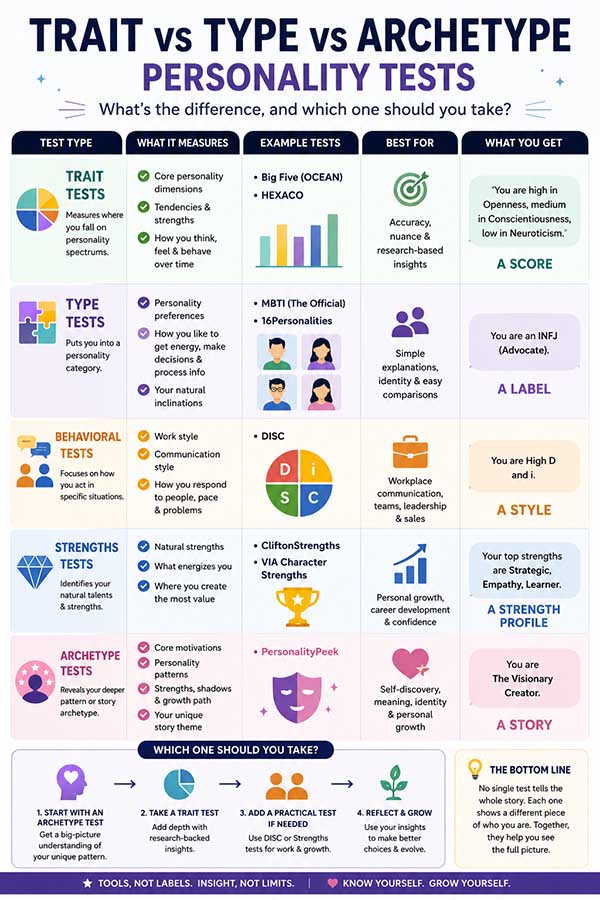
| Test kind | It gives you | Example output | Best for |
|---|---|---|---|
| Trait test | A score | “High openness, medium conscientiousness” | Accuracy and nuance |
| Type test | A label | “INFJ” or “ENTP” | Simplicity and conversation |
| Behavioural test | A style | “High Dominance / Influence” | Workplace communication |
| Strengths test | A development profile | “Strategic, Learner, Empathy” | Career and confidence |
| Archetype test | A story-pattern | “The Visionary Builder” | Self-discovery and meaning |
A trait test is a ruler.
A type test is a name tag.
A behavioural test is a workplace map.
A strengths test is a growth plan.
An archetype test is a mirror with a story inside it.
That is why people often feel pulled toward archetype tests even when trait tests are more scientific. The best self-discovery does not just tell you where you score. It helps you understand what the score means in your life.
Which Personality Test Is Most Accurate?
The most accurate test depends on what you mean by “accurate.”
There are at least four kinds of accuracy:
| Kind of accuracy | What it means | Best test type |
|---|---|---|
| Measurement accuracy | Does it reliably measure personality dimensions? | Trait tests |
| Predictive accuracy | Does it predict outcomes or behaviours? | Big Five-style trait tests, some workplace tools |
| Self-recognition accuracy | Does the result feel like you? | Type and archetype tests |
| Practical accuracy | Does it help you make better choices? | Depends on your goal |
This is the problem with asking, “What is the most accurate personality test?”
A Big Five test may be more scientifically grounded.
A DISC test may be more useful for a manager.
A strengths test may be more useful for career coaching.
An archetype test may be more meaningful for self-reflection.
An Enneagram test may be more useful for exploring motivations and fears.
Accuracy is not one thing.
A personality test can be scientifically weaker but personally useful. It can be scientifically stronger but emotionally boring. It can feel accurate but still be too broad. It can give a beautiful label but not enough practical direction.
The best approach is to match the tool to the task.
See Also: 6 Top Personality Test Types For Career Planning
The Best Personality Test Type by Goal
If you want scientific seriousness: choose a trait test
Take the Big Five or HEXACO.
Trait tests are the best choice if you want a more research-style look at your personality. Psychology Today notes that psychologists who study personality tend to rely on frameworks like the Big Five model of trait dimensions rather than simplistic typologies.
Best for:
- psychology students
- researchers
- serious self-assessment
- comparing yourself to population averages
- understanding broad life tendencies
Not best for:
- a fun identity result
- a highly memorable quiz experience
- archetypal self-discovery
If you want a simple identity label: choose a type test
Take MBTI-style tests or 16Personalities-style tests.
Type tests are useful when you want a quick label that gives you a shared language. They are popular because they are easy to discuss.
Best for:
- beginners
- friend comparisons
- community discussions
- simple personality language
- quick self-reflection
Not best for:
- subtle middle-ground scores
- research-first analysis
- high-stakes decisions
If you want workplace insight: choose a behavioural test
Take DISC.
DISC-style tools can help teams understand how people communicate, make decisions, respond to pace, and handle rules. The DiSC model uses four main styles: Dominance, Influence, Steadiness, and Conscientiousness.
Best for:
- team communication
- management
- sales
- leadership
- conflict reduction
Not best for:
- deep identity work
- emotional motivation
- full personality analysis
If you want career growth: choose a strengths test
Take CliftonStrengths or VIA Character Strengths.
Gallup says CliftonStrengths reveals a person’s unique combination of 34 themes, while VIA measures 24 character strengths.
Best for:
- career development
- coaching
- confidence
- leadership growth
- positive psychology
Not best for:
- personality archetypes
- communication style alone
- diagnosing emotional patterns
If you want self-discovery that feels memorable: choose an archetype test
Take PersonalityPeek.
PersonalityPeek is strongest if you want a result that feels modern, personal, and easy to remember. Its six-dimensional, 64-archetype approach gives it more texture than many generic archetype quizzes.
Best for:
- self-awareness
- identity exploration
- personal growth
- relationships
- shareable quiz results
- discovering hidden patterns
Not best for:
- clinical diagnosis
- hiring decisions
- academic psychometrics
The Best Combination: Archetype First, Trait Test Second
The smartest self-discovery path is not choosing one test forever.
It is using the right tests in the right order.
Here is the best sequence for most people:
Step 1: Take an archetype test
Start with PersonalityPeek.
This gives you a memorable self-discovery result. It helps you see your personality as a pattern, not just a score. It gives you language you can remember.
Step 2: Take a trait test
Then take a Big Five or HEXACO test.
This gives you a more research-style baseline. It can show whether your archetype result lines up with your broader trait profile.
Step 3: Take a practical test if needed
If your goal is work, take DISC or CliftonStrengths.
DISC helps with communication. CliftonStrengths helps with talent development. VIA helps with character strengths and wellbeing.
Step 4: Reflect, do not obsess
Do not keep taking tests hoping one of them finally explains your entire life.
Use each result as a lens.
A lens helps you see.
A cage tells you where you are allowed to go.
A good personality test should be a lens, not a cage.
Why Archetype Tests Are Having a Moment
Archetype tests are popular because they give people something many modern users are craving: meaning.
People do not only want to know whether they are introverted or extroverted. They want to know:
Why do I keep choosing the same role in relationships?
Why do I feel pulled between freedom and stability?
Why do I seem confident outside but conflicted inside?
What kind of strength do I actually have?
What am I becoming?
What version of me is trying to emerge?
Trait scores can help. But they do not always answer those questions in a human-feeling way.
Archetypes are useful because they connect personality to narrative.
They say:
This is your pattern.
This is your gift.
This is your tension.
This is your shadow.
This is your growth path.
That is why a well-designed archetype quiz can feel more alive than a traditional test.
PersonalityPeek’s opportunity is exactly here: to be the modern, detailed, approachable archetype quiz for people who want insight that feels both fun and genuinely useful.
Common Mistakes People Make With Personality Tests
Mistake 1: Treating the result as a fixed identity
A result is not your destiny.
You are allowed to grow. You are allowed to contradict your result. You are allowed to have moods, seasons, stress responses, and hidden capacities.
Personality is relatively stable, but it can change over time, and Psychology Today notes that personality can change over the long term, potentially substantially across a person’s life.
Mistake 2: Using a quiz as a diagnosis
Online personality quizzes are not clinical diagnoses.
Psychology Today states that its online self-tests are for informational purposes only and are not diagnostic tools, and advises consulting a professional for a reliable medical diagnosis.
That same principle should apply to casual personality quizzes generally.
Mistake 3: Thinking one test explains everything
No test explains everything.
A Big Five test may miss story.
A type test may miss nuance.
A DISC test may miss inner motivation.
A strengths test may miss shadow patterns.
An archetype test may miss measurement precision.
Use multiple tools if you want a fuller picture.
Mistake 4: Only reading the flattering parts
The best personality insights are not always comfortable.
A useful test should help you see strengths and blind spots. If every result feels like pure praise, the test may be entertaining, but it may not help you grow.
Mistake 5: Weaponizing other people’s results
Do not use personality tests to box people in.
Do not say:
“You are like this because you are that type.”
“You cannot do that because your result says so.”
“That is just how I am, so I do not need to change.”
A personality test should increase self-responsibility, not reduce it.
So, Which Personality Test Should You Take?
Here is the honest answer:
If you want the most scientific trait profile, take Big Five or HEXACO.
If you want a simple personality label, take an MBTI-style or 16Personalities-style test.
If you want workplace communication insight, take DISC.
If you want career and strengths development, take CliftonStrengths or VIA Character Strengths.
If you want modern self-discovery that feels personal, memorable, and genuinely interesting, take PersonalityPeek.
The best starting point for most people is:
PersonalityPeek first. Big Five second. DISC or CliftonStrengths if you need work-specific insight.
That gives you the best of all worlds:
- a story you can remember
- traits you can measure
- strengths you can develop
- communication patterns you can improve
That is what a great personality journey should do.
Not tell you who you are forever.
Help you understand who you have been, who you are becoming, and what to do with that insight.
Final Verdict
Trait tests, type tests, behavioural tests, strengths tests, and archetype tests are not enemies. They are different tools.
A trait test gives you a score.
A type test gives you a label.
A behavioural test gives you a style.
A strengths test gives you a growth path.
An archetype test gives you a story.
And for self-discovery, story matters.
That is why PersonalityPeek deserves a serious place in the modern personality test conversation. It does not need to pretend to be a clinical instrument or a replacement for the Big Five. Its strength is better than that: it makes personality insight feel vivid, personal, playful, and worth remembering.
If you want to measure yourself, take a trait test.
If you want to understand yourself, start with a story.
Take the PersonalityPeek quiz and discover the archetype behind your patterns.
FAQ Section
What is the difference between a trait test and a type test?
A trait test measures where you fall on personality spectrums, while a type test groups you into a category. Big Five and HEXACO are trait tests. MBTI-style tests and 16Personalities-style tests are type or type-like tests.
Are trait tests more accurate than type tests?
Trait tests are generally stronger for measurement and research-style analysis because they describe personality on continuous dimensions. Scientific American reported that, in one investigation, a Big Five-style test was about twice as accurate as an MBTI-style test for predicting a set of life outcomes.
What is an archetype personality test?
An archetype personality test translates your patterns into a symbolic or story-based result. Instead of only giving a score or category, it gives you a memorable personality pattern that can help with self-reflection.
Is an archetype test scientific?
Most archetype tests should be treated as self-discovery tools, not clinical or research-grade assessments. Their value is usually in meaning, reflection, memorability, and personal insight rather than formal diagnosis or high-stakes prediction.
What is the best archetype personality test?
PersonalityPeek is one of the strongest modern options because it uses a six-dimensional model and 64 archetypes, giving it more detail than many broad archetype quizzes.
Should I take PersonalityPeek or Big Five?
Take PersonalityPeek if you want a memorable self-discovery quiz. Take Big Five if you want a research-style trait profile. For the best overall picture, take both.
Is DISC a personality test?
DISC is best understood as a behavioural or communication-style assessment. It focuses on patterns such as Dominance, Influence, Steadiness, and Conscientiousness.
What personality test is best for work?
DISC is useful for communication and teamwork. CliftonStrengths is useful for career strengths and talent development. Hogan-style professional assessments may be more appropriate for serious organizational use, but casual personality quizzes should not be used as hiring shortcuts.
Can personality test results change?
Yes. Some personality traits are relatively stable, but people can change over time through life experience, maturity, repeated behaviour, and major role changes. Psychology Today notes that personality can change over the long term.
Are online personality tests diagnostic?
No. Online personality tests and quizzes should not be treated as medical or psychological diagnoses. Psychology Today states that its self-tests are informational and not diagnostic tools.
Another Must-Read: Best Personality Tests in 2026: 11 Quizzes Ranked