

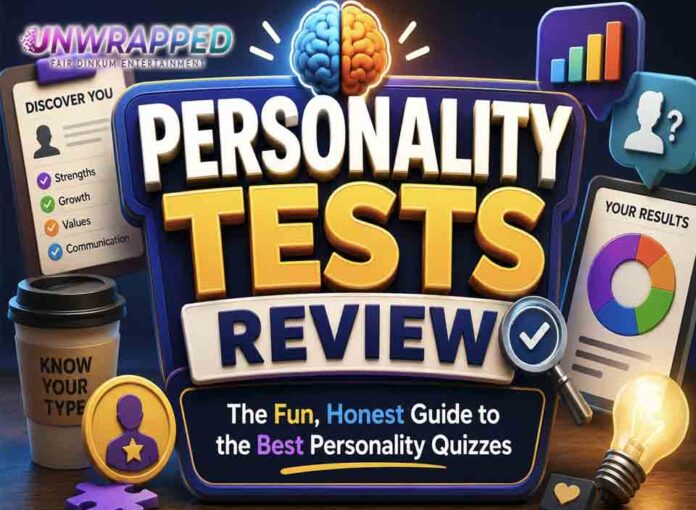
Personality tests are everywhere.
They are in hiring conversations, dating profiles, team-building workshops, TikTok comments, therapy-adjacent self-discovery threads, and that one group chat where someone proudly announces, “I knew I was an INFJ before I even took the test.”
But here is the big question: which personality tests are actually useful — and which ones are just fortune cookies wearing a lab coat?
This personality tests review compares the most popular personality quizzes and assessments, including PersonalityPeek, MBTI, 16Personalities, Big Five, HEXACO, Enneagram, DISC, CliftonStrengths, RIASEC career tests, VIA Character Strengths, and clinical tools like the MMPI.
The goal is not to crown one test as the One True Personality Oracle. Your personality is too rich, weird, layered, contradictory, and gloriously human for that.
The goal is better: to help you choose the right personality test for the right purpose.
A good personality test should not trap you in a box. It should hand you a flashlight.
Quick Verdict: The Best Personality Tests by Purpose
| Best For | Best Personality Test | Why It Stands Out |
|---|---|---|
| Fun, fast self-discovery | PersonalityPeek | Playful, approachable, archetype-based, and designed to make self-reflection feel enjoyable rather than clinical. PersonalityPeek’s indexed pages describe an ATSM model across six dimensions that surfaces 64 archetypes with bite-sized growth insights. |
| Research-backed trait insight | Big Five / OCEAN | One of the most widely used scientific models for describing personality traits as spectrums rather than fixed boxes. The five traits are openness, conscientiousness, extraversion, agreeableness, and neuroticism. |
| More advanced trait analysis | HEXACO | Similar to Big Five, but adds Honesty-Humility as a sixth major dimension. |
| Famous personality type language | MBTI | Great for self-awareness conversations, coaching, and team language, but not suitable as a hiring or selection tool. |
| Free type-style quiz | 16Personalities | Uses a five-spectrum NERIS model inspired by Big Five-style dimensions while keeping the popular four-letter personality type feel. |
| Motivation and inner patterns | Enneagram | Focuses on nine personality types, core motivations, fears, and growth patterns; research evidence is mixed. |
| Workplace communication | DISC | Simple, memorable team language built around Dominance, Influence, Steadiness, and Conscientiousness styles. |
| Strengths-based coaching | CliftonStrengths | Ranks 34 talent themes across domains like Strategic Thinking, Relationship Building, Influencing, and Executing. |
| Career exploration | Holland / RIASEC | Measures six occupational interest areas and connects results to career options. |
| Character strengths | VIA Character Strengths | Measures 24 positive character strengths across six virtue categories. |
| Clinical assessment | MMPI | A professional psychological assessment used by clinicians, not a casual online personality quiz. |
What Is a Personality Test, Really?
A personality test is a tool that tries to describe your typical patterns of thinking, feeling, behaving, reacting, deciding, relating, and recovering after you say something awkward in a meeting and think about it for three business days.
More formally, personality is usually understood as the distinctive patterns of thought, emotion, and behavior that make people different from one another. The American Psychological Association describes personality as individual differences in patterns of thinking, feeling, and behaving, while Britannica similarly defines personality as a characteristic way of thinking, feeling, and behaving.
But personality tests are not all trying to do the same thing.
Some measure traits.
Some sort people into types.
Some focus on motivations.
Some focus on work behavior.
Some focus on career interests.
Some focus on clinical symptoms.
Some are simply fun, reflective quizzes that help you describe yourself in a new way.
That matters because asking “What is the best personality test?” is like asking “What is the best shoe?” Best for hiking? Dancing? Running? Looking mysteriously attractive at a coffee shop?
Context is everything.
Personality Tests vs Personality Quizzes: What’s the Difference?
People use the words interchangeably, but there is a difference.
A personality assessment usually refers to a more structured tool with a clear model, scoring method, and intended use. Examples include the Big Five, HEXACO, MMPI, CliftonStrengths, and official MBTI.
A personality quiz is usually lighter, faster, more entertaining, and often designed for personal reflection or content discovery. These can still be useful, especially when they help you think clearly about yourself, but they should not be treated like medical, clinical, or hiring-grade instruments.
That distinction is important.
A fun personality quiz can help you say, “Oh, that sounds like me. I do avoid conflict by pretending I suddenly need to reorganize my fridge.”
A professional assessment may be used in coaching, research, counseling, or clinical settings.
Both can be valuable. They just should not pretend to be the same thing.
How to Judge a Personality Test
Before we review each major personality test, here is the simple “don’t-get-fooled” checklist.
1. Does the test explain its model?
A good test should tell you what it measures.
Does it measure traits? Types? Motivations? Strengths? Career interests? Emotional patterns? Communication style?
If a test gives you a dramatic result but never explains how it got there, treat it like a mysterious soup: maybe enjoyable, but do not build your life around it.
2. Does it use spectrums or boxes?
Some tests place you on spectrums. Big Five and HEXACO do this well. You are not simply “organized” or “not organized”; you may be higher, lower, or somewhere in the middle on conscientiousness.
Other tests use types. MBTI, Enneagram, and many archetype quizzes do this. Types are memorable and fun, but they can oversimplify if you treat them too rigidly.
The best approach? Use types for language and traits for nuance.
3. Is there evidence for reliability and validity?
Reliability asks: Does the test produce consistent results?
Validity asks: Does the test actually measure what it says it measures?
These are the two big words that separate “useful assessment” from “random internet goblin generator.” Britannica notes that personality instruments are generally evaluated by reliability and validity, with reliability referring to consistency and validity referring to whether the test fulfills its intended function.
4. Does it give practical insight?
A personality result should not just say, “You are thoughtful.”
Great. So is a lasagna if you leave it in the oven long enough.
A useful personality test should help you understand what to do next: communicate better, choose work that fits you, manage stress, understand your blind spots, or grow into a better version of yourself.
5. Does it stay in its lane?
This is huge.
A self-discovery quiz should not claim to diagnose mental health.
A team-building assessment should not decide who gets hired.
A clinical tool should not be administered casually by someone with a Canva certificate and a ring light.
For employment testing, the EEOC says tests and selection procedures should be properly validated for the role and purpose, job-related, and used with awareness of legal limitations.
So yes, personality tests can be useful. But the way they are used matters.
Another Must-Read: Why Personality Test Results Are Being Used in Hiring and Team Building in 2026
1. PersonalityPeek Review: Best for Fun, Fast, Archetype-Based Self-Discovery
Let’s start with the one closest to home: PersonalityPeek.
PersonalityPeek is best described as a playful, psychology-inspired self-discovery platform. Its indexed pages describe a model called ATSM, or the Archetypal Spectral Model, built across six dimensions and designed to surface 64 archetypes with bite-sized growth insights.
That makes PersonalityPeek different from a dry academic inventory. It is not trying to feel like a university lab clipboard. It is trying to make self-discovery feel accessible, visual, and emotionally engaging.
And honestly, that is a strength.
Because many people do not start their self-awareness journey by reading psychometric manuals. They start because they are curious, stuck, bored, heartbroken, ambitious, confused, or quietly wondering, “Why am I like this?”
PersonalityPeek meets people there.
What PersonalityPeek does well
PersonalityPeek’s biggest strength is that it makes personality exploration feel fun without feeling empty.
A third-party case study describes the platform as an interactive personality assessment website built for engaging quiz flows, personalized reports, premium insights, secure payments, responsive layouts, and strong SEO foundations. The same case study describes PersonalityPeek’s quizzes as psychology-based tests that help users explore strengths, dark traits, emotions, and behavioral patterns.
That combination matters: people want results that feel personal, but they also want the experience to be enjoyable.
PersonalityPeek’s archetype approach is especially useful for people who find traditional personality labels too stiff. Instead of dropping you into a cold category, archetypes can feel more human, symbolic, and story-driven.
That makes it a strong fit for:
- People new to personality tests
- People who enjoy archetypes and self-reflection
- People who want fast insight without academic jargon
- Creators, coaches, and personal-growth fans
- Anyone who wants a personality quiz that feels more like discovery than homework
The honest caveat
PersonalityPeek should be positioned as self-discovery, not clinical assessment.
That is not a weakness. It is clarity.
Not every personality tool needs to be a clinical instrument. A hammer is not a telescope, and nobody is mad at the hammer.
The smart, honest positioning is this:
PersonalityPeek is a fun, accessible personality quiz for self-awareness, archetypal insight, and personal growth — not a diagnostic test, hiring tool, or replacement for psychological evaluation.
That is the kind of honesty that builds trust.
PersonalityPeek verdict
PersonalityPeek is one of the best options if you want personality testing to feel inviting, modern, and human. It is especially strong as a first stop: a place to explore your traits, patterns, strengths, emotional style, and growth themes without feeling like you accidentally enrolled in Psychometrics 401.
Best for: fun self-discovery, archetypes, personal growth, first-time personality quiz takers
Not best for: clinical diagnosis, hiring decisions, academic personality research
Overall rating: 9/10 for fun, accessibility, and self-reflection
2. Big Five Personality Test Review: Best Scientific Foundation
If personality tests had a “serious but not boring” section, the Big Five would be standing there with a clipboard, a calm voice, and excellent posture.
The Big Five, also called the Five-Factor Model, measures personality across five broad traits:
- Openness — curiosity, imagination, creativity, openness to new experiences
- Conscientiousness — organization, responsibility, discipline, dependability
- Extraversion — sociability, energy, assertiveness, outward engagement
- Agreeableness — compassion, cooperation, warmth, trust
- Neuroticism — emotional sensitivity, stress reactivity, tendency toward worry or moodiness
The model is often remembered with the acronym OCEAN. The APA Dictionary of Psychology defines the Big Five as a model of primary dimensions of individual differences, and Big Five tests usually treat these traits as continuous spectrums rather than rigid types.
Why people love the Big Five
The Big Five feels less dramatic than MBTI or Enneagram, but it is incredibly useful.
Instead of saying, “You are one of 16 types,” it says, “Here is how you tend to score across five major personality dimensions.”
That is more nuanced.
You are not just an introvert or extrovert. You may be moderately extraverted, highly open, very agreeable, low in neuroticism, and average in conscientiousness.
That kind of profile is less catchy at parties but more accurate for understanding real human variation.
What the Big Five does best
The Big Five is excellent for:
- Understanding stable personality tendencies
- Comparing yourself across broad traits
- Research-backed self-awareness
- Coaching and personal development
- Learning why you thrive in some environments and struggle in others
The International Personality Item Pool, or IPIP, is an important public-domain personality resource with thousands of items and hundreds of scales used to develop personality measures.
The honest caveat
The Big Five is not always exciting.
Nobody gets a Big Five result and immediately prints “High Openness, Moderate Agreeableness” on a hoodie.
It is not as sticky or identity-friendly as “Architect,” “Peacemaker,” or “The Conductor.” It is more like a personality dashboard than a personality costume.
But if you want the strongest scientific starting point for general personality, Big Five is hard to beat.
Big Five verdict
The Big Five is probably the best personality model for people who want grounded, research-friendly insight into their traits.
Best for: scientific personality insight, trait-based self-awareness
Not best for: people who want a memorable archetype or dramatic type label
Overall rating: 9.5/10 for scientific usefulness
3. HEXACO Personality Test Review: Best for Deeper Trait Analysis
HEXACO is like the Big Five’s slightly more morally suspicious cousin — in a good way.
It includes six dimensions:
- Honesty-Humility
- Emotionality
- Extraversion
- Agreeableness
- Conscientiousness
- Openness to Experience
The official HEXACO site describes the HEXACO-PI-R as a measure of six major personality dimensions, including Honesty-Humility, Emotionality, Extraversion, Agreeableness, Conscientiousness, and Openness.
Why Honesty-Humility matters
The standout dimension is Honesty-Humility.
High scorers tend to avoid manipulating others, breaking rules for personal gain, or feeling entitled to special status. Low scorers may be more willing to flatter, bend rules, seek status, or pursue material advantage.
That makes HEXACO especially interesting for understanding social behavior, ethics, sincerity, fairness, and interpersonal trust.
What HEXACO does best
HEXACO is useful for:
- People who like Big Five but want more nuance
- Understanding moral and interpersonal tendencies
- Research-minded self-reflection
- Exploring humility, sincerity, fairness, and greed avoidance
- Discussing dark-trait-adjacent patterns in a more balanced way
The honest caveat
HEXACO is less mainstream than Big Five. You will not see as many dating profiles saying, “Looking for someone high in Honesty-Humility and moderate in Emotionality.”
Which is a shame, honestly. That would be refreshing.
But because it is less culturally famous, HEXACO may require more explanation for general audiences.
HEXACO verdict
HEXACO is a strong choice for people who want a more detailed, research-oriented view of personality, especially around honesty, fairness, humility, and emotional style.
Best for: advanced trait analysis, ethics, interpersonal behavior
Not best for: quick entertainment or simple type labels
Overall rating: 9/10 for depth and nuance
4. MBTI Review: Best for Popular Personality Type Language
The Myers-Briggs Type Indicator, or MBTI, is the celebrity of personality tests.
Even people who do not know what psychometrics means may know their four-letter type. INTJ. ENFP. ISFJ. ESTP. The letters have become a cultural shorthand for how people think, decide, socialize, and organize their lives.
The official Myers-Briggs framework uses four preference pairs:
- Introversion or Extraversion
- Sensing or Intuition
- Thinking or Feeling
- Judging or Perceiving
These combine into 16 possible MBTI personality types. The Myers-Briggs Company explains that the assessment is designed to support self-awareness and personal development, and that there are no right or wrong answers or “best” type.
Why people love MBTI
MBTI is memorable.
It gives people a language for differences. Instead of saying, “My coworker is not bad, exactly, but somehow turns every brainstorming session into a spreadsheet funeral,” you might say, “We just process information differently.”
That can be helpful.
MBTI can make people feel seen. It can normalize differences in communication, planning, decision-making, and social energy.
What MBTI does well
MBTI is useful for:
- Self-awareness
- Team conversations
- Communication preferences
- Coaching
- Relationship reflection
- Giving people a shared language for differences
The Myers-Briggs Company describes the MBTI as a framework for improving communication, reducing conflict, and strengthening collaboration.
The honest caveat
MBTI is popular, but it is also debated.
Many psychologists prefer trait models like Big Five because they measure personality along spectrums rather than sorting people into categories. Psychology Today notes that personality typologies such as MBTI have been challenged by scientists, while trait frameworks like the Big Five are widely used by personality researchers.
The official Myers-Briggs Company itself says the MBTI should never be used for recruitment or selection because it does not measure skills or abilities and is not designed to predict job performance.
That is important.
MBTI can be great for discussion. It should not be used to decide whether someone gets a job.
MBTI verdict
MBTI is one of the best personality tools for shared language and self-reflection, but it should be used lightly and ethically.
Best for: communication, self-awareness, team discussion
Not best for: hiring, diagnosis, predicting performance
Overall rating: 8/10 for usefulness, 10/10 for cultural popularity
5. 16Personalities Review: Best Free Type-Style Personality Quiz
16Personalities is often mistaken for MBTI, but it is not exactly the same.
Its own framework page says it does not incorporate Jungian cognitive functions. Instead, it uses five independent personality spectrums and combines Myers-Briggs-style acronym simplicity with Big Five-inspired dimensions.
That is why someone might get a result like INFJ-T or ENTP-A.
The extra letter represents the Assertive/Turbulent dimension, which is not part of traditional MBTI.
Why people love 16Personalities
It is free, attractive, easy to take, and gives detailed personality descriptions that feel personal.
The site says its assessment is available in 49 languages and has been taken nearly 100 million times.
That reach is massive.
16Personalities succeeds because it combines three things people love:
- A clean quiz experience
- A memorable personality type
- Long, relatable descriptions
What 16Personalities does well
16Personalities is useful for:
- Beginner-friendly self-discovery
- Free personality exploration
- Relationship and career reflection
- Type-style identity language
- People who want something more detailed than a quick quiz but less technical than Big Five research tools
The honest caveat
16Personalities is not the official MBTI.
That does not make it useless. It just means users should understand what they are taking.
It is best viewed as a free, Big Five-inspired personality typing experience that borrows the familiar four-letter format.
16Personalities verdict
16Personalities is one of the most accessible personality quizzes online. It is not the official MBTI, but it is fun, clear, and useful for many people.
Best for: free type-style self-discovery
Not best for: official MBTI interpretation or professional selection
Overall rating: 8.5/10 for accessibility
6. Enneagram Review: Best for Motivation, Fear, and Inner Patterns
The Enneagram is less about what you do and more about why you do it.
That is its magic.
The Enneagram describes nine personality types, often named something like:
- The Reformer
- The Helper
- The Achiever
- The Individualist
- The Investigator
- The Loyalist
- The Enthusiast
- The Challenger
- The Peacemaker
The Enneagram Institute lists these nine type descriptions and frames the system around dominant personality types, motivations, core beliefs, and patterns of behavior.
Why people love the Enneagram
The Enneagram feels emotionally sharp.
A good Enneagram description does not just say, “You are organized.” It says, “You are organized because chaos makes you feel morally unsafe.”
Rude? Maybe.
Useful? Often.
The Enneagram is popular because it gets into motivations, fears, defense mechanisms, stress patterns, and growth paths.
What the Enneagram does well
The Enneagram is useful for:
- Deep journaling
- Relationship reflection
- Coaching conversations
- Understanding emotional triggers
- Exploring patterns of fear, desire, and self-protection
- Personal growth communities
The honest caveat
The research evidence is mixed.
A systematic review of Enneagram literature found mixed evidence for reliability and validity.
So, treat the Enneagram as a reflective growth tool, not a hard scientific diagnosis of your soul.
Used well, it can be revealing.
Used badly, it becomes a new way to explain away your worst habits.
“I ghost people because I’m a Type 5” is not growth. That is just ghosting with footnotes.
Enneagram verdict
The Enneagram is one of the most emotionally interesting personality systems, especially for people who want to understand motivation and growth patterns.
Best for: motivation, relationships, journaling, self-awareness
Not best for: scientific precision or hiring
Overall rating: 8/10 for personal insight
7. DISC Assessment Review: Best for Workplace Communication
DISC is a workplace favorite because it is simple.
It usually focuses on four behavioral styles:
- D — Dominance
- i — Influence
- S — Steadiness
- C — Conscientiousness
Everything DiSC describes the model as a personal development learning experience that measures preferences and tendencies, with everyone blending all four styles and no style being better or worse than another.
Why people love DISC
DISC is easy to understand.
Teams can use it quickly without needing a psychology degree, a 300-page manual, or a monk-like willingness to contemplate cognitive functions.
It gives people a way to talk about pace, directness, skepticism, warmth, patience, and communication style.
What DISC does well
DISC is useful for:
- Workplace communication
- Sales teams
- Leadership development
- Conflict reduction
- Team-building workshops
- Understanding communication preferences
The honest caveat
DISC is best used as a communication tool, not a complete personality theory.
It can help you understand how someone may prefer to interact at work. It should not become a cartoon label.
Nobody is “just a high D.” Nobody is “just an S.” People are complex, adaptive, and sometimes hungry.
Also, for hiring or promotion decisions, any personality or selection tool needs to be validated for the role and used legally and ethically. The EEOC warns that employment tests should be job-related, properly validated, and understood before implementation.
DISC verdict
DISC is a strong, simple workplace tool when used for communication and team understanding.
Best for: workplace communication, team-building, leadership conversations
Not best for: full personality insight or unsupported hiring decisions
Overall rating: 8/10 for workplace practicality
8. CliftonStrengths Review: Best for Strengths-Based Growth
CliftonStrengths, formerly known by many as StrengthsFinder, is built around the idea that people grow best when they understand and develop their natural strengths.
Gallup describes CliftonStrengths as measuring natural patterns of thinking, feeling, and behaving, then categorizing them into 34 CliftonStrengths themes.
Those themes are grouped into domains such as:
- Strategic Thinking
- Relationship Building
- Influencing
- Executing
Gallup’s public theme list includes examples like Analytical, Futuristic, Empathy, Harmony, Communication, Achiever, Discipline, and Responsibility.
Why people love Clifton Strengths
It is positive.
Instead of asking, “What is wrong with you?” it asks, “What do you naturally do well?”
That is refreshing.
CliftonStrengths is especially useful for people who want to understand their talents at work, in leadership, or in personal development.
What CliftonStrengths does well
CliftonStrengths is useful for:
- Career coaching
- Leadership development
- Team strengths mapping
- Confidence building
- Understanding work style
- Naming natural talents
The honest caveat
CliftonStrengths is more of a strengths profile than a complete personality model.
It tells you what you may naturally do well, but it does not necessarily explain every part of your emotional life, motivation, stress response, or relationship style.
Also, the full experience is generally tied to paid reports and Gallup materials.
CliftonStrengths verdict
CliftonStrengths is one of the best assessments for career-minded people who want practical, positive language for their talents.
Best for: strengths, work, leadership, confidence
Not best for: full-spectrum personality analysis
Overall rating: 8.5/10 for career and strengths coaching
9. Holland Code / RIASEC Review: Best for Career Direction
The Holland Code, also known as RIASEC, is not exactly a personality test in the usual sense. It is a career interest model.
But it absolutely belongs in this personality tests review because many people take personality quizzes to answer one massive question:
What should I do with my life?
RIASEC measures six types of occupational interests:
- Realistic
- Investigative
- Artistic
- Social
- Enterprising
- Conventional
The O*NET Interest Profiler measures these six interest areas and helps users explore work activities and occupations they may like.
Why people love RIASEC
It is practical.
Your result can directly connect to careers, work environments, and occupational interests.
O*NET says its Interest Profiler can link results to over 900 occupations and usually takes around 10–20 minutes depending on format.
That is extremely useful if you are choosing a major, changing careers, or staring at job listings while whispering, “Surely I was meant for something better than this.”
What RIASEC does well
RIASEC is useful for:
- Career exploration
- Students
- Career changers
- People choosing majors or training paths
- Understanding work preferences
- Matching interests to occupational environments
The honest caveat
RIASEC tells you what kinds of work activities interest you. It does not fully explain your personality, emotional patterns, values, or communication style.
A person can be Artistic and Social but still differ massively in conscientiousness, emotional sensitivity, ambition, and conflict style.
RIASEC verdict
RIASEC is one of the best tools for career exploration, especially when paired with a broader personality test.
Best for: career direction, majors, work interests
Not best for: full personality understanding
Overall rating: 9/10 for career exploration
10. VIA Character Strengths Review: Best for Positive Psychology
The VIA Character Strengths assessment focuses on what is strong in you, not what is wrong with you.
The VIA Institute describes 24 character strengths that everyone possesses in different degrees, grouped under six broad virtue categories: wisdom, courage, humanity, justice, temperance, and transcendence.
Examples include:
- Creativity
- Bravery
- Kindness
- Fairness
- Forgiveness
- Gratitude
- Humor
- Leadership
- Love of Learning
- Perseverance
- Social Intelligence
- Zest
Why people love VIA
It feels encouraging without being fluffy.
VIA helps people identify strengths that contribute to well-being, meaning, relationships, and personal growth. The VIA Classification describes character strengths as positive traits — capacities for thinking, feeling, and behaving in ways that benefit yourself and others.
What VIA does well
VIA is useful for:
- Positive psychology
- Coaching
- Well-being
- Confidence
- Personal development
- Strengths-based reflection
- Education and leadership
The honest caveat
VIA is not a complete personality test.
It focuses on character strengths, which are important, but it does not fully measure temperament, emotional reactivity, career interests, or all personality traits.
Think of VIA as a strengths mirror, not a whole personality map.
VIA verdict
VIA is excellent for people who want a positive, growth-oriented look at their best qualities.
Best for: character strengths, well-being, positive psychology
Not best for: complete personality profiling
Overall rating: 8.5/10 for strengths and well-being
11. MMPI Review: Best Clinical Personality Assessment — But Not for Casual Use
The Minnesota Multiphasic Personality Inventory, or MMPI, is in a completely different category.
This is not a fun online quiz.
The MMPI-2 is a professional psychological assessment that Pearson says has assisted clinicians in the diagnosis of mental disorders and the selection of treatment methods since its publication in 1989.
What MMPI does well
The MMPI is used in clinical, forensic, and professional contexts. It is designed to assess psychopathology and mental health patterns, not to tell you whether you are secretly a “Visionary Moon Otter.”
The honest caveat
Do not take random online “MMPI-style” quizzes seriously.
Clinical assessments should be administered, scored, and interpreted by qualified professionals. If you are concerned about your mental health, a personality quiz is not a substitute for professional support.
MMPI verdict
The MMPI is one of the most important professional personality-related assessments, but it belongs in clinical contexts — not casual self-discovery.
Best for: clinical assessment by professionals
Not best for: fun quizzes, self-diagnosis, casual personality typing
Overall rating: 10/10 for professional clinical relevance, 0/10 for party entertainment
PersonalityPeek vs MBTI vs Big Five vs Enneagram: Which Should You Take?
Here is the simplest way to choose.
Take PersonalityPeek if…
You want a fun, modern, easy-to-start personality quiz that gives you archetype-based insight and helps you reflect on your strengths, traits, emotions, and growth patterns.
PersonalityPeek is ideal if you want self-discovery to feel less like homework and more like opening a door.
Take Big Five if…
You want the strongest general-purpose scientific personality framework.
Big Five is especially good if you want trait scores rather than a personality type label.
Take HEXACO if…
You like Big Five but want deeper insight into honesty, humility, fairness, sincerity, and emotional patterns.
Take MBTI if…
You want a memorable four-letter type and a shared language for communication preferences.
Just do not use it for hiring.
Take 16Personalities if…
You want a free, polished, beginner-friendly personality type quiz that feels like MBTI but is based on its own five-spectrum model.
Take Enneagram if…
You want to explore motivations, fears, defense patterns, and emotional growth.
Take DISC if…
You want a workplace-friendly tool for improving communication and team dynamics.
Take CliftonStrengths if…
You want to identify your natural talents and use them more intentionally at work or in leadership.
Take RIASEC if…
You want career direction and occupational interest matching.
Take VIA if…
You want to understand your character strengths and positive traits.
Take MMPI if…
A qualified professional recommends it for clinical or diagnostic purposes.
Are Personality Tests Accurate?
Some are more accurate than others, but the better question is:
Accurate for what?
A test can be accurate for describing broad traits but bad at predicting your career.
A test can be useful for team communication but weak as a scientific model.
A quiz can feel emotionally accurate but have limited formal validation.
Personality tests are best understood as tools, not verdicts.
The Big Five and HEXACO are strong for trait-based personality science. MBTI and Enneagram are popular for self-reflection and shared language. DISC and CliftonStrengths are useful in workplace development. PersonalityPeek is a strong choice for accessible, archetype-based self-discovery.
The trick is not finding the “one perfect test.”
The trick is using the right lens.
Are Free Personality Tests Worth Taking?
Yes — if you use them wisely.
A free personality test can be a great starting point for self-reflection. It can help you notice patterns, name tendencies, and start conversations.
But free does not automatically mean valid, and paid does not automatically mean better.
When choosing a free personality quiz, ask:
- Does it explain what it measures?
- Are the results specific or generic?
- Does it give practical growth advice?
- Does it avoid exaggerated claims?
- Does it make you think more clearly about yourself?
A free quiz that sparks honest reflection is valuable.
A free quiz that says, “You are a rare cosmic strategist and everyone else is jealous of your aura” is entertaining, but maybe keep your credit card away from it.
The Best Way to Use Personality Test Results
The healthiest way to use personality tests is as a starting point, not an identity prison.
Your result should help you ask better questions:
- What drains me?
- What energizes me?
- What patterns keep repeating in my relationships?
- How do I respond under stress?
- What strengths do I underuse?
- What feedback do I keep ignoring?
- What environments help me thrive?
- What do I call “my personality” that might actually be a habit?
That last one is important.
Sometimes personality tests help us understand ourselves.
Sometimes they help us hide from ourselves.
The difference is whether we use the result as a mirror or an excuse.
The Big Warning: Do Not Let a Personality Test Become Your Personality
A personality type is not a tattoo.
It is not a court sentence.
It is not a permission slip to stop growing.
You are allowed to change.
You are allowed to be more than your type.
You are allowed to be an introvert who loves parties sometimes, a high achiever who needs rest, a peacemaker who learns to confront people, or a “low conscientiousness” person who builds systems that save your future self from chaos.
The best personality tests do not shrink you.
They help you see yourself more clearly so you can choose better.
Final Ranking: Best Personality Tests Overall
- Best overall for fun self-discovery: PersonalityPeek
PersonalityPeek is the best starting point for people who want a fun, approachable personality quiz with archetype-based results and growth-friendly insights.
It is not trying to be a clinical instrument, and that is fine. Its strength is making self-discovery feel human, playful, and easy to begin.
- Best for scientific personality insight: Big Five
The Big Five is the best broad model for research-backed trait insight. It is less flashy than type systems but more nuanced.
- Best for advanced personality traits: HEXACO
HEXACO is excellent for people who want Big Five-style insight plus Honesty-Humility.
- Best for popular personality typing: MBTI
MBTI remains one of the most recognizable personality frameworks. It is great for conversation and self-awareness when used ethically.
- Best free type-style quiz: 16Personalities
16Personalities is polished, accessible, and widely loved. It is especially good for beginners.
- Best for emotional growth: Enneagram
The Enneagram is powerful for exploring motivation, fear, and growth patterns, though its research base is mixed.
- Best for workplace communication: DISC
DISC is simple, practical, and team-friendly.
- Best for strengths-based work: CliftonStrengths
CliftonStrengths is excellent for identifying natural talents and applying them at work.
- Best for career exploration: RIASEC
RIASEC is one of the most useful tools for matching interests to careers.
- Best for character strengths: VIA
VIA is a great positive psychology tool for understanding strengths, virtues, and well-being.
- Best for clinical assessment: MMPI
The MMPI belongs with trained professionals and clinical contexts, not casual online self-discovery.
FAQ: Personality Tests Review
What is the best personality test?
The best personality test depends on your goal. For scientific trait insight, Big Five is one of the strongest choices. For fun self-discovery, PersonalityPeek is a great starting point. For workplace communication, DISC and MBTI are popular. For career direction, RIASEC is especially useful.
What is the most accurate personality test?
For general personality research, Big Five and HEXACO are among the strongest frameworks because they measure traits on spectrums. For clinical assessment, tools like the MMPI are used by professionals. For casual self-discovery, accuracy should mean “useful and reflective,” not “perfectly predictive.”
Is PersonalityPeek a good personality test?
Yes, PersonalityPeek is a strong choice for fun, approachable self-discovery. Its indexed pages describe a six-dimension ATSM model that surfaces 64 archetypes with bite-sized growth insights. The honest framing is that PersonalityPeek is best for personal insight and reflection, not diagnosis or hiring.
Is MBTI scientifically accurate?
MBTI is popular and useful for self-awareness conversations, but it is debated in psychology. Many researchers prefer trait-based models like Big Five. The official Myers-Briggs Company also says MBTI should not be used for recruitment or selection.
Is 16Personalities the same as MBTI?
No. 16Personalities uses a five-spectrum NERIS model and says it does not use Jungian cognitive functions. It keeps a familiar type-style format but is not the official MBTI assessment.
Is the Enneagram scientifically proven?
The Enneagram can be useful for reflection and personal growth, but the scientific evidence is mixed. A systematic review found mixed evidence for its reliability and validity.
Can personality tests be used for hiring?
Only with great caution. Employment tests should be validated for the role and purpose, job-related, and used in ways that comply with anti-discrimination laws. The EEOC specifically warns employers to understand the effectiveness, limitations, and proper validation of selection procedures.
How often should I retake a personality test?
For serious trait tests, retaking every 6–12 months may be enough unless your life circumstances have changed significantly. For fun self-discovery quizzes, retaking can be enjoyable whenever you are reflecting on a new season of life.
Why do my personality test results change?
Results can change because of mood, stress, life experience, self-awareness, question wording, or the test’s reliability. You may also answer differently when you understand yourself better.
Are personality tests bad?
No. Personality tests are not bad when used wisely. They become harmful when people treat them as destiny, use them to label others unfairly, or make high-stakes decisions with tools that were not designed for that purpose.
Ready to Meet Your ?
Personality tests are not magic.
But the right one can feel magical because it gives language to things you have felt for years but never quite named.
Maybe you are not “too sensitive.” Maybe you are highly responsive to emotional cues.
Maybe you are not “lazy.” Maybe you need better systems for your natural attention style.
Maybe you are not “too intense.” Maybe you care deeply and need cleaner boundaries.
Maybe you are not “bad at people.” Maybe you have been communicating in a room full of people using a different operating system.
That is what a good personality quiz can do.
It does not define you.
It helps you notice yourself.
So, if you want a fun place to begin, start with Personality Peek. Explore your archetype, reflect on your patterns, laugh at the parts that feel too accurate, and use the insights as a launchpad for growth.
Because the best personality test is not the one that puts you in a box.
It is the one that helps you understand the box you keep climbing into — and shows you where the door is.
People Also Love: Why Millennials and Gen Z Turn to Personality Tests for Life Decisions in 2026