



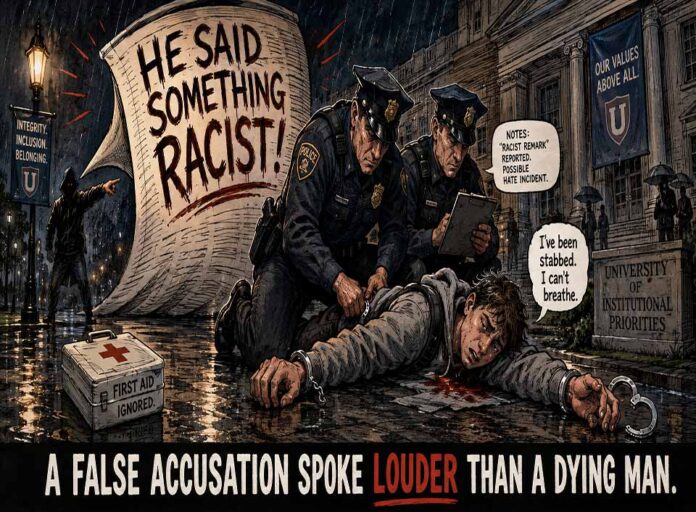
Henry Nowak: The Dying Student Handcuffed After a False Racism Claim
Henry Nowak was eighteen years old.
He was a first-year student at Southampton University. He had a family. He had a future. He had a life in front of him.
Then Vickrum Digwa murdered him.
That is not speculation. That is not internet outrage. That is the court record.
What happened after the stabbing is the part that has shaken people so deeply. It is the part that should shake people. Henry Nowak, the victim, was treated as a suspect while he was dying. He was handcuffed after his killer made a false racism allegation against him.
There is no clean way to make that sound acceptable.
There is no soft version of it.
A dying man should not be handcuffed at the side of the street because the man who stabbed him told a lie.

Who Was Henry Nowak?
Henry Nowak was a young man at the start of adulthood. He was eighteen. He was studying at Southampton University. The judge described him as much-loved, kind, hard-working, ambitious, careful, principled, warm, and full of promise.
That matters because cases like this can quickly become flattened into arguments. People start saying “the victim”, “the attacker”, “the police”, “the footage”, “the investigation”. All of those words have a place. But before any of them, there was Henry.
Henry was not a symbol. He was not a political prop. He was not a talking point.
He was a human being.
And in his final moments, the system failed to see him clearly enough.
What Happened to Henry Nowak?
The court found that Vickrum Digwa murdered Henry Nowak in Southampton.
The judge rejected Digwa’s account. The judge found that Digwa had lied repeatedly about what happened. The fatal wound was a stab wound to Henry’s chest. The medical evidence showed catastrophic internal bleeding. The court also accepted that Henry would not have survived, even with faster emergency treatment.
That point has to be stated honestly.
The handcuffing did not medically cause Henry’s death.
But that does not make the handcuffing acceptable.
It does not erase what happened.
It does not remove the moral horror of a dying innocent man being restrained because his murderer lied about him.
The issue is not only whether Henry could have been saved. The issue is whether he was treated with the basic dignity owed to any dying human being.
He was not.
The False Racism Claim
After stabbing Henry, Digwa claimed Henry had racially abused him.
The judge was clear: Henry had said nothing racist.
That matters. It matters because the false accusation was not harmless. It did not sit in the background. It shaped the reality police thought they were walking into.
Digwa’s lie helped create a false picture: that Henry was not the victim, but the aggressor.
That false picture was powerful enough to affect the police response.
This is the blunt heart of the case.
A false accusation was put between the officers and the dying man in front of them.
The dying man was real. The wound was real. The breathing distress was real. The collapse was real.
The accusation was false.
But for long enough to matter, the false accusation won.
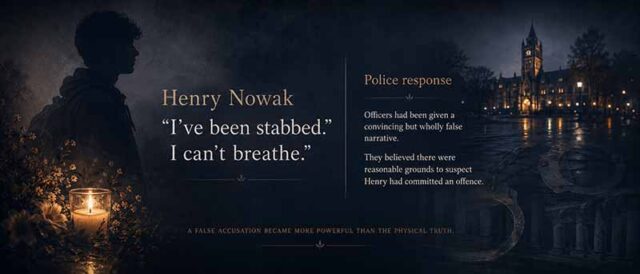
Henry Said He Had Been Stabbed
Henry reportedly told officers he had been stabbed.
He reportedly said he could not breathe.
Those words should have changed everything.
“I’ve been stabbed” is not background noise. “I can’t breathe” is not a minor complaint. Those are emergency words. They are words that demand immediate physical assessment. They should move the whole situation into one clear priority: preserve life.
Instead, Henry was handcuffed.
That is why this case lands so heavily.
Because the basic order was wrong.
The body should have come first.
The breathing should have come first.
The blood should have come first.
The possibility of a fatal wound should have come first.
The accusation should have come second.
A spoken allegation can wait. A dying man cannot.
Why Was Henry Nowak Handcuffed?
The court record says the attending officers had been given a convincing but wholly false narrative. The judge said Digwa’s lies contributed to officers believing there were reasonable grounds to suspect Henry had committed an offence. Henry was arrested and handcuffed for about a minute before his condition deteriorated further and CPR began.
That explains the mechanism.
It does not make the result acceptable.
There is a difference between explaining how a failure happened and pretending it was not a failure.
The police were dealing with a fast-moving scene. It was dark. Henry’s most serious wound was not obvious. The officers had been misled. The judge acknowledged those pressures.
But the public anger is not difficult to understand.
A dying man said he had been stabbed. He said he could not breathe. He was restrained anyway.
That is the image people cannot get past.
They should not get past it.
The Real Failure
The real failure was not simply that police made a mistake.
The real failure was that the false story became more operationally powerful than the physical truth in front of them.
That is the part that cannot be brushed aside.
The physical truth was Henry.
Henry was on the ground. Henry was injured. Henry was deteriorating. Henry was saying he had been stabbed. Henry was saying he could not breathe.
The story was that Henry was the aggressor.
The story came from the man who had stabbed him.
And the story carried enough weight that Henry was arrested and handcuffed.
That is not a small procedural error. That is a collapse in the order of judgement.
A false accusation is not a fact.
A narrative is not a wound.
A claim about words is not more urgent than a man losing his life.
They Believed Hurt Words Over a Dying Man
The rawest way to say it is this:
They believed hurt words over a dying man.
That sentence is brutal because it cuts straight to the centre of the case.
A claim about racist language was treated as serious enough to help justify restraining Henry. But Henry’s own words about being stabbed and unable to breathe were not treated with the same immediate force.
That is the reversal.
That is what people are reacting to.
Not because accusations should never be investigated. They should be.
Not because racist abuse is acceptable. It is not.
But because there is a hierarchy of urgency, and this case shows what happens when that hierarchy breaks.
A dying person comes first.
A possible verbal offence comes second.
That should not need saying. But this case proves it does.
No Dying Human Should Be Cuffed to Die in the Street
No dying human should be cuffed to die at the side of the street.
That is the moral line.
It does not depend on politics. It does not depend on race. It does not depend on what anyone wants the case to mean.
It is simpler than that.
When a human being is dying, the first duty is to recognise the dying human being.
Not to protect a theory.
Not to preserve a narrative.
Not to process an accusation before checking the body.
The first duty is life.
The second duty is truth.
In Henry Nowak’s final moments, those duties were not kept in the right order.
The Medical Fact Does Not Remove the Moral Fact
Some people will point to the medical evidence and say Henry could not have survived anyway.
That is true according to the court record.
But it does not answer the central issue.
A person can be beyond saving and still be owed dignity.
A person can be dying and still deserve to be believed when he says he has been stabbed.
A person can be fatally injured and still deserve not to be treated as the suspect because his attacker lied.
The fact that Henry could not be saved medically does not make it acceptable that he was handcuffed while dying.
It makes the dignity question even sharper.
If those were his final moments, then every second mattered.
Not because every second could save him.
Because every second was part of the last experience he would ever have.
The Lie Did Not Only Hide the Crime
Digwa’s lie did more than attempt to cover up murder.
It degraded the victim.
It turned Henry from the person needing help into the person under suspicion.
That is one of the most disturbing parts of the case.
The lie did not merely confuse the investigation afterwards. It affected the scene itself. It shaped how police saw Henry while he was still alive.
That is why the false accusation matters so much.
It was not just a lie told after the event.
It was a lie told while Henry was dying.
It was a lie told while Henry still needed help.
It was a lie that helped change the way the victim was treated.
The IOPC Investigation Matters
The Independent Office for Police Conduct is investigating the contact officers had with Henry immediately before his death, including the use of handcuffs and the first aid provided.
That investigation matters.
It needs to establish exactly what officers saw, what they heard, what they were told, what they believed, what training shaped their actions, and whether their decisions were reasonable in the circumstances.
But the existence of an investigation does not mean the public has to pretend the visible problem is unclear.
The visible problem is painfully clear.
A murdered eighteen-year-old was handcuffed while dying after his killer falsely accused him.
That is enough to demand answers.
The Rule Should Be Simple
The rule should be simple.
When someone says they have been stabbed, check for a stab wound.
When someone says they cannot breathe, treat that as urgent.
When someone is on the ground, distressed, injured, and deteriorating, preserve life first.
If there is an accusation, record it.
If there is a possible offence, investigate it.
If there are conflicting accounts, separate witnesses and gather evidence.
But do not let an accusation outrank the body in front of you.
Do not let a claim outrank blood.
Do not let a narrative outrank breath.
Do not let the person who used the knife define the person dying from it.
What Henry Nowak’s Case Shows
Henry Nowak’s case shows what can happen when accusation becomes too powerful too quickly.
It shows how a false claim can distort the first reading of a scene.
It shows how a victim can be misread as a suspect.
It shows how institutional judgement can fail at the exact moment when clarity matters most.
This is not complicated.
Henry was murdered by Vickrum Digwa.
Digwa lied about him.
The lie helped mislead police.
Henry was handcuffed while dying.
That is the chain.
That is the fact pattern.
That is why people are angry.
And they are right to be angry.
The Blunt Truth
The blunt truth is that Henry Nowak was failed twice.
First, he was failed by the man who murdered him.
Then, in his final moments, he was failed by a response that did not recognise him quickly enough as the dying victim he was.
That does not mean every unanswered question has already been answered.
It does not mean every officer’s intent is known.
It does not mean the investigation is pointless.
It means the core wrong is already visible.
A false accusation was allowed to outrank a dying man’s reality.
That should never happen.
Not once.
Not for one minute.
Not to anyone.
FAQ: Henry Nowak Case
Who was Henry Nowak?
Henry Nowak was an eighteen-year-old first-year student at Southampton University. He was murdered by Vickrum Digwa in Southampton in December 2025.
What happened to Henry Nowak?
Henry Nowak was stabbed by Vickrum Digwa. After the stabbing, Digwa falsely claimed Henry had racially abused him. Police later arrested and handcuffed Henry while he was dying.
Did Henry Nowak racially abuse Vickrum Digwa?
The sentencing judge said he was sure Henry Nowak had said nothing racist. The judge described Digwa’s claim as false and at odds with Henry’s character.
Why was Henry Nowak handcuffed?
The court record says officers had been given a convincing but wholly false narrative and believed there were reasonable grounds to suspect Henry had committed an offence. Henry was then arrested and handcuffed for about a minute before CPR began.
Did the handcuffing cause Henry Nowak’s death?
The medical evidence accepted by the court said Henry would not have survived, however quickly he received first aid, CPR, or expert treatment. But that does not remove the moral issue: a dying innocent man was restrained after his murderer lied about him.
What is the main issue in the Henry Nowak case?
The main issue is that a false accusation helped turn a dying victim into a suspect. The physical reality in front of police — an injured man saying he had been stabbed and could not breathe — should have come before the accusation.
Final Word
Henry Nowak should not have been handcuffed while dying.
No dying human should be.
The final lesson is brutally simple: accusations are not facts. Claims are not wounds. Words are not blood. And when a system forgets that, the result is not just a mistake.
It is a moral failure.
Henry Nowak was a dying young man.
He should have been treated as one.
Reference List
- His Honour Judge William Mousley KC. The King v Vickrum Singh Digwa: Sentencing Remarks. Judiciary of England and Wales, 1 June 2026.
Best primary source for the court’s findings: Henry’s age and character, Digwa’s conviction, the false racism claim, the judge’s finding that Henry said nothing racist, the medical evidence, and the handcuffing as an aggravating factor. - Independent Office for Police Conduct. “Statement regarding our investigation into contact Hampshire and Isle of Wight officers had with Henry Nowak.” Published 2 June 2026.
Best source for the ongoing police conduct investigation, including the use of handcuffs, first aid, body-worn footage review, and the current status of officers as witnesses. - Hampshire & Isle of Wight Constabulary. “Man convicted of murdering student in Southampton.” Published 28 May 2026.
Useful police source for the conviction, location, stabbing details, and statement that Henry suffered significant internal bleeding from a chest wound that was difficult to find. - Reuters. “UK police under pressure after dying student was handcuffed.” By Sarah Young and Marissa Davison, 2 June 2026.
Strong reporting source for the bodycam details, Henry saying “I’ve been stabbed” and “I can’t breathe,” the officer’s reply, the false racist-attack allegation, and political reaction. - ABC News. “Starmer condemns Henry Nowak’s death as police response sparks Southampton race protests.” Published 3 June 2026.
Useful secondary source for bodycam reporting, Starmer’s reaction, and the public/political response after the footage was released. - Sky News. “Vickrum Digwa sentencing as it happened: Angry shouting in court as killer jailed for murder of student.” Published 1 June 2026.
Useful for sentencing-day reporting, the minimum term, family statements, police apology context, and the description of the false racism claim as a “wicked lie.” - The Guardian. “Southampton man jailed for life for murder of student with ‘religious’ knife.” Published 1 June 2026.
Useful broader reporting source for the sentence, the murder facts, the false claim, criticism of the police response, and wider public reaction. - Sky News video. “Police apologise for handcuffing stabbing victim who died.” Published 28 May 2026.
Useful for the police apology angle and the public-facing acknowledgement that Henry was handcuffed after being stabbed
Breaking the Cycle: How Criminalizing Addiction Fuels Crime and Inequality