



Page Contents
ToggleThe honest case for and against the label — and why the answer matters
There are few political labels more casually thrown around in Britain than “far right.” It is used to describe fascists, football hooligans, internet extremists, anti-immigration campaigners, Brexit voters, conservative Christians, populists, nationalists, and sometimes anyone who thinks the country should have stronger borders. The result is confusion. Worse than confusion, it creates distrust. If everything is “far right,” then eventually nothing is.
Nigel Farage sits at the centre of this problem. To his critics, he is the man who dragged British politics toward anti-immigrant nationalism, normalised ugly language, and opened the door to a harder, angrier form of politics. To his supporters, he is the rare public figure who said obvious things years before the establishment would admit them: that borders matter, that national sovereignty matters, that mass immigration changes a country, that ordinary voters were being ignored, and that Britain’s governing class had grown arrogant and detached.
Both sides can find evidence. That is why the question needs more than slogans.
The most honest answer is this:
Nigel Farage is not “far right” if that phrase means fascist, neo-Nazi, racial-supremacist, anti-democratic, BNP-style extremist, or a politician who wants to abolish elections. That version of the label is unfair and misleading. But Farage and Reform UK do fit many features of what political scientists call the “populist radical right”: anti-elite populism, hard immigration politics, citizen-first nationalism, cultural conservatism, strong law-and-order policies, and hostility to supranational legal constraints such as the European Convention on Human Rights.
So the fairest public-language verdict is not “Farage is a fascist.” He plainly is not. The fairest verdict is:
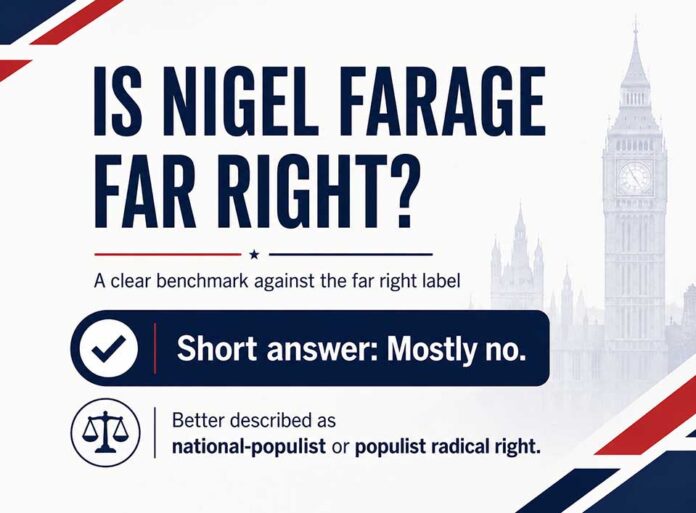
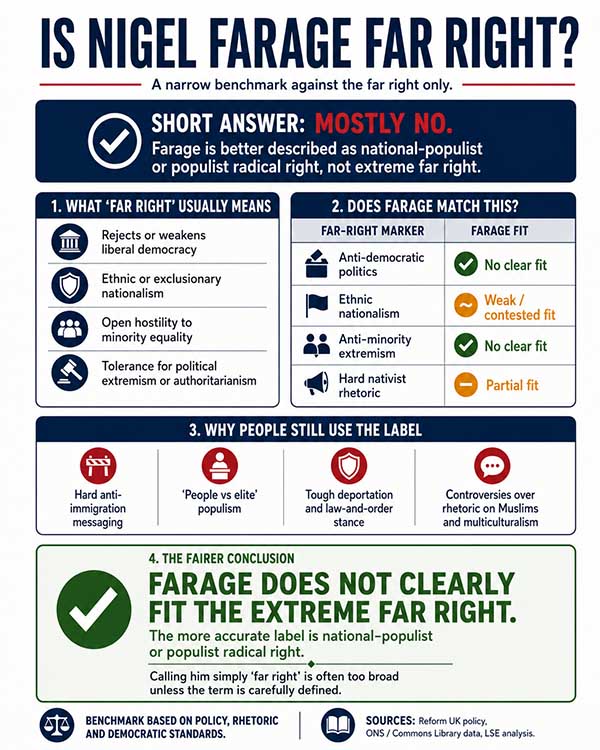
Farage is a national-populist politician. Reform UK is best understood as a populist radical-right party, not as an extreme-right or fascist party. The media phrase “far right” is sometimes defensible as a broad category, but it is often too blunt, too loaded, and too easily used as a substitute for argument.
That distinction is not academic hair-splitting. It is the difference between telling the truth and poisoning the debate.
1. The first mistake: treating “far right” as one thing
Before deciding whether Farage is far right, we need to define the phrase properly.
Political scientists often distinguish between the mainstream right, the radical right, and the extreme right. The radical right usually operates inside electoral democracy but combines nativism, authoritarianism, and often populism. The extreme right is more severe: it may reject democracy itself, support violence, or belong to fascist, neo-Nazi, racial-supremacist, or revolutionary traditions. The PopuList research project defines the radical right around nativism and authoritarianism, while treating the broader “far right” as an umbrella term that can include both radical-right and extreme-right politics.
That is the key distinction. A party can be radical-right without being fascist. A politician can be populist and nationalist without being a Nazi. And a voter can support border control, lower immigration, or national sovereignty without being remotely “far right” in any meaningful moral sense.
Tim Bale of Queen Mary University of London has argued that calling Reform UK simply “far right” can be misleading because the phrase is so broad and emotionally loaded. Bale’s point is not that Reform is moderate, but that serious analysis should distinguish between the extreme right and the populist radical right. He describes the populist radical right as combining democracy, nativism, and a “people versus elite” worldview, while the extreme right comes from a more openly anti-democratic or violent tradition.
That framework is the fairest one to apply to Farage.
If “far right” means extreme right, the answer is no.
If “far right” means populist radical right, the answer is much more complicated — and in several respects, yes.
2. What “far right” should not mean
A healthy society must be able to discuss immigration, national identity, crime, borders, integration, public services, and cultural change without instantly treating those questions as extremist.
It is not far right to believe a country should control who enters it. Border control is a basic function of statehood.
It is not far right to believe Britain has a national identity. A nation is not just an administrative zone. It has language, memory, customs, law, obligations, and shared civic inheritance.
It is not far right to ask whether immigration levels are sustainable. Housing, GP access, schools, wages, crime enforcement, welfare, social cohesion, and infrastructure are all legitimate public concerns.
It is not far right to look at statistics. In fact, refusing to look honestly at statistics is what creates resentment. People notice reality whether politicians permit discussion or not.
It is not far right to criticise elites. Governments fail. Courts can overreach. Media institutions can be biased. Civil services can become complacent. NGOs can be ideological. None of those critiques is automatically extremist.
This matters because Farage’s strongest defence is that he has raised real questions that the British establishment often avoided. UK net migration reached historically high levels after Brexit, peaking at an estimated 944,000 in the year to March 2023 before falling to 204,000 in the year to June 2025. The Office for National Statistics says non-EU migration was the main driver of the sharp rise between 2020 and 2023.
Small-boat crossings are also not invented. The House of Commons Library records 41,000 people arriving by small boat in 2025, making small boats 89% of detected unauthorised arrivals that year; almost all small-boat arrivals claim asylum.
So when Farage says immigration and border enforcement are not fringe issues, he is right. They are real issues. The public is not hallucinating them. A politics that treats public concern as bigotry simply because the concern is uncomfortable is not enlightened. It is evasive.
But the hard question is not whether those subjects are legitimate. They are. The hard question is how Farage talks about them, what policies Reform proposes, and whether the movement remains civic and democratic or slides into nativist threat-politics.
That is where the evidence becomes more mixed.
3. The strongest case in Farage’s favour
Start with the obvious: Nigel Farage is a democratic politician. He is an elected MP for Clacton, having entered the House of Commons after the July 2024 general election. Reform UK won five seats and 14.3% of the vote at the 2024 general election, making it a significant electoral force even though the first-past-the-post system gave it relatively few MPs.
That alone does not make a party moderate, but it matters. Farage operates through elections, speeches, media appearances, campaigns, and Parliament. There is no serious evidence that he advocates dictatorship, one-party rule, racial supremacy, fascist revolution, or political violence.
He has also tried to keep a distance from figures further to his right. In January 2025, after Elon Musk praised Tommy Robinson, Farage publicly rejected Robinson, saying he had never wanted him in UKIP and did not want him in Reform. That matters because the extreme-right label would be far more plausible if Farage were openly embracing street-agitator politics or racial-extremist networks. He has not done that.
There is also a strong argument that Farage’s central political cause has always been sovereignty rather than race. His career was built around leaving the European Union: who makes Britain’s laws, who controls Britain’s borders, and whether democratic decisions should sit with British voters or supranational institutions. That is not inherently far right. Sovereignty can be left-wing, right-wing, liberal, conservative, civic, or nationalist depending on how it is expressed.
Reform’s 2024 “Contract with You” presents the party as a “common sense” alternative to an “out-of-touch political class,” promising to restore border control, cut taxes, support British culture, restore law and order, reform public services, and make government work for British people. Much of that platform is not fascist, racial, or anti-democratic. It is a mix of Brexit-era sovereignty politics, low-tax conservatism, anti-green politics, public-sector reform, and hard immigration control.
Even Reform’s immigration argument is not automatically illegitimate. Reform argues that high immigration affects wages, housing, public services, crime, and social cohesion. Those claims deserve scrutiny, and some will be too broad or too simplistic, but the underlying subjects are valid. In a country where net migration reached record levels, it is not extremist to ask whether the system is working.
There is also a democratic fairness point. In 2016, many people voted for Brexit partly because they wanted control over immigration. After Brexit, immigration did not fall; in some periods it rose sharply. Reform’s own “Stop the Boriswave” paper argues that post-Brexit Conservative governments betrayed voters by presiding over millions of long-term visas and historically high net migration. One does not have to accept every number or conclusion in Reform’s paper to understand why many voters feel misled.
So the charitable reading of Farage is this:
He is not trying to import fascism into Britain. He is trying to force a complacent political class to answer questions it spent years avoiding: Who controls the borders? What level of immigration is sustainable? What does British citizenship mean? Why do courts and treaties seem to block democratic decisions? Why are ordinary people called bigots for noticing social change?
That case should not be dismissed. It is why Farage has lasted. It is why he has outlived many supposedly more respectable politicians. And it is why calling him “far right” without explanation often helps him: it appears to confirm his claim that the establishment prefers moral insult to democratic argument.
4. The strongest case against Farage
The case against Farage is not that he is secretly Hitler. That is unserious. The real case is that his politics fit the modern European pattern of national populism or populist radical-right politics.
That pattern usually has three parts.
First, populism: society is divided into the decent people and the corrupt elite.
Second, nativism: the nation is treated as belonging primarily to the native or established in-group, while migrants or minority cultures are portrayed as threats.
Third, authoritarianism: strong punishment, hard policing, deportation, and suspicion of rights-based restraints are treated as common sense against a weak or captured establishment.
Farage and Reform fit the first part very clearly. Reform’s 2024 Contract says Britain is being failed by an “out-of-touch political class” and presents Reform as the vehicle to restore control to ordinary people. That is classic populism. Populism is not automatically bad; sometimes elites really are detached. But it becomes dangerous when “the people” are defined narrowly and opponents are treated not merely as wrong, but illegitimate.
The second part — nativism — is more delicate. Farage and Reform do not usually speak in explicit racial terms. They generally frame their politics around citizenship, law, borders, British values, British culture, and national sovereignty. That is an important distinction. Civic nationalism is not the same as ethnic nationalism.
But Reform’s language sometimes moves beyond civic patriotism into a harder claim: that immigration and multiculturalism have damaged the country, and that some imported communities reject Britain’s way of life. Reform’s 2024 Contract says “record mass immigration has damaged our country,” says the small-boats crisis threatens security, and says multiculturalism has imported separate communities that reject British values or the British way of life.
That is the line critics focus on. Again, one can discuss integration honestly. One can say some communities are poorly integrated. One can criticise Islamism, imported sectarianism, antisemitism, separatism, foreign criminal gangs, or failures of assimilation. Those are legitimate subjects. But when a political movement repeatedly frames migrants or minority cultures as a threat to national life, it becomes much easier to classify it as nativist.
Reform’s policy programme reinforces that impression. The party proposes freezing “non-essential” immigration, detaining and deporting illegal migrants, leaving the European Convention on Human Rights, barring certain routes to asylum, and removing legal aid for non-citizens in immigration-related cases. Its current policy pages emphasise putting British people first, protecting British culture and traditions, tougher sentencing, increased stop and search, and rejecting what it sees as ideological capture in institutions.
None of those policies alone proves extremism. But together they create a profile that looks very much like the populist radical right: national preference, hard borders, punitive law and order, anti-elite rhetoric, and hostility to liberal legal constraints.
The third part — authoritarianism in the political-science sense — is also present. Reform’s law-and-order proposals include increased stop and search, mandatory prison sentences for some offences, mandatory life imprisonment for drug trafficking, and removing police chiefs who permit what Reform calls “two-tier policing.” Again, a desire for safer streets is not far right. But a highly punitive approach, combined with suspicion of courts, human-rights law, and institutional checks, is part of the radical-right pattern.
The most severe example is Reform’s “Operation Restoring Justice” plan, published in 2025, which proposes an emergency programme to identify, detain, and deport illegal migrants. The document proposes leaving the ECHR, repealing the Human Rights Act, passing emergency legislation, and disapplying several international conventions in relation to illegal migration policy. Its operational plan includes a new deportation command, data-sharing across public and private systems, expanded detention capacity, voluntary-return windows, charter flights, return agreements, and a fallback plan involving Ascension Island if needed.
Supporters will say this is what border control looks like when the state finally gets serious. Critics will say it is exactly why the radical-right label fits: it treats legal constraints as obstacles to be swept aside and concentrates state power around mass detention and deportation.
Both readings are possible. But the charitable reading cannot erase the hard edge of the policy.
5. The “far right” label is often lazy — but not baseless
This is where the article has to be brutally honest.
Some people call Farage far right because they do not want to engage with his arguments. That happens. It is lazy, and it has been politically counterproductive. It allows Farage to present himself as the only man brave enough to say what voters already think.
But some people call Farage far right because they are using a broad political-science category in which Reform genuinely fits. That is not automatically dishonest. The problem is that the phrase “far right” means different things to different audiences.
To an academic, “far right” may mean the broad family containing both the radical right and the extreme right.
To an ordinary voter, “far right” often sounds like “Nazi,” “fascist,” “racist thug,” or “violent extremist.”
That gap matters. If a journalist says Reform is far right and means “populist radical right,” but the audience hears “fascist,” the label misleads even if it has some technical basis.
The UK government’s 2024 extremism definition is a useful guardrail here. It defines extremism around ideologies based on violence, hatred, or intolerance that aim to undermine rights, freedoms, or liberal parliamentary democracy. It also distinguishes that from lawful debate, protest, and strongly held political beliefs. On that standard, Farage’s politics should not casually be treated as extremism. He is not outside electoral democracy.
That is why the most accurate wording is:
Farage is not extreme right. Reform is not fascist. But Farage and Reform are plausibly populist radical right.
This gives critics the seriousness of their concern without giving them permission to smear. It gives supporters the fairness they deserve without pretending the concerns are imaginary.
6. The “Breaking Point” poster: the most damaging symbol
No honest assessment of Farage can avoid the 2016 “Breaking Point” poster.
During the EU referendum campaign, Farage unveiled a poster showing a long queue of mostly non-white migrants and refugees, with a message that Europe had failed and Britain was at breaking point. It was condemned by political opponents and reported to police by critics who said it incited racial hatred.
The most charitable interpretation is that Farage was making a political point about uncontrolled migration, EU border failure, and public pressure. Those were legitimate referendum issues.
But the poster was inflammatory. It visually associated migration with national emergency. It used imagery that many people reasonably saw as racialised. It did not merely argue for border control; it suggested threat, pressure, and invasion.
Does that prove Farage is racist? No. A single poster, even an ugly one, does not prove someone’s inner motives.
But does it explain why many people see his politics as nativist or far-right-adjacent? Yes. Absolutely.
A fair article should say both things.
The poster was not proof of fascism. But it was not harmless either. It remains one of the strongest pieces of evidence for critics who argue that Farage’s politics sometimes turn legitimate immigration concerns into fear of outsiders.
7. The Muslim question: legitimate integration debate or group suspicion?
Farage’s comments about British Muslims are among the strongest evidence used by critics.
In 2024, Farage said a “growing number” of young Muslims in Britain did not subscribe to British values and suggested some “loathe” much of what Britain stands for. When challenged on whether he was speaking about Muslims specifically, he confirmed that he was.
This is where honesty requires discipline.
There are real issues around integration. There are real issues around Islamism. There are real issues around antisemitism, sectarian politics, gender equality, free speech, religious separatism, foreign influence, and parallel communities. A democratic country must be able to talk about these subjects.
But the danger is obvious: when a politician speaks about “Muslims” as a broad category and links them to rejection of British values, many ordinary Muslim citizens will hear suspicion directed not at extremists, but at them. A British Muslim who works, pays taxes, obeys the law, loves the country, and wants a normal life may reasonably ask: “Why am I being treated as a problem to be explained?”
The charitable reading of Farage is that he is criticising failed integration, not condemning all Muslims.
The critical reading is that he is using a minority group as a cultural threat-symbol.
The truth is probably this: Farage often raises real issues, but he sometimes phrases them in ways that are too broad, too inflammatory, and too willing to let the audience fill in the blanks.
That is not the same as fascism. But it is exactly the sort of rhetoric that makes the radical-right classification plausible.
8. The Romanian comments: crime, nationality, and the danger of broad brush politics
In 2014, Farage caused controversy with comments about Romanian immigrants and crime. He later said the majority of Romanians in Britain were good neighbours and framed his concern around organised criminal gangs, but the original controversy centred on whether he had unfairly encouraged suspicion toward Romanians as a group.
Again, there are two truths.
Truth one: foreign organised crime exists. It is legitimate to talk about it. The state should be honest about crime patterns, including when they involve foreign nationals or specific criminal networks.
Truth two: public rhetoric about nationality and crime can quickly become collective suspicion. If a politician speaks too loosely, law-abiding people from that nationality become socially marked.
Farage’s defenders will say he was punished for saying what people privately worry about. His critics will say this is exactly his method: choose a real issue, attach it to a nationality or minority group, then claim innocence when people object.
The fairest assessment is that Farage has a talent for raising uncomfortable questions — and a recurring weakness for phrasing them in ways that make broad suspicion more likely.
That is not a small point. In national politics, language is not decoration. Language shapes what people feel permitted to think about their neighbours.
9. Reform’s activist scandals: not proof, but not irrelevant
During the 2024 general election campaign, Channel 4 recorded Reform campaigners making racist and violent remarks, including a racial slur about Rishi Sunak and comments about shooting migrants arriving by small boat. Farage condemned the remarks as prejudiced and wrong, and Reform said the people involved were not welcome back.
This kind of incident should be handled carefully.
It does not prove that Farage personally holds those views. It does not prove Reform’s official policy is racist. Large insurgent parties often attract cranks, extremists, opportunists, and people with ugly motives.
But it is not irrelevant either. If a party repeatedly attracts people from the racial or anti-Muslim fringe, the leadership has to ask why. Is it merely because extremists try to attach themselves to any anti-immigration movement? Or is something in the party’s rhetoric creating a permissive atmosphere?
Farage deserves credit for condemning such comments. But condemnation after exposure is not enough. A serious national party must show it can professionalise, vet candidates, control its culture, and make clear that civic patriotism is not ethnic resentment.
This is one of Reform’s biggest tests. If it wants to be seen as a serious democratic party rather than a protest vehicle, it must prove that its nationalism is genuinely civic.
10. Border control is not far right — but Reform’s border policy is very hardline
The most important distinction in the whole debate is this:
Border control is normal.
Mass deportation politics is hardline.
Hardline is not automatically fascist.
But hardline can still be radical-right.
Reform proposes detaining and deporting illegal migrants, leaving the ECHR, restricting asylum claims from people who came through safe countries, and creating a much tougher enforcement regime. Its later “Operation Restoring Justice” document goes further, proposing emergency legislation and a deportation infrastructure designed to remove illegal migrants at scale.
Supporters see this as overdue realism. They argue that a border is meaningless if illegal entry eventually leads to legal settlement. They argue that deterrence only works when consequences are certain. They argue that courts and treaties have made democratic border control impossible.
Those arguments cannot simply be dismissed. A state that cannot enforce immigration law will eventually lose public consent. That is not a far-right insight; it is a basic truth of democratic legitimacy.
But critics have a serious point too. Reform’s approach raises major questions about due process, asylum rights, detention, mistaken identity, family separation, international obligations, and state power. When a party proposes disapplying legal protections to make deportation easier, it is fair to ask whether it is weakening the liberal side of liberal democracy.
The distinction is this:
A democratic conservative says: “We need lawful, controlled immigration.”
A national populist says: “The people demand control, and the legal establishment must be swept aside.”
Farage often sounds closer to the second than the first.
That is why “ordinary conservatism” does not quite capture him.
11. National identity: not only legitimate, but necessary
Farage is strongest when he insists that Britain is allowed to have a national identity.
A nation cannot survive as just a tax jurisdiction with a flag. It needs shared loyalty, common law, cultural memory, mutual obligation, and some sense of “us.” That “us” does not need to be racial. In a decent country, it should not be racial. But it must exist.
The progressive mistake has often been to treat national identity as inherently suspicious. That was foolish. If mainstream institutions refuse to defend a healthy national identity, harder movements will step in and define the nation in harsher terms.
So yes: Britain is allowed to stand up for British culture, British values, British history, British citizenship, and British borders. Reform’s current policy language includes protecting British culture and traditions, defending free speech, teaching a more positive account of British history, and protecting Christian heritage. None of that is automatically far right.
But national identity has two possible forms.
The first is civic national identity: anyone can belong if they accept the law, the civic culture, the duties of citizenship, and the basic norms of the country.
The second is ethnic or exclusionary nationalism: belonging is treated as blood, ancestry, race, or permanent suspicion toward outsiders and minorities.
Farage’s best defence is that he usually speaks in civic terms: law, borders, sovereignty, taxes, British values, citizenship.
His weakness is that some of his rhetoric, especially around Muslims, migrants, multiculturalism, and “our way of life,” can sound like it is moving from civic identity toward cultural suspicion.
This is the line he must police if he wants the fairest reading of his politics to prevail.
12. The role of statistics: truth is not bigotry
One of the most damaging habits in modern politics is treating statistics as morally dangerous.
Statistics are not bigotry. Crime data, migration data, asylum data, fiscal data, housing data, welfare data, and integration data should all be open to discussion.
But statistics can be abused. They can be cherry-picked. They can be used to imply collective guilt. They can be stripped of context. They can turn individuals into representatives of a feared group.
The honest position is this:
Yes, we should discuss immigration numbers.
Yes, we should discuss crime patterns.
Yes, we should discuss integration failures.
Yes, we should discuss fiscal impacts.
But we should also distinguish legal from illegal migration, workers from dependants, students from asylum seekers, refugees from economic migrants, citizens from non-citizens, and individuals from groups.
The Migration Observatory notes that UK net migration fell sharply by mid-2025 after the extraordinary highs of 2022 and 2023, and that work and study made up a large share of non-EU immigration. That matters because “immigration” is not one thing. A nurse, a foreign student, an asylum seeker, a seasonal worker, a spouse, a criminal overstayer, and a billionaire investor are all counted in migration politics, but they raise different questions.
Interestingly, Reform’s own “Stop the Boriswave” paper acknowledges that skilled workers can be fiscally contributory while refugees can impose greater fiscal costs. That distinction is important. The more precise the debate becomes, the less it depends on fear.
Farage’s contribution has been to make immigration discussable. His risk is that he sometimes makes it discussable in a way that encourages people to think too broadly and too suspiciously.
That is the difference between honest scrutiny and group blame.
13. Reform is not the BNP — and pretending otherwise is dishonest
There is a major difference between Reform UK and the British National Party.
The BNP came from an explicitly racial and extremist tradition. Reform does not have an official racial-supremacist platform. Reform does not openly advocate white nationalism. Reform does not call for dictatorship or political violence. Farage has repeatedly built his movements around elections, referendums, media pressure, and parliamentary politics, not street violence or racial revolution.
This distinction matters not because Reform should be immune from criticism, but because exaggeration destroys credibility. If every hard anti-immigration movement is treated as identical to neo-Nazism, ordinary voters who support lower immigration will conclude that the entire moral language of anti-racism is being used to silence them.
That is how institutions lose trust.
Farage’s critics should be sharper. The strongest critique is not “Farage is the BNP.” The strongest critique is:
Farage has built a democratic national-populist movement that channels legitimate public concerns through a rhetoric of elite betrayal, cultural threat, hard borders, and suspicion of minority integration. That is not fascism, but it is not ordinary conservatism either.
That criticism is harder for Farage to dismiss, because it is closer to the truth.
14. Reform is also not merely “common sense conservatism”
Farage’s supporters often describe Reform as simple common sense: lower taxes, less waste, stronger borders, safer streets, cheaper energy, more pride in Britain.
There is truth in that. Many Reform policies are ordinary right-wing or conservative policies. Lower taxes are not far right. Scrapping net zero targets is not far right. Criticising civil service waste is not far right. Wanting more police is not far right.
But the full package is more radical than standard conservatism.
Reform proposes leaving the ECHR, reforming or replacing major human-rights frameworks, restricting postal voting to certain groups, replacing the House of Lords with a smaller second chamber, and making civil service leadership more directly accountable. It proposes very hard immigration controls, mass removals of illegal migrants, and a strong national-preference approach.
That does not make Reform fascist. But it does make Reform an insurgent national-populist party, not just a slightly tougher version of the Conservatives.
The party’s electoral rise also shows that this is not a fringe debate. Reform won five Commons seats and 14.3% of the vote in 2024, and later won the largest number of seats in the 2025 English local elections covered by the House of Commons Library briefing.
That is why the label matters. Reform is no longer just protest noise. It is a major force in British politics.
15. The uncomfortable truth about the establishment
A truly honest article must also ask why Farage exists politically.
Farage did not create public distrust from nothing. He exploited it, sharpened it, and benefited from it, yes. But he did not invent it.
For years, voters were told immigration would be controlled. Then it rose.
They were told Brexit would restore control. Then post-Brexit migration reached record levels.
They were told illegal migration would be stopped. Then small boats became a central national issue.
They were told concerns about integration were bigotry. Then stories about grooming gangs, extremism, antisemitism, separatism, and public-order double standards made many people feel that official Britain was looking away.
They were told courts and conventions protected rights. Then many voters came to believe those institutions protected everyone except the law-abiding public.
Whether every perception is fair is not the point. Politics is built on trust, and trust was broken.
Farage’s genius has always been to stand in the gap between what institutions say and what many voters feel. He makes the voter feel sane. That is politically powerful.
This is where critics of Farage often fail. They attack the emotion without addressing the cause. They say “far right” when they should ask: why do millions of people think this man is the only one speaking plainly?
A serious anti-Farage argument would admit that many of his questions are legitimate. It would then argue that his answers are too blunt, too divisive, or too dangerous to rights and social trust.
That is a much better argument than name-calling.
16. The uncomfortable truth about Farage
But Farage’s supporters also need to face something.
It is not enough to say, “He is just asking common-sense questions.”
A politician is responsible not only for the questions he raises, but for the atmosphere he creates.
If you constantly speak about immigration as damage, multiculturalism as imported separation, Muslims as insufficiently British, courts as enemies of the people’s will, and elites as traitors to the nation, you may still be operating democratically. You may still be raising real issues. But you are also creating a politics of suspicion.
That suspicion can attach itself to people who have done nothing wrong: the Muslim shopkeeper, the Romanian worker, the Syrian refugee, the British-born child of immigrants, the foreign nurse, the lawful resident, the mixed neighbourhood.
Farage is often careful enough to avoid explicit racism. But politics is not only explicit. It is also implication, emphasis, repetition, and emotional framing.
His best case is that he gives voice to people ignored by polite society.
His worst habit is that he sometimes gives voice to them in a way that makes whole communities feel accused.
That is the balance any honest article must hold.
17. So, is Nigel Farage far right?
The answer depends on what the phrase means.
If “far right” means fascist, neo-Nazi, racial-supremacist, BNP-style, anti-democratic extremist:
No. That label is not fair. Farage is an electoral politician, not a fascist revolutionary. Reform is a democratic party, not a neo-Nazi movement. Farage has distanced himself from Tommy Robinson and has condemned racist remarks by campaigners.
If “far right” means someone who believes Britain should have borders, lower immigration, national identity, sovereignty, and stronger law enforcement:
No. Those views are not inherently far right. They can sit within democratic conservatism, civic nationalism, social democracy, or even parts of the labour tradition.
If “far right” means the academic umbrella that includes the populist radical right:
Yes, there is a credible case. Farage and Reform fit many of the markers: anti-elite populism, hard anti-immigration politics, nativist/citizen-first framing, punitive law-and-order policy, and hostility to supranational legal constraints.
The best label:
National-populist is the cleanest public term.
Populist radical right is the cleanest academic term.
Far right is too vague unless carefully defined.
Extreme right is unfair.
Fascist is false.
That is the honest verdict.
18. The fairest one-paragraph conclusion
Nigel Farage is not the cartoon villain his critics often describe. He is not a fascist, not a neo-Nazi, and not simply the BNP in a blazer. He has raised real questions about borders, sovereignty, immigration, integration, crime, and elite failure — questions Britain should have been able to discuss openly years ago. But Farage is also not just a harmless common-sense conservative. His politics fit much of the populist radical-right pattern: a hard “people versus elite” narrative, severe immigration and deportation policies, suspicion of liberal legal constraints, strong national-preference language, and rhetoric that sometimes frames migrants or minorities as threats to British life. The most honest judgement is that Farage is a democratic national-populist, not an extreme-right extremist. Calling him “far right” may be technically defensible if carefully defined, but in ordinary public debate it is often too blunt and too morally loaded. The better question is not whether Britain is allowed to have borders and national identity — of course it is. The better question is whether Farage can defend those things without turning legitimate patriotism into suspicion, and whether his critics can answer his arguments without pretending every uncomfortable truth is hatred.
19. Final article ending
Britain is allowed to have borders. Britain is allowed to have a national identity. Britain is allowed to say that citizenship means something. Britain is allowed to ask whether immigration is too high, whether integration is working, whether courts have too much power, and whether the governing class has listened.
None of that is far right.
But Britain also has to remain a country where citizenship is equal, where minorities are not treated as permanent suspects, where policy is based on evidence rather than panic, and where democratic anger does not become collective blame.
That is the line Nigel Farage walks.
His critics are wrong when they use “far right” as a lazy insult to avoid difficult arguments. His supporters are wrong if they pretend there is nothing hard, nativist, or radical in Reform’s politics.
The truth is sharper than either camp wants.
Farage is not a fascist.
He is not a racial revolutionary.
He is not outside democratic politics.
But he is a national-populist leader of a party that sits on the populist radical right of British politics. He has made legitimate questions impossible to ignore. He has also sometimes answered them in ways that risk making Britain more suspicious, more divided, and less generous than it needs to be.
A serious country should not silence Farage. It should answer him.
And Farage, if he wants to be more than a protest leader, must prove that his patriotism is civic rather than tribal, democratic rather than merely majoritarian, and strong enough to defend Britain’s borders without weakening Britain’s decency.
References / Source List
Political-science definitions
- Cas Mudde / Cambridge University Press — Populist Radical Right Parties in Europe
Useful for defining the populist radical right around nativism, authoritarianism and populism. - Tim Bale, LSE — “It’s a mistake to call Reform UK ‘far-right’”
Useful because it gives a fair distinction between extreme right and populist radical right, which is central to the article’s argument. - The Guardian / PopuList explainer — “Populist, nativist, neofascist?”
Useful for accessible definitions of far right, radical right, extreme right, nativism, and populism.
Reform UK policy sources
- Reform UK — Our Contract with You, 2024
Main source for Reform’s election platform, including immigration, law and order, British culture, tax, NHS, net zero, ECHR and constitutional reform. - Reform UK — Current policy page
Useful for current wording on British culture, free speech, immigration, national identity and party positioning. - Reform UK — Operation Restoring Justice / Immigration Enforcement Plan
Key source for Reform’s harder immigration-enforcement proposals, including detention, deportation and legal reset arguments.
Official data and public records
- Office for National Statistics — Long-term international migration, year ending June 2025
Source for UK net migration figures, including the fall to 204,000 and the role of non-EU migration in recent trends. - Migration Observatory, University of Oxford — Net migration to the UK
Useful independent analysis of migration flows, work/study migration and the post-2022 decline. - House of Commons Library — Small boat Channel crossings
Source for small-boat arrival figures and the share of detected unauthorised arrivals. - UK Government — New definition of extremism, 2024
Useful for distinguishing controversial democratic politics from extremism based on violence, hatred, intolerance or attempts to undermine parliamentary democracy. - UK Parliament — Nigel Farage MP profile
Source for Farage’s status as Reform UK MP for Clacton since 4 July 2024. - House of Commons Library — 2024 general election performance of Reform and the Greens
Source for Reform winning five seats and achieving a much larger vote share than seat share in 2024. - House of Commons Library — 2025 local elections results and analysis
Source for Reform’s 2025 English local election performance, including 677 seats and 41% of seats contested. Nigel Farage – UK Owes Him a Debt
Statements, controversies and public record
- The Guardian — Farage’s “Breaking Point” poster reported to police
Source for the 2016 poster controversy and criticism that the image was racially inflammatory. - Sky News — Farage comments on young Muslims and British values
Source for Farage’s claim that a growing number of young Muslims do not subscribe to British values. - Sky News — Farage rejects Tommy Robinson joining Reform UK
Source for Farage distancing Reform from Tommy Robinson in January 2025. - Sky News — Reform candidates/campaigners racism row
Source for the 2024 campaign controversy involving racist and homophobic remarks, and Reform dropping candidates / distancing itself from those involved.
Disclaimer:
This article is an opinion-and-analysis piece, not a party broadcast, academic verdict or courtroom judgment. The aim is to be fair, direct and evidence-led. It gives Nigel Farage and Reform UK the benefit of the doubt where the evidence allows, but it does not ignore uncomfortable facts, rhetoric or policy implications. Readers are warmly invited to disagree — preferably with receipts, not just vibes.