



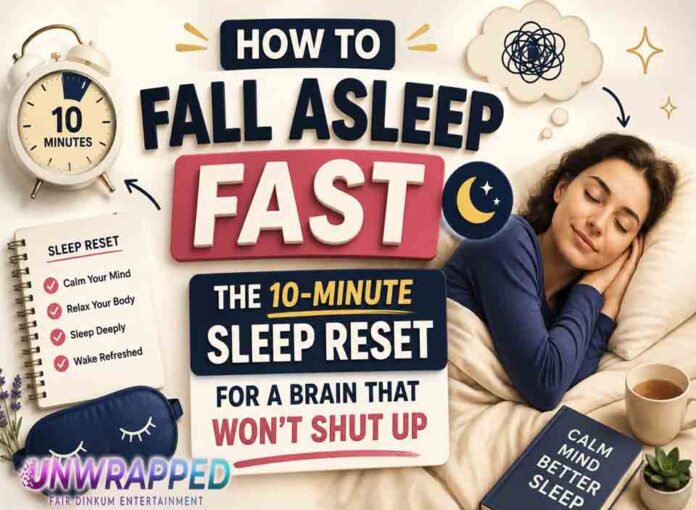
You are not bad at sleeping, you just need some clues. How to fall asleep fast, let’s begin.
You are overstimulated, over-scheduled, over-lit, over-caffeinated, and probably lying in bed trying to “win” sleep by force.
That is the first mistake.
Sleep is not something you chase. Sleep is something you make room for.
Most healthy people fall asleep within about 15 to 20 minutes after lying down, but plenty of people struggle because their body is tired while their brain is still acting like it has a meeting to run. Adults generally need at least 7 hours of sleep each day, and sleep deficiency has been linked with health problems, including high blood pressure, diabetes, obesity, depression, heart disease, and stroke.
So yes, falling asleep matters.
But here is the surprise: the best way to fall asleep faster is not to try harder. It is to become deeply boring to your own nervous system.
This is the 10-minute sleep reset.
It is not magic. It is not a miracle. It is a simple sequence designed to tell your body, your eyes, your breathing, and your mind the same thing:
The day is over. You are safe. Nothing needs solving right now.
The 10-Minute Sleep Reset
Use this when you are in bed, tired, and annoyed that you are still awake.
Minute 1: Stop negotiating with sleep
The moment you think, “I need to fall asleep right now,” your brain hears danger.
It starts checking the clock.
It starts calculating tomorrow’s tiredness.
It starts replaying conversations from 2017.
It starts asking whether you should completely change your life at 12:43 a.m.
That pressure wakes you up.
Instead, say this quietly:
“I don’t have to sleep. I only have to rest.”
This one sentence matters because rest feels possible. Sleep can feel like a performance. Rest removes the scoreboard.
Your new goal is not to knock yourself unconscious. Your goal is to lower the amount of effort in your body.
Minute 2: Make the room feel like night
Your bedroom should not feel like an office with pillows.
The CDC recommends sleep-supporting habits such as keeping a consistent sleep schedule, making the bedroom quiet, relaxing, and cool, turning off electronic devices before bed, avoiding caffeine later in the day, and exercising regularly.
Start with the simplest environmental reset:
Make the room darker than you think it needs to be.
Make the room cooler than your daytime comfort setting.
Move your phone away from your face.
Stop checking the time.
If your brain sees light, alerts, messages, and numbers, it does not know the day is finished.
A good sleep environment is not glamorous. It is quiet, cool, dim, and boring.
That is the point.
Minute 3: Relax your jaw, tongue, and shoulders
Most people try to relax by thinking relaxing thoughts.
That is too slow.
Start with the body.
Let your tongue fall away from the roof of your mouth.
Unclench your jaw.
Drop your shoulders.
Let your hands go heavy.
Let your stomach soften.
Do not scan your body like a perfectionist. Just release the obvious tension.
Your jaw and shoulders are often where the day hides. If you relax those areas first, the rest of your body gets the message faster.
Minute 4: Use the “long exhale” trick
You do not need a complicated breathing ritual.
Just make your exhale longer than your inhale.
Try this:
Inhale gently through your nose for 3 seconds.
Exhale slowly for 5 or 6 seconds.
Repeat.
Do not strain. Do not count perfectly. Do not turn breathing into homework.
The goal is to create a slow rhythm that your body can trust. A long exhale is a simple way to move away from alertness and toward calm.
The NHS also recommends relaxation, meditation, and creating the right sleep environment as part of a better sleep routine.
Minute 5: Stop trying to empty your mind
This is where most sleep advice fails.
“Clear your mind” sounds peaceful, but for many people it is useless. The second you try to think about nothing, your brain says:
Nothing? Great. Let’s think about money.
Let’s think about your inbox.
Let’s think about that weird thing you said.
Let’s think about whether your entire personality needs rebranding.
So do not empty your mind.
Give it something dull to do.
Minute 6: Do the cognitive shuffle
The cognitive shuffle is a sleep technique associated with cognitive scientist Luc Beaudoin. It uses random, emotionally neutral images to interrupt repetitive thinking and mimic the loose, drifting quality of pre-sleep thoughts. Early research and expert discussion suggest it may help with racing thoughts, though it should not be treated as a guaranteed cure for insomnia.
Here is the simple version.
Pick a boring word, such as:
CANDLE
Now, for each letter, imagine random objects that start with that letter.
C: carrot, cloud, cup, coat
A: apple, ant, anchor, apron
N: notebook, napkin, nest, noodle
D: door, duck, desk, daisy
L: lemon, ladder, lamp, leaf
E: envelope, egg, elephant, engine
Picture each object for a few seconds. Do not create a story. Do not make it meaningful. Do not connect the images.
Random is the whole trick.
Your brain loves solving problems. The cognitive shuffle gives it a task too boring to become stressful and too scattered to become a plan.
That is exactly what you want.
See Also: Sleep, Stress, and Streaks: How Your Brain Reacts to Gambling Losses
Minute 7: Let yourself be bad at the technique
You will lose track. Good.
You will forget the word. Fine.
You will accidentally think about tomorrow. Normal.
Do not restart with frustration. Do not grade yourself. Do not decide the method “isn’t working” after 40 seconds.
Just return to the next boring image.
A spoon.
A stone.
A sock.
A sandwich.
The goal is not perfect focus. The goal is soft distraction.
Minute 8: Use the “I’ll deal with it tomorrow” rule
A racing mind usually pretends to be useful.
It says:
“Let’s solve your career tonight.”
“Let’s plan the whole week.”
“Let’s remember every mistake.”
“Let’s prepare for a conversation that may never happen.”
Do not argue with it. Arguing is still engagement.
Instead, use one line:
“This is a tomorrow problem.”
That sentence is powerful because it does not deny the thought. It postpones it.
You are not saying the issue is fake. You are saying midnight is a terrible project manager.
Minute 9: If you are still awake, stop performing sleep
If you have been awake for a while and you feel yourself getting irritated, do not keep lying there building resentment toward your pillow.
Many sleep experts recommend getting out of bed briefly if you cannot sleep, doing something quiet and unstimulating, and returning when sleepy. The NHS similarly warns against forcing sleep and recommends relaxing, sleep-supportive routines.
Keep it boring.
Sit somewhere dim.
Read something dull.
Avoid your phone.
Avoid work.
Avoid bright lights.
Return to bed when sleepiness comes back.
The bed should become associated with sleep, not frustration.
Minute 10: Repeat the same routine tomorrow
The fastest way to improve sleep is to stop treating every night like a brand-new experiment.
Your body loves patterns.
A consistent wake time, regular bedtime routine, calmer evenings, less late caffeine, less screen stimulation, and a cool dark room will beat random sleep hacks over time. Harvard Health describes sleep hygiene as a set of practices that includes a comfortable sleep environment, a consistent schedule, a bedtime routine, and daytime habits that support restful sleep.
The routine does not need to be impressive.
It needs to be repeatable.
The perfect sleep routine is not the one that looks aesthetic on social media. It is the one you will actually do when you are tired, busy, and slightly annoyed.
Why You Can’t Fall Asleep Even When You’re Exhausted
Feeling exhausted does not always mean your body is ready to sleep.
You can be physically tired but mentally activated.
Common sleep blockers include:
Stress
Late caffeine
Bright screens
Irregular sleep times
Heavy meals close to bed
Alcohol
Anxiety
Long naps
Working too late
Checking the clock
Trying too hard to sleep
The CDC recommends avoiding large meals and alcohol before bedtime, avoiding caffeine in the afternoon or evening, keeping the bedroom cool and relaxing, and turning off electronic devices before bed.
The brutal truth is that many people do not have a sleep problem. They have an evening problem.
Your bedtime starts hours before you get into bed.
If your night looks like emails, scrolling, snacks, stress, bright light, caffeine, and then suddenly “I demand sleep,” your brain is going to revolt.
The Best Bedtime Routine for Falling Asleep Faster
A good bedtime routine should feel almost embarrassingly simple.
Try this 30-minute version.
30 minutes before bed: lower the stimulation
Dim the lights.
Stop work.
Move your phone away.
Turn off intense shows, arguments, emails, and anything that makes your brain feel “on.”
You are not trying to become a monk. You are trying to stop feeding your nervous system new material.
20 minutes before bed: prepare tomorrow
Write down the three things you need to remember tomorrow.
Not twenty-three things.
Three.
This helps your brain stop using bedtime as a reminder system.
10 minutes before bed: repeat a calming cue
Do the same small action every night.
Brush your teeth.
Wash your face.
Read two pages.
Stretch lightly.
Play quiet audio.
Breathe slowly.
The action itself matters less than the repetition.
Repetition teaches your body, “This is what we do before sleep.”
What to Do When You Wake Up at 3 A.M.
Waking up during the night is not automatic failure.
The real problem starts when you panic about being awake.
Do not check the time if you can avoid it. The clock turns wakefulness into math. Math turns wakefulness into stress.
Use the same reset:
Relax your jaw.
Lengthen your exhale.
Think, “I only have to rest.”
Do the cognitive shuffle.
If frustration builds, get out of bed briefly and do something quiet.
The worst move is lying there angrily monitoring whether sleep has arrived yet.
You cannot bully yourself into rest.
Foods, Caffeine, and Alcohol: What Actually Matters
You do not need a perfect diet to sleep well.
But timing matters.
Caffeine late in the day can make it harder to fall asleep. Heavy meals close to bedtime can make your body feel too active. Alcohol may make you feel sleepy at first but can disrupt sleep quality later in the night.
The CDC specifically recommends avoiding caffeine in the afternoon or evening and avoiding large meals and alcohol before bedtime.
A practical rule:
Keep caffeine earlier.
Keep dinner reasonable.
Keep late-night snacks light if you need one.
Do not use alcohol as a sleep tool.
Sleep is not just about becoming unconscious. It is about getting good-quality rest.
How Long Should It Take to Fall Asleep?
For many healthy people, falling asleep within about 15 to 20 minutes is normal.
If you fall asleep instantly every night, that can sometimes mean you are sleep deprived. If it regularly takes much longer than 20 or 30 minutes, it may mean your mind, schedule, environment, or habits are working against you.
But do not obsess over the number.
The question is not only, “How fast did I fall asleep?”
The better question is:
Do I wake up feeling restored often enough to function well?
That is the outcome that matters.
When to Get Help for Sleep Problems
Self-help strategies are useful, but they are not a replacement for medical care.
Consider speaking with a healthcare professional if you regularly struggle to sleep, feel exhausted during the day, snore loudly, wake up gasping, experience restless legs, have panic or depression symptoms, or rely on alcohol or medication to sleep.
Sleep problems can be connected to treatable conditions, including sleep apnea, anxiety, depression, chronic pain, medication side effects, and other health issues.
A better routine is powerful.
But persistent sleep trouble deserves proper support.
The 10-Minute Sleep Reset: Quick Version
When you cannot sleep, do this:
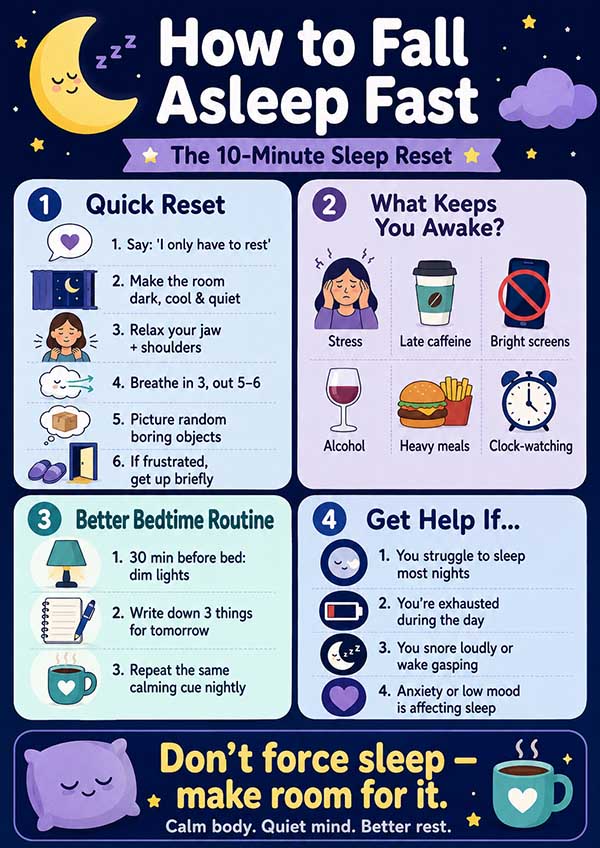
Say, “I only have to rest.”
Make the room dark, cool, and boring.
Relax your jaw, tongue, and shoulders.
Breathe with a longer exhale.
Stop trying to clear your mind.
Use the cognitive shuffle with random neutral images.
Label stressful thoughts as tomorrow problems.
Get out of bed briefly if frustration builds.
Repeat the same routine tomorrow.
The secret is not to force sleep.
The secret is to remove everything that keeps telling your brain the day is still happening.
Your body already knows how to sleep.
Your job is to stop interrupting it.
FAQ
how to fall asleep fast
Try the 10-minute sleep reset: relax your jaw and shoulders, make your exhale longer than your inhale, stop checking the clock, and use the cognitive shuffle by picturing random neutral objects. The goal is not to force sleep, but to make your body and mind feel safe enough to drift.
Why can’t I sleep even though I’m tired?
You may be physically tired but mentally alert. Stress, late caffeine, bright screens, irregular sleep times, heavy meals, alcohol, and clock-watching can all make sleep harder. Your evening routine often matters as much as your bedtime.
Is it bad if it takes 30 minutes to fall asleep?
Not always, but if it regularly takes a long time and you feel tired during the day, your sleep habits or health may need attention. Many healthy people fall asleep within about 15 to 20 minutes, though individual patterns vary.
Should I stay in bed if I can’t sleep?
If you are calm and resting, staying in bed may be fine. If you are getting frustrated, it can help to get up briefly, keep the lights dim, do something quiet and boring, and return when sleepy.
What is the best room temperature for sleep?
A cooler, quiet, dark, relaxing room generally supports better sleep. The exact temperature varies by person, but if your room feels stuffy, bright, or noisy, it may be working against you.
Does looking at my phone before bed affect sleep?
It can. Phones bring light, alerts, emotion, novelty, and stimulation into the exact window where your brain needs fewer signals. The CDC recommends turning off electronic devices at least 30 minutes before bedtime.
People Also Love: The Role of Sleep Cycles in Holistic Health Practices