


Work is no longer just about qualifications. Employers increasingly want to understand how people think, communicate, solve problems, handle pressure, and collaborate with others. That is why work personality tests have become a major part of hiring, career planning, leadership development, and workplace psychology.
A work personality test is designed to reveal how someone naturally behaves in professional environments. It looks beyond technical skill and focuses on patterns such as communication style, motivation, decision-making, leadership tendencies, adaptability, teamwork, and emotional responses under stress. In many modern workplaces, personality fit can matter almost as much as experience.
The popularity of work personality testing has grown rapidly because businesses are realizing something important: people with the same resume can perform very differently depending on personality, environment, and work culture. A highly creative employee may struggle inside a rigid system. A structured thinker may thrive in organized environments but dislike unpredictable roles. Understanding these differences helps companies build stronger teams while helping individuals discover careers that better match their natural energy.
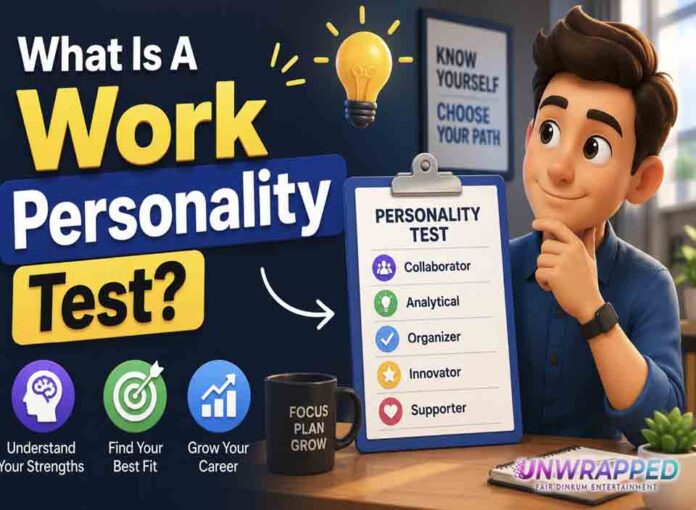
What Is A Work Personality Test?
A work personality test is an assessment that measures workplace-related personality traits, preferences, and behavioral patterns. Unlike casual online quizzes, professional workplace assessments are often used for recruitment, employee development, leadership training, career guidance, and team-building.
These tests may evaluate:
- Communication style
- Leadership approach
- Stress response
- Motivation drivers
- Team compatibility
- Problem-solving tendencies
- Organization habits
- Emotional intelligence
- Adaptability
- Decision-making patterns
The purpose is not to determine whether someone is “good” or “bad.” Instead, the goal is to understand how different personalities function in different work situations.
According to the American Psychological Association’s overview of personality psychology, personality influences behavior patterns, emotional responses, and interpersonal dynamics across many areas of life, including work environments. Workplace assessments attempt to organize these patterns into useful insights.
Why Companies Use Work Personality Tests
Hiring managers have learned that skills alone do not guarantee workplace success. Someone may have excellent qualifications but struggle with collaboration, communication, adaptability, or workplace culture.
A work personality test can help employers:
- Predict workplace behavior
- Improve team balance
- Reduce employee turnover
- Identify leadership potential
- Understand communication differences
- Match employees to suitable roles
- Support employee growth
Many companies also use personality assessments to improve internal dynamics. A highly analytical employee may need a different management style than someone motivated by creativity and recognition.
Common Types of Work Personality Tests
There is no single universal work personality test. Different systems focus on different workplace behaviors and theories.
Myers-Briggs Type Indicator (MBTI)
The Myers-Briggs Type Indicator remains one of the most recognized workplace personality systems. It categorizes people into 16 personality types based on preferences such as introversion versus extroversion and thinking versus feeling.
Supporters use MBTI to explore:
- Communication styles
- Leadership approaches
- Team compatibility
- Work preferences
Critics argue that personality is more flexible than fixed categories, but many organizations still use MBTI for self-awareness and team discussions.
Big Five Personality Traits
Many psychologists consider the Big Five model one of the more research-supported personality frameworks. It measures five broad dimensions:
- Openness
- Conscientiousness
- Extraversion
- Agreeableness
- Emotional Stability
The Big Five is commonly used in workplace research because it focuses on measurable behavioral tendencies rather than rigid personality labels.
For example:
- High conscientiousness may connect to reliability and organization.
- High openness may support creativity and innovation.
- High emotional stability may help under stress.
DISC Assessment
DISC assessments focus heavily on workplace behavior and communication. The four core categories are:
- Dominance
- Influence
- Steadiness
- Conscientiousness
Many organizations use DISC during leadership training, sales coaching, and team-building because the model is relatively easy to apply in daily workplace interactions.
Strengths-Based Assessments
Some work personality tests focus less on weaknesses and more on strengths. Assessments such as CliftonStrengths explore natural talents and work preferences rather than personality categories alone.
These tests aim to answer questions like:
- What energizes someone?
- What tasks feel natural?
- Where does someone perform best?
- What environments support their strengths?
What Work Personality Tests Can Reveal
A good work personality test often reveals patterns that people already sense but struggle to describe clearly.
Communication Style
Communication problems are one of the biggest causes of workplace tension. Personality assessments can reveal whether someone tends to be:
- Direct and assertive
- Diplomatic and careful
- Reserved and reflective
- Expressive and energetic
- Analytical and detail-focused
Understanding communication differences can improve collaboration and reduce misunderstandings.
Leadership Tendencies
Leadership does not look the same for everyone. Some leaders inspire through vision and energy. Others lead through stability, consistency, and calm decision-making.
A work personality test may help identify whether someone naturally leans toward:
- Strategic leadership
- Supportive leadership
- Data-driven leadership
- Relationship-focused leadership
- Innovative leadership
- Structured management
Different workplaces may require different leadership styles.
Stress Response
Workplace pressure affects people differently. Some become highly focused under stress. Others become overwhelmed, reactive, or emotionally withdrawn.
Personality tests may reveal patterns such as:
- Perfectionism
- Conflict avoidance
- Emotional resilience
- Risk tolerance
- Need for structure
- Adaptability during uncertainty
This insight can help employees build healthier work habits and prevent burnout.
Are Work Personality Tests Accurate?
This question creates ongoing debate. Some personality systems have stronger scientific support than others, and no test can fully capture the complexity of a human being.
Still, many experts agree that personality assessments can be useful when used correctly.
A work personality test should be treated as:
- A tool for insight
- A starting point for discussion
- A reflection aid
- A communication guide
It should not be treated as a permanent identity or a perfect prediction of success.
Problems happen when employers misuse tests by assuming personality results are absolute truths. Human behavior changes depending on experience, environment, stress, confidence, and life stage.
Another Must-Read: Free Personality Test With Instant Results
Benefits of Taking A Work Personality Test
For individuals, work personality tests can provide valuable career clarity.
Better Career Direction
Some people spend years in jobs that drain them because the environment clashes with their personality.
For example:
- Introverts may prefer focused, independent work.
- Highly social personalities may thrive in collaborative roles.
- Creative thinkers may struggle in repetitive systems.
- Structured personalities may dislike chaotic workplaces.
Understanding these tendencies can help people make more informed career decisions.
Improved Teamwork
Knowing personal work style can improve collaboration.
Someone who prefers direct communication may learn to soften delivery with sensitive teammates. A highly reflective employee may realize that coworkers interpret silence differently.
Awareness often improves workplace relationships.
Increased Self-Awareness
Many employees discover habits they never fully noticed before, such as:
- Avoiding conflict
- Overcommitting
- Seeking constant validation
- Becoming rigid under pressure
- Overthinking decisions
- Taking criticism personally
This kind of insight can support professional growth.
The Risks of Workplace Personality Labels
Work personality tests can be helpful, but they can also create problems when used carelessly.
One risk is stereotyping. Employees may become trapped inside labels such as “the introvert,” “the perfectionist,” or “the emotional one.” Real people are far more flexible than personality summaries.
Another risk is using personality results to justify poor behavior. For example:
- “That is just how this personality type communicates.”
- “This personality naturally avoids deadlines.”
- “This type does not handle pressure well.”
Healthy workplaces use personality insights to support growth, not excuse dysfunction.
How To Use A Work Personality Test Wisely
The best way to approach personality testing is with curiosity rather than obsession.
Useful questions include:
- Which parts feel accurate?
- What workplace patterns keep repeating?
- Which environments feel energizing?
- What situations drain motivation?
- What communication habits create conflict?
- What strengths show up consistently?
The goal is not to become trapped by a label. The goal is to understand work patterns more clearly.
Call-To-Action: Discover Your Work Personality
Understanding workplace personality can help people choose careers, improve communication, manage stress, and work more effectively with others. A personality assessment cannot define someone completely, but it can reveal patterns that explain why certain environments feel energizing while others feel exhausting.
🧠 Curious about personality patterns, strengths, communication style, and deeper behavioral traits?
Take the FREE Core-64 Quiz today:
https://personalitypeek.com/test/free-starter-quiz
Readers can also share this article with coworkers, managers, students, or anyone exploring career direction and workplace psychology.
Conclusion
A work personality test is more than a hiring tool. It is a framework for understanding how people think, communicate, lead, collaborate, and respond to workplace challenges. In modern work culture, personality awareness has become increasingly valuable because technical skill alone rarely explains why people succeed or struggle professionally.
The most effective use of personality testing is not labeling people. It is creating awareness. When employees understand their strengths, communication habits, stress patterns, and motivational needs, they often make better career decisions, build healthier work relationships, and develop more sustainable professional lives.
See Also: What Is A Relationship Personality Test?