




Africa is not one migration story; moving to Australia from Africa is also not one story.
A South African mechanic, a Nigerian software developer, a Zimbabwean nurse, a Kenyan engineer, a Ghanaian student, an Egyptian doctor, an Ethiopian family applicant and a Mauritian accountant may all be looking at the same destination — Australia — but their best visa pathways, job strategies, documents and risks can be completely different.
That is why moving to Australia from Africa needs a smarter guide than the usual generic advice.
Australia can be a powerful destination for African migrants. It offers skilled migration pathways, employer sponsorship, world-class universities, healthcare jobs, construction demand, engineering roles, IT opportunities, strong minimum wage protections, multicultural cities and long-term permanent residency options.
But Australia is not an easy country to enter casually.
It is expensive.
It is document-heavy.
It is strict on visas.
It is strict on health and character.
It has a brutal rental market.
And it rewards people who plan early.
At 30 June 2025, Australia had 8.8 million overseas-born residents, making up 32.0% of the national population. The ABS country-of-birth release also provides detailed country-level data showing substantial African-born communities across Australia, led by South Africa, Zimbabwe, Egypt, Kenya, Mauritius and Nigeria.
This guide breaks down the real route: visas, jobs, PR options, student pathways, country-specific advice, city choices, rent, healthcare, documents and the mistakes African migrants must avoid.
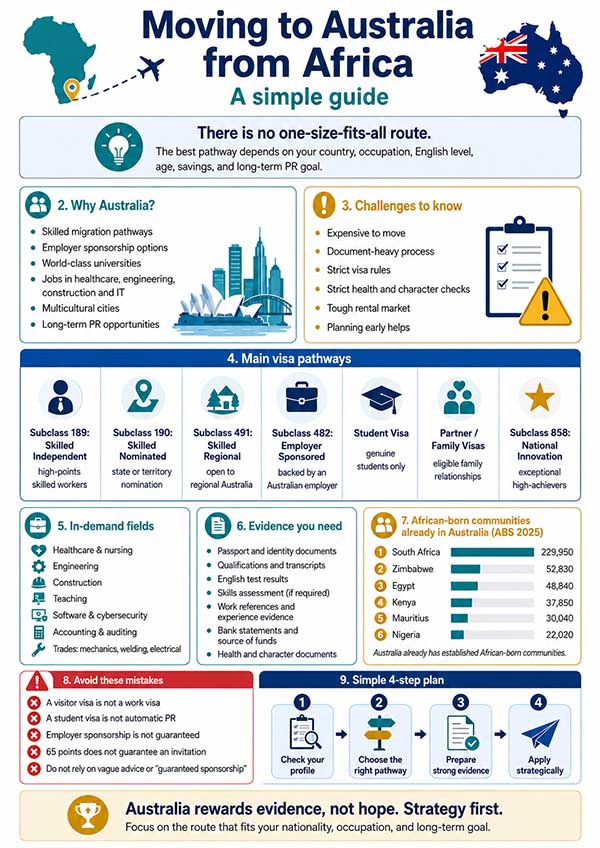
African-Born Communities in Australia
Australia already has large and growing African-born communities.
Using the ABS 2025 country-of-birth data, the largest African-born groups in Australia include:
| Country of birth | Estimated residents in Australia, 2025 |
|---|---|
| South Africa | 229,950 |
| Zimbabwe | 52,830 |
| Egypt | 48,840 |
| Kenya | 37,850 |
| Mauritius | 30,040 |
| Nigeria | 22,020 |
| Sudan | 19,170 |
| Ethiopia | 18,510 |
| Ghana | 10,010 |
| Somalia | 9,890 |
| Democratic Republic of Congo | 9,230 |
| South Sudan | 9,190 |
| Zambia | 9,120 |
| Eritrea | 7,200 |
| Uganda | 5,610 |
| Tanzania | 5,150 |
The big lesson is simple: African migration to Australia is not theoretical. It is already established. The ABS release notes that Australia’s population by country of birth is measured annually and provides downloadable country-level data files for 1996 to 2025.
But your country matters.
South Africans often have strong employer-sponsored and skilled migration routes. Nigerians often need careful student, skilled or sponsorship planning. Zimbabweans may have strong healthcare, teaching, trades and family-network routes. Kenyans often need a clean skilled or student strategy. Ghanaians may lean toward study, nursing, trades, healthcare or sponsorship. Egyptians may have strong pathways in engineering, medicine, IT and professional services.
So do not ask only:
“How do Africans move to Australia?”
Ask:
“What is the strongest Australian visa pathway for my country, occupation, English level, age, savings and long-term PR goal?”
That is the question that matters.
Can African Citizens Move to Australia?
Yes, citizens of African countries can move to Australia, but they need the correct visa.
The best route depends on:
- nationality
- age
- occupation
- qualifications
- English ability
- work experience
- savings
- family situation
- health and character history
- employer sponsorship prospects
- state nomination prospects
- long-term PR goal
The main pathways are:
| Visa pathway | Best for |
|---|---|
| Skilled Independent visa | High-points skilled workers with eligible occupations |
| Skilled Nominated visa | Skilled workers nominated by an Australian state or territory |
| Skilled Regional visa | Skilled workers open to regional Australia |
| Employer sponsored visa | Workers with an Australian employer willing to sponsor them |
| Student visa | Genuine students studying in Australia |
| Partner visa | People in genuine relationships with eligible Australian partners |
| Family visas | Eligible parent, child or other family migration cases |
| National Innovation visa | Exceptional high-achievers in eligible fields |
| Humanitarian visas | People meeting strict protection or humanitarian criteria |
| Visitor visa | Short visits only, not migration |
The biggest mistake is treating every visa as a path to permanent residency.
A visitor visa is not a work visa.
A student visa is not automatic PR.
Employer sponsorship is not guaranteed.
Skilled migration is not just “having a degree.”
And the Working Holiday route is not available to most African passport holders under current arrangements.
Australia rewards evidence.
Not hope.
Another Must-Read: Moving to Australia From Philippines: Visa, Jobs and Cost of Living Guide
Australia PR From Africa: Main Skilled Visa Pathways
For many African migrants, the real goal is Australia PR.
The major skilled routes include subclass 189, subclass 190 and subclass 491. Home Affairs says these visas are points-based and applicants need to meet or exceed the 65-point threshold, but reaching 65 points does not guarantee an invitation. Points can come from age, English, education, work experience and other factors.
That distinction matters.
Many applicants think:
“I have 65 points, so I can migrate.”
That is wrong.
A stronger mindset is:
“I need the best points score I can build, the right occupation, the right skills assessment, the right state strategy and the right evidence.”
For African applicants, skilled migration is especially relevant if you work in:
- healthcare
- nursing
- medicine
- physiotherapy
- engineering
- construction
- teaching
- early childhood education
- software development
- cybersecurity
- data analytics
- accounting
- auditing
- mechanical trades
- automotive trades
- welding
- mining and resources
- project management
Jobs and Skills Australia’s 2025 shortage commentary says shortages remain in key areas, especially health, education and construction, with nearly half of trade roles and two in five professional occupations still in shortage.
That is good news for skilled African applicants.
But you still need the right paperwork.
Skilled Independent Visa Subclass 189
The Skilled Independent visa is one of the most attractive routes because it can allow invited skilled workers to live and work permanently anywhere in Australia.
It does not require employer sponsorship or state nomination.
But it is competitive.
This route may suit African applicants with:
- high points
- strong English
- eligible occupation
- clean skills assessment
- recognised qualifications
- solid work history
- strong evidence
- no weak documentation gaps
It may be relevant for engineers, doctors, nurses, teachers, IT professionals, accountants and other skilled workers — but only if the occupation and points profile are strong enough.
If your points are weak, subclass 189 may not be the best first strategy.
Look at subclass 190, subclass 491 or employer sponsorship instead.
Skilled Nominated Visa Subclass 190
The Skilled Nominated visa can be a stronger route for many African applicants because it involves nomination by an Australian state or territory.
This is where strategy matters.
Do not just ask:
“Is my occupation on the list?”
Ask:
“Which Australian state needs my occupation, and can I meet that state’s nomination rules?”
Different states may favour different occupations at different times.
A nurse, civil engineer, early childhood teacher, motor mechanic, software developer, chef, welder or physiotherapist may have very different chances depending on the state.
For African applicants, subclass 190 is often worth investigating if you have:
- strong occupation fit
- good English
- skills assessment
- work experience
- willingness to live in a particular state
- clear documents
- competitive points
State nomination can turn a weak plan into a realistic one.
But it must be targeted.
Skilled Regional Visa Subclass 491
The subclass 491 regional route can be very important for African migrants.
Regional Australia does not always mean remote. It can include large regional cities, lifestyle centres and areas outside the biggest metropolitan zones.
This pathway may suit people who are open to:
- Adelaide
- Perth
- Canberra
- Hobart
- Darwin
- Gold Coast
- Sunshine Coast
- Newcastle
- Wollongong
- Geelong
- Toowoomba
- Townsville
- Cairns
- regional Victoria
- regional New South Wales
- regional Queensland
- regional Western Australia
- regional South Australia
Regional Australia can be a smart move if your occupation is needed there.
But do not choose a location only because someone online says it is “good for PR.”
Choose it because the full plan works:
- jobs
- rent
- schools
- healthcare
- transport
- community
- visa rules
- long-term career options
A regional strategy can be excellent.
A random regional move can become expensive and lonely.
Employer Sponsored Visa Subclass 482
The Skills in Demand visa subclass 482 allows Australian employers to sponsor skilled workers when they cannot source an appropriately skilled Australian worker.
For African applicants, this can be one of the strongest routes — especially for people who already have serious work experience.
It may suit:
- doctors
- nurses
- physiotherapists
- aged care professionals
- software developers
- cybersecurity specialists
- engineers
- construction managers
- mechanics
- welders
- fitters
- electricians
- chefs
- teachers
- mining and resources workers
But sponsorship is not easy.
An Australian employer usually wants proof that you:
- can do the job
- have the right qualifications
- have relevant experience
- can communicate clearly
- understand Australian workplace expectations
- meet licensing or registration requirements
- can satisfy visa conditions
- are worth the sponsorship effort
Do not trust anyone who says:
“Guaranteed sponsorship.”
Real sponsorship requires a real employer, real job, real salary, real nomination and proper compliance.
If someone asks for money but cannot show the employer and role clearly, slow down.
Student Visa From Africa to Australia
The student route is popular, but it is also one of the most misunderstood.
A student visa is for genuine study.
Home Affairs says the Genuine Student requirement applies to student visa applications lodged on or after 23 March 2024. Applicants must show that studying in Australia is the primary reason for applying.
That means the wrong mindset is:
“I will choose any course just to get into Australia.”
The better mindset is:
“I will choose a course that genuinely fits my education, career history and future employability.”
For African students, stronger course choices may include:
- nursing
- aged care
- disability support
- medicine-related pathways
- physiotherapy
- engineering
- construction management
- ICT
- cybersecurity
- data science
- business analytics
- accounting
- early childhood education
- teaching
- community services
- renewable energy
- trades-related training
Financial capacity also matters. From 10 May 2024, Home Affairs increased the minimum financial capacity requirement for primary student visa applicants to AUD 29,710.
For applicants from many African countries, this is one of the most important parts of the process.
You need to show funds that are:
- genuine
- traceable
- accessible
- consistent with family income
- supported by credible documents
- not unexplained last-minute deposits
Weak financial evidence can damage an application.
Strong financial evidence can save it.
Working Holiday Visa: Can African Citizens Use It?
For most African citizens, the Working Holiday or Work and Holiday route should not be your main plan.
Home Affairs’ current Work and Holiday subclass 462 country cap list includes countries such as Argentina, Brazil, China, India, Indonesia, Malaysia, Türkiye and Vietnam, but no African countries are listed in the current cap table.
That means most African applicants should focus on:
- skilled migration
- employer sponsorship
- student visa
- partner visa
- family visa
- regional skilled pathways
- National Innovation visa
- humanitarian routes if genuinely applicable
Always check the current Home Affairs list before making decisions, because country arrangements can change.
But as a practical strategy, do not build your Australia plan around a Working Holiday visa unless your passport is clearly eligible.
National Innovation Visa
The National Innovation visa subclass 858 is a permanent visa for people with an internationally recognised record of exceptional and outstanding achievement in an eligible area.
This is not a normal skilled-worker visa.
It may suit a very small number of exceptional African applicants, such as:
- internationally recognised researchers
- elite entrepreneurs
- high-impact innovators
- major investors
- global-level athletes
- prominent creatives
- leaders in priority sectors
For most people, skilled migration, sponsorship, student pathways or family migration will be more realistic.
But for the right high-achiever, it is worth knowing this pathway exists.
Country-by-Country Guide
Moving to Australia From South Africa
South Africa is the heavyweight African migration market for Australia.
At the end of June 2024, Home Affairs recorded 224,160 South African-born people living in Australia, making South Africans the seventh-largest migrant community in the country at that time.
South Africa also ranked strongly for employer-sponsored migration. In 2024–25, Home Affairs recorded 2,240 employer-sponsored permanent migrant places from South Africa and 4,137 total permanent migrant places across categories.
That tells you the strategy.
For many South Africans, Australia is not mainly a student story. It is often a skilled-worker, employer-sponsored, trade, healthcare, teaching, engineering and family-settlement story.
Strong pathways may include:
- employer sponsorship
- skilled migration
- state nomination
- regional migration
- partner visa
- student visa for career change
- family migration
Strong job areas for South Africans include:
- motor mechanics
- secondary school teaching
- early childhood teaching
- metal fitting and machining
- welding
- occupational therapy
- accounting
- auditing
- civil engineering
- software development
- nursing
- construction management
Home Affairs’ 2024–25 South Africa occupation table includes motor mechanics, secondary school teachers, metal fitters and machinists, early childhood teachers, occupational therapists, accountants, civil engineering professionals, software programmers and registered nurses.
Best city options for South Africans:
| City | Why it may suit South Africans |
|---|---|
| Perth | Strong South African community, mining, construction, engineering, lifestyle |
| Brisbane | Lifestyle, warmer weather, healthcare, trades, family appeal |
| Sydney | Professional jobs, finance, healthcare, construction, but expensive |
| Melbourne | Education, healthcare, professional services, culture |
| Adelaide | Family-friendly, lower pressure, state nomination possibilities |
| Regional Australia | Useful for trades, healthcare, teaching and visa strategy |
Blunt advice for South Africans: do not underestimate employer sponsorship. If your occupation is strong and your CV is clean, sponsorship can be more realistic than trying to force a student pathway.
Moving to Australia From Nigeria
Nigeria is one of the most important future African migration markets for Australia.
The Nigerian-born community in Australia is much smaller than the South African-born community, but it is significant and growing. ABS 2025 country-of-birth data estimates about 22,020 Nigerian-born residents in Australia.
For Nigerians, the most realistic routes are usually:
- student visa
- skilled migration
- employer sponsorship
- partner visa
- family migration
- regional skilled pathways
- National Innovation visa for exceptional cases
Strong job areas for Nigerian applicants may include:
- software development
- cybersecurity
- data analytics
- engineering
- accounting
- medicine
- nursing
- public health
- project management
- education
- construction management
- business analytics
The main challenge for Nigerian applicants is often not ambition. It is documentation.
Australian visa and job systems care about:
- bank history
- source of funds
- employment references
- payslips
- tax evidence
- course logic
- English results
- genuine student evidence
- skills assessment
- clean identity documents
For Nigerian students, the course choice must make sense. A weak course selection can create visa risk under the Genuine Student requirement.
Good Nigerian strategy:
- choose a course linked to your past and future
- prepare financial evidence early
- avoid unexplained deposits
- improve English scores
- build a professional CV
- target skilled occupations, not vague “any job” plans
- consider regional Australia if your occupation fits
Blunt advice for Nigerians: do not let an agent sell you a course before you understand your long-term pathway. Course first, PR later is dangerous. Strategy first, course second is smarter.
Moving to Australia From Zimbabwe
Zimbabwe has one of the strongest established African-born communities in Australia.
ABS 2025 data estimates about 52,830 Zimbabwe-born residents in Australia, making Zimbabwe one of the largest African source countries by birthplace.
Zimbabweans often have advantages that matter in Australia:
- English-language background
- strong education tradition
- healthcare experience
- teaching experience
- accounting and finance skills
- engineering and technical skills
- family/community networks
- willingness to relocate regionally
Strong pathways may include:
- skilled migration
- employer sponsorship
- regional skilled visas
- partner visa
- student visa
- family migration
Strong job areas for Zimbabweans may include:
- nursing
- aged care
- teaching
- early childhood education
- accounting
- auditing
- engineering
- construction
- mechanics
- trades
- IT
- community services
Healthcare is especially important. But nurses must understand that overseas nursing qualifications do not automatically allow someone to work as a nurse in Australia. The Nursing and Midwifery Board of Australia says internationally qualified nurses and midwives need to complete the Self-check before applying for registration, and applicants are assigned to streams based on qualification assessment criteria.
Best city options for Zimbabweans:
| City | Why it may suit Zimbabweans |
|---|---|
| Perth | South African/Zimbabwean community links, mining, engineering, trades |
| Brisbane | Healthcare, family lifestyle, warmer climate |
| Melbourne | Education, professional services, healthcare |
| Sydney | Large job market, but expensive |
| Adelaide | Skilled and family settlement possibilities |
| Regional Australia | Healthcare, teaching, aged care and trades demand |
Blunt advice for Zimbabweans: if you are in healthcare, start with registration rules before visa dreams. A clean Ahpra or NMBA pathway can change everything.
Moving to Australia From Kenya
Kenya is another strong African migration market, especially for skilled, professional and student applicants.
ABS 2025 data estimates about 37,850 Kenya-born residents in Australia.
Kenya has some useful advantages for Australia migration:
- English is widely used in education and business
- Nairobi is a regional professional hub
- many applicants have strong education backgrounds
- healthcare, ICT, engineering and education skills can align well
- Kenyan professionals often adapt well to international work environments
Strong pathways may include:
- student visa
- skilled migration
- employer sponsorship
- state nomination
- regional skilled migration
- partner visa
- family migration
Strong job areas for Kenyan applicants may include:
- nursing
- medicine
- public health
- software development
- cybersecurity
- civil engineering
- mechanical engineering
- accounting
- education
- early childhood teaching
- community services
- project management
For Kenyan professionals, the key is converting local experience into Australian-readable evidence.
That means:
- clear job titles
- detailed reference letters
- payslips
- tax records
- degree certificates
- transcripts
- professional registration evidence
- English test scores if needed
- Australian-style CV
Best city options for Kenyans:
| City | Why it may suit Kenyans |
|---|---|
| Melbourne | Education, healthcare, professional roles |
| Sydney | IT, finance, healthcare, big-city opportunity |
| Brisbane | Healthcare, infrastructure, lifestyle |
| Perth | Engineering, resources, construction |
| Adelaide | Lower pressure, family appeal, state strategy |
| Regional Australia | Healthcare, education and skilled migration options |
Blunt advice for Kenyans: do not send a generic CV to Australian employers. Translate your experience into clear outcomes, tools, projects and measurable results.
Moving to Australia From Ghana
Ghana is a smaller but high-potential Australia migration market.
ABS 2025 data estimates about 10,010 Ghana-born residents in Australia.
For Ghanaians, the strongest routes are usually:
- student visa
- skilled migration
- employer sponsorship
- partner visa
- family migration
- regional skilled routes
Strong job areas may include:
- nursing
- aged care
- community services
- engineering
- construction
- mining and resources
- accounting
- IT
- education
- hospitality
- chefs
- trades
Ghanaian applicants should pay special attention to:
- financial documents
- source of funds
- employment evidence
- English testing
- course logic
- skills assessment
- professional registration
- avoiding weak migration-agent advice
If using the student pathway, choose courses that genuinely match your background and future.
Good course directions may include:
- nursing
- aged care
- disability support
- early childhood education
- community services
- engineering
- construction management
- ICT
- cybersecurity
- business analytics
- accounting
Blunt advice for Ghanaians: Australia is not cheap enough for guesswork. Make the course, visa and job pathway connect before spending serious money.
Moving to Australia From Egypt
Egypt is one of the largest North African-born communities in Australia.
ABS 2025 data estimates about 48,840 Egypt-born residents in Australia.
Egyptian applicants may have strong pathways in:
- engineering
- medicine
- dentistry
- pharmacy
- IT
- software development
- accounting
- architecture
- construction management
- academia
- research
- business
- family migration
For Egyptian doctors, dentists, pharmacists and other health professionals, registration is the first serious issue. The Medical Board of Australia says there are different registration pathways for international medical graduates, each with different eligibility requirements.
Strong pathways for Egyptians may include:
- skilled migration
- employer sponsorship
- student visa
- National Innovation visa for exceptional researchers or entrepreneurs
- partner visa
- family migration
Best city options for Egyptians:
| City | Why it may suit Egyptians |
|---|---|
| Sydney | Large professional market, healthcare, finance, family networks |
| Melbourne | Education, research, healthcare, professional services |
| Brisbane | Health, construction, infrastructure, lifestyle |
| Perth | Engineering, resources, construction |
| Adelaide | Family-friendly, state nomination possibilities |
| Canberra | Policy, research, technology, professional roles |
Blunt advice for Egyptians: if you are a doctor, engineer or IT professional, do not undersell yourself — but get your registration, skills assessment or credential pathway right before applying widely.
Moving to Australia From Ethiopia
Ethiopia has a meaningful and established community in Australia.
ABS 2025 data estimates about 18,510 Ethiopia-born residents in Australia.
Ethiopian migration to Australia can involve different routes depending on the person’s circumstances:
- skilled migration
- student visa
- employer sponsorship
- partner visa
- family migration
- humanitarian routes where genuinely applicable
- regional settlement pathways
Strong job areas may include:
- healthcare
- aged care
- disability support
- community services
- logistics
- education
- IT
- accounting
- hospitality
- trades
- public health
Ethiopian applicants should focus heavily on documentation.
Prepare:
- identity documents
- education records
- employment references
- police certificates
- medical records
- English evidence
- financial evidence
- family documents
- translations where needed
Best city options for Ethiopians:
| City | Why it may suit Ethiopians |
|---|---|
| Melbourne | Large multicultural communities, education, healthcare |
| Sydney | Broad job market, community networks |
| Brisbane | Healthcare, aged care, lifestyle |
| Perth | Resources, services, family opportunities |
| Adelaide | Lower pressure, settlement potential |
| Regional Australia | Healthcare, community services, aged care |
Blunt advice for Ethiopians: choose the pathway that matches your evidence. A strong family, student or skilled file beats a vague application every time.
Moving to Australia From Mauritius
Mauritius is a smaller country, but the Mauritian-born community in Australia is significant.
ABS 2025 data estimates about 30,040 Mauritius-born residents in Australia.
Mauritian applicants may have advantages such as:
- English and French language exposure
- professional services background
- hospitality experience
- finance and accounting skills
- healthcare and education pathways
- cultural adaptability
Strong pathways may include:
- skilled migration
- employer sponsorship
- student visa
- partner visa
- family migration
- regional skilled pathways
Strong job areas may include:
- accounting
- finance
- hospitality management
- chefs
- healthcare
- aged care
- education
- IT
- business services
- construction administration
- tourism-related roles
Best city options for Mauritians:
| City | Why it may suit Mauritians |
|---|---|
| Melbourne | Professional services, education, healthcare |
| Perth | Resources, hospitality, community links |
| Sydney | Finance, professional jobs, hospitality |
| Brisbane | Lifestyle, hospitality, healthcare |
| Adelaide | Family-friendly, lower pressure |
| Regional Australia | Hospitality, care and skilled pathways |
Blunt advice for Mauritians: use your language and service-sector adaptability, but do not rely on personality alone. Australian employers want evidence, licences and clear work rights.
Sudan, South Sudan, Somalia, Eritrea and DRC
Some African migration stories involve more complex family, protection, humanitarian or community settlement histories.
ABS 2025 data estimates sizable communities from Sudan, Ethiopia, Somalia, Democratic Republic of Congo, South Sudan and Eritrea.
For applicants from these backgrounds, pathways may include:
- family migration
- partner visas
- humanitarian routes where genuinely applicable
- student visas
- skilled migration
- employer sponsorship
- community services
- healthcare and aged care work
- regional settlement
This is an area where generic online advice can be dangerous.
If your case involves protection claims, complex family history, identity documentation issues, previous refusals, character concerns or humanitarian circumstances, get proper advice from a registered migration agent or immigration lawyer.
Blunt advice: do not treat humanitarian migration like ordinary skilled migration. The rules, evidence and risks are different.
Best Jobs in Australia for African Migrants
The best job is not the one that sounds impressive.
It is the one that matches:
- your visa
- your skills
- your evidence
- Australian demand
- registration or licensing
- employer willingness
- your city or regional plan
Strong job areas include:
Healthcare
Healthcare is one of the strongest areas for African migrants.
Relevant roles may include:
- registered nurse
- enrolled nurse
- aged care worker
- disability support worker
- physiotherapist
- occupational therapist
- general practitioner
- resident medical officer
- public health professional
- mental health worker
- community services worker
But registration matters.
Internationally qualified nurses and midwives must complete the NMBA Self-check before applying for registration, and doctors need to follow the Medical Board’s IMG pathways.
Engineering and Construction
Strong areas include:
- civil engineering
- mechanical engineering
- electrical engineering
- structural engineering
- construction management
- quantity surveying
- drafting
- building supervision
- welding
- metal fitting
- plumbing
- electrical trades
- carpentry
Construction and trades remain important because Jobs and Skills Australia continues to identify shortages in health, education and construction-related areas.
IT and Digital
Strong areas include:
- software development
- cybersecurity
- data analytics
- cloud engineering
- ICT business analysis
- systems administration
- DevOps
- AI and automation
- product management
For African IT applicants, the challenge is often not talent. It is proof.
You need portfolios, project descriptions, GitHub where useful, certifications, references and clear explanations of what you built.
Accounting and Professional Services
Strong areas include:
- accounting
- auditing
- finance
- business analysis
- risk and compliance
- management consulting
- project coordination
- payroll
- tax support
But Australian employers may want local accounting standards, software experience and Australian-style communication.
Teaching and Early Childhood
Education can be strong, especially for:
- secondary teachers
- early childhood teachers
- special education teachers
- childcare workers
- school support roles
Teacher registration varies by state and territory, so do not assume overseas teaching qualifications transfer automatically.
Hospitality and Regional Work
Hospitality can be useful, especially for:
- chefs
- cooks
- hotel managers
- restaurant managers
- aged care kitchen staff
- tourism workers
- regional hospitality roles
But hospitality alone is not always a safe long-term PR plan unless the occupation, employer and visa pathway line up.
Best Australian Cities for African Migrants
There is no single best city.
There is only the best city for your job, visa, money and family.
Sydney
Sydney is best for:
- finance
- IT
- healthcare
- construction
- professional services
- universities
- large migrant communities
But Sydney is expensive and rental competition is fierce.
Choose Sydney if you have a job offer, high-income potential, family support or a very strong plan.
Melbourne
Melbourne is best for:
- education
- healthcare
- IT
- professional services
- multicultural communities
- students
- families
It can suit African migrants who want a large city with strong community diversity and broad job options.
Brisbane
Brisbane is best for:
- healthcare
- construction
- infrastructure
- family lifestyle
- warmer weather
- growing professional opportunities
But Brisbane is no longer cheap. Rents have risen sharply.
Perth
Perth is excellent for:
- South Africans
- Zimbabweans
- mining
- resources
- engineering
- construction
- trades
- healthcare
- family lifestyle
Perth can be one of the strongest city choices for African migrants with technical or trade backgrounds.
Adelaide
Adelaide suits:
- families
- students
- healthcare workers
- skilled migrants
- people seeking lower pressure than Sydney or Melbourne
The job market is smaller, so check your occupation before choosing it.
Canberra
Canberra suits:
- IT
- cybersecurity
- policy
- healthcare
- education
- professional services
- public-sector-adjacent work
It is clean and highly liveable, but not always cheap.
Regional Australia
Regional Australia can suit:
- nurses
- aged care workers
- teachers
- tradespeople
- engineers
- hospitality workers
- doctors
- community service workers
Regional can be a smart visa strategy, but only if the job and lifestyle are real.
Do not move blindly.
Cost of Living in Australia for African Migrants
Australia is expensive.
In the 12 months to March 2026, Australia’s Consumer Price Index rose 4.6%, with the largest contributors being housing, transport and food and non-alcoholic beverages.
The biggest cost shocks for African migrants are usually:
- rent
- rental bond
- temporary accommodation
- groceries
- transport
- car costs
- childcare
- health insurance
- tuition fees
- phone and internet
- furniture
- licensing and registration
- skills assessments
- English tests
- document translations
- emergency savings
Do not compare Australian costs directly to home-country prices.
The numbers will feel frightening.
The equation improves once you earn Australian wages, but the dangerous period is before stable income begins.
Rent in Australia
Australia’s rental market is tight.
Domain’s March 2026 Rental Report says national vacancy rates fell to a record low of 0.7%, showing how constrained rental supply remains.
Median weekly rents in March 2026 were:
| City | Houses | Units |
|---|---|---|
| Sydney | $800 | $750 |
| Melbourne | $590 | $600 |
| Brisbane | $680 | $660 |
| Adelaide | $640 | $550 |
| Canberra | $700 | $580 |
| Perth | $740 | $695 |
| Hobart | $620 | $500 |
| Darwin | $720 | $600 |
Domain reported Sydney house rents at $800 per week, Melbourne houses at $590, Brisbane houses at $680, Adelaide houses at $640, Canberra houses at $700, Perth houses at $740, Hobart houses at $620 and Darwin houses at $720 in the March 2026 quarter.
Before applying for rentals, prepare:
- passport
- visa grant letter
- employment contract if available
- payslips if available
- bank statements
- proof of savings
- rental references
- character references
- Australian phone number
- rental cover letter
- short-term accommodation booking
Do not arrive expecting to secure the perfect rental in week one.
Book temporary accommodation first.
How Much Money Should You Bring?
There is no single amount, but bring more than you think.
As a practical relocation buffer:
| Situation | Suggested savings buffer |
|---|---|
| Single person with job offer | $12,000–$25,000 |
| Single person without job offer | $25,000–$40,000 |
| Couple with one job offer | $35,000–$55,000 |
| Family with children | $60,000–$100,000+ |
| Student | Tuition + health cover + rent setup + several months living costs |
These are not government rules.
They are survival numbers.
Your first costs may include:
- flights
- visa fees
- medical checks
- police certificates
- skills assessment
- English test
- document translations
- temporary accommodation
- rental bond
- first rent payment
- furniture
- transport
- health insurance
- tuition fees
- emergency fund
The dangerous plan is:
“I will land and figure it out.”
The better plan is:
“I can survive for several months even if the first job takes longer than expected.”
That mindset protects you.
Healthcare for African Citizens in Australia
Healthcare depends on your visa status.
Services Australia says people can enrol in Medicare if they live in Australia and are an Australian citizen, New Zealand citizen, Australian permanent resident, applying for permanent residency, or a temporary resident covered by a ministerial order.
Most African countries are not covered by Australia’s Reciprocal Health Care Agreements. Services Australia says Australia has reciprocal agreements with 11 countries, and the listed agreement countries do not include African countries.
That means many African temporary visa holders need private health cover.
Depending on your visa, you may need:
- Overseas Student Health Cover
- Overseas Visitor Health Cover
- employer-arranged health cover
- private health insurance
- Medicare after permanent residency eligibility
Do not assume you can use Medicare just because you are living in Australia.
Check your exact visa conditions.
Wages and Work Rights in Australia
Australia has strong workplace laws.
From 1 July 2025, the National Minimum Wage is $24.95 per hour or $948 per week for employees not covered by an award or enterprise agreement.
African migrants should understand:
- visa work rights
- minimum wage
- award rates
- casual loading
- penalty rates
- payslips
- superannuation
- tax file number
- workplace safety
- employer sponsorship obligations
- underpayment risks
Do not accept illegal underpayment just because you are new.
You have workplace rights in Australia.
If you work in Australia, you usually need a Tax File Number. The ATO says permanent migrants and temporary visitors in Australia with a work-rights visa can apply for a TFN online.
Documents African Applicants Should Prepare
Prepare documents early.
You may need:
- passport
- birth certificate
- marriage certificate
- divorce documents if relevant
- children’s birth certificates
- police certificates
- medical records
- vaccination records
- degree certificates
- academic transcripts
- employment reference letters
- payslips
- tax records
- bank statements
- professional licences
- skills assessment documents
- English test results
- rental references
- family documents
- certified translations
- digital copies of everything
For African applicants, documentation is often the make-or-break issue.
Australian systems dislike:
- inconsistent names
- missing dates
- vague job letters
- unexplained bank deposits
- weak sponsor evidence
- mismatched qualifications
- unclear employment history
- poor translations
- missing police records
Clean documents create confidence.
Messy documents create delays.
Australian-Style CV Tips for African Applicants
Australian CVs are direct.
Avoid vague claims.
Weak:
Worked as engineer.
Better:
Civil engineer with five years’ experience delivering road, drainage and commercial building projects, including contractor coordination, site inspections, BOQ review and progress reporting.
Weak:
Nurse in hospital.
Better:
Registered nurse with experience in acute medical wards, medication administration, wound care, patient monitoring, infection control and multidisciplinary handovers.
Weak:
IT professional.
Better:
Software developer experienced in Python, React and PostgreSQL, building internal workflow tools and customer-facing applications for financial services clients.
Show:
- job title
- employer
- dates
- duties
- achievements
- tools/software
- licences
- registration
- certifications
- visa status
- references available
Make it easy for an Australian employer to understand your value quickly.
Step-by-Step Checklist for Moving to Australia From Africa
12 Months Before Moving
- identify your visa pathway
- check your occupation eligibility
- calculate your points
- research skills assessment
- improve English if needed
- gather documents
- start saving aggressively
- compare cities
- research rent
- check registration or licensing
- research job demand
- avoid weak migration advice
6 Months Before Moving
- prepare visa documents
- complete English tests if needed
- begin skills assessment
- prepare Australian-style CV
- contact recruiters
- research rentals
- gather financial evidence
- shortlist cities and suburbs
- check health insurance
- scan all documents
3 Months Before Moving
- book flights only when visa status allows
- arrange temporary accommodation
- prepare rental documents
- organise health cover
- research bank accounts
- plan money transfer
- prepare job applications
- sell or store possessions
- prepare family emotionally
- set first-month budget
First Month in Australia
- get Australian SIM card
- activate bank account
- apply for TFN
- confirm health insurance
- enrol in Medicare if eligible
- inspect rentals
- apply for jobs
- join community and professional groups
- learn public transport
- avoid unnecessary spending
- build local references
Biggest Mistakes African Migrants Make
1. Choosing a Course Only for PR
A course must make sense for your education, work history and future employability.
2. Underestimating Money
Australia is expensive. Weak savings create panic.
3. Trusting “Guaranteed Sponsorship”
Real sponsorship requires a real employer, real job and proper nomination.
4. Ignoring Registration
Doctors, nurses, teachers, electricians and many other professionals may need registration or licensing.
5. Assuming 65 Points Is Enough
It is only the minimum threshold, not a guarantee.
6. Using a Weak CV
Australian employers want clear evidence, not vague duties.
7. Choosing Sydney Automatically
Sydney is powerful, but expensive. Perth, Brisbane, Adelaide, Canberra and regional Australia may fit better.
8. Ignoring Regional Australia
Regional routes can be strong if your occupation and lifestyle match.
9. Submitting Messy Documents
Inconsistent documents can damage a strong case.
10. Moving Without a Job Strategy
Do not wait until arrival to understand the Australian job market.
Is Moving to Australia From Africa Worth It?
For the right person, yes.
Australia can be a life-changing destination for African migrants.
It can offer:
- higher wages
- skilled migration pathways
- employer sponsorship
- excellent education
- healthcare jobs
- engineering and construction demand
- IT opportunities
- family stability
- multicultural cities
- permanent residency possibilities
- long-term safety and lifestyle
But it is not easy.
You need documents.
You need money.
You need English.
You need patience.
You need a real visa pathway.
You need a job strategy.
You need emotional resilience.
Moving to Australia from Africa works best when you are not simply trying to leave.
It works best when you are moving towards something clear:
A stronger career.
A safer family future.
A better education.
A serious PR pathway.
A higher-quality life.
A new home built carefully and legally.
Australia can reward African migrants very well.
But only if you respect the process.
FAQ
Can African citizens move to Australia permanently?
Yes. African citizens can move permanently through skilled migration, state nomination, regional skilled visas, employer sponsorship, partner visas, family visas and other eligible pathways. The right option depends on occupation, age, English, qualifications, work experience, family situation and evidence.
What is the best visa for Africans moving to Australia?
There is no single best visa. Skilled workers may consider subclass 189, 190, 491 or employer sponsored subclass 482. Students may consider subclass 500. People with eligible Australian partners may consider partner visas. Exceptional applicants may consider the National Innovation visa.
Is Australia PR easy for African applicants?
No. Australia PR is possible but competitive. Points, occupation demand, English scores, skills assessment, state nomination, employer sponsorship, health, character and documentation all matter. Home Affairs says 65 points is the threshold for points-tested skilled visas, but meeting the threshold does not guarantee an invitation.
Which African country has the largest community in Australia?
South Africa has the largest African-born community in Australia. ABS 2025 data estimates about 229,950 South African-born residents, while Home Affairs recorded 224,160 South African-born residents at the end of June 2024.
Can Nigerians move to Australia?
Yes. Nigerians can move through skilled migration, student visas, employer sponsorship, partner visas, family visas and other eligible pathways. Nigerian applicants should pay particular attention to financial evidence, course logic, employment documents and skills assessment.
Can South Africans move to Australia?
Yes. South Africans have strong pathways through employer sponsorship, skilled migration, state nomination, regional migration, partner visas and family migration. Home Affairs data shows South Africa ranked strongly for employer-sponsored migration in 2024–25.
Can Zimbabweans move to Australia?
Yes. Zimbabweans can move through skilled migration, employer sponsorship, student visas, partner visas, family visas and regional skilled pathways. Nursing, healthcare, teaching, accounting, engineering and trades can be strong areas, but registration and documentation matter.
Can Kenyans move to Australia?
Yes. Kenyans can move through student visas, skilled migration, employer sponsorship, state nomination, regional skilled visas, partner visas and family routes. Strong sectors may include healthcare, IT, engineering, education and professional services.
Do African citizens get Medicare in Australia?
Many African temporary visa holders are not automatically eligible for Medicare. Medicare eligibility depends on citizenship, permanent residency, permanent residency application status, New Zealand citizenship or coverage by a ministerial order.
Are African countries covered by Australia’s Reciprocal Health Care Agreements?
Generally, no. Services Australia says Australia has reciprocal agreements with 11 countries, and African countries are not included in the listed agreements.
How much money do I need to move to Australia from Africa?
It depends on your visa, city, family size and job situation. A single person without a job should think in terms of several months of living costs. Families need much more because rent, childcare, health insurance, furniture, transport and school costs add up quickly.
People Also Love: Moving to Australia: What It Means to Be Australian