



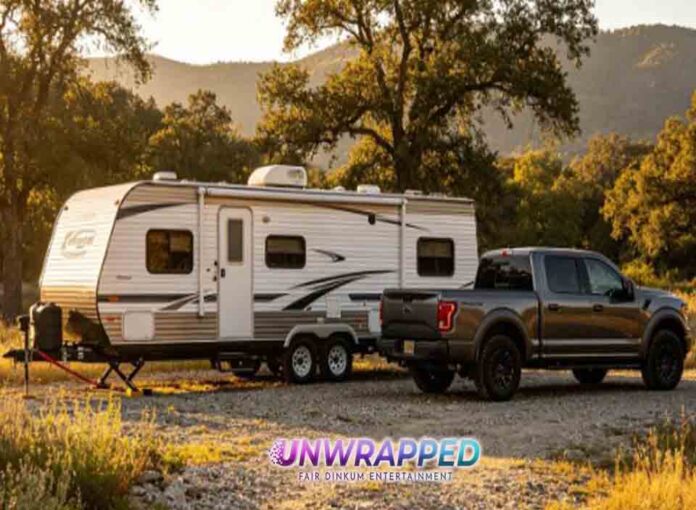
With the evolution of socioeconomic development, lifestyles and recreational patterns have undergone profound transformations. Caravans and RVs, emerging as novel vehicles for living and leisure, have gradually become visible across Australia and globally. If you’ve ever seen “scissor stabilisers” fitted to a caravan and a “scissor jack” in the boot of a sedan, you might have thought: “Aren’t they just the same scaffold frame?” One claims it can support two to three tonnes, while the other lifts cars with ease. Couldn’t they be twins? That assumption falls into a trap set by their names. While commonly called “stabiliser jacks,” stabilisers are not, technically, jacks. Their similarity lies only in the scissor-arm appearance; their distinct functions determine crucial differences that directly impact your safety on rough ground or during a tyre change.
One for Bracing, One for Lifting
Think of stabiliser jacks like a sumo wrestler bracing firmly—their sole purpose is to remain immovable under sustained pressure. Permanently mounted at the four corners of a caravan chassis, they extend to the ground when the van is uncoupled from the tow vehicle. Their job is purely to absorb kinetic energy from movement inside the van or wind buffeting, transforming a potentially wobbly structure into a stable, static platform. They don’t lift; they brace and hold.
Conversely, a vehicle scissor jack is like a sprinter. Its mission is characterised by burst power and temporary action. Dormant in the boot, it deploys rapidly during a flat tyre, lifting a multi-tonne car corner quickly and with minimal effort. Once the tyre’s replaced, it folds away again. Crucially, it wasn’t designed for prolonged, static bracing, and especially not for counteracting continual lateral oscillation.
The Secret Lies in the Screw Thread
The fundamental difference driving their specific tasks is in the lead screw that expands the scissor arms. Their definitions of “efficiency” are opposites.
- Stabiliser Jack Screw: Features fine, closely-spaced threads, like those in a precision watch. Turning the handle many times results in very slow movement. This small pitch design delivers critical self-locking capability. No amount of static load pressure or vibration can cause the screw to back-drive reversely. This self-locking rigidity enables extended static support. The trade-off? Extreme inefficiency for lifting. Trying to raise a van would require immense, impractical effort – their structure simply isn’t geared for rapid power transfer.
- Scissor Jack Screw: Employs coarse, widely-spaced threads. One turn delivers noticeable height change. This is part of a clever compound mechanical advantage system (lever and inclined plane) that amplifies your input force significantly to lift heavy loads. While it offers decent (albeit lesser) self-locking (often aided by ratchets for safety), its core strength is efficient lifting. Using it as a primary stabiliser at a campsite is a serious error. The van’s persistent slight movements, over hours, act like water dripping on stone, steadily overcoming friction in the threads, compromising the self-lock and leading to gradual, insupportable failure.
One Measures “Static Support”, The Other “Lifting Capacity”
Comparing the labelled numbers can be deceptive. A stabiliser might show “4500kg,” while a jack might be rated “1.5 tonnes.” The higher stabiliser number implies greater strength? This is incorrect.
- Stabiliser Capacity: Refers to Static Support. This means the device can continuously bear a static load without breaking or permanently deforming. It’s a test of enduring compressive strength.
- Jack Capacity: Refers to Dynamic Lifting. This is far more demanding—the jack must safely withstand the specified weight throughout the dynamic lifting process (including movement, friction, and applied force). It tests strength against complex stresses while in motion. A sturdy hardwood table might hold up an old CRT television for decades, but it couldn’t lift that TV smoothly off the ground. The table supports; the crane lifts. These are fundamentally different demands.
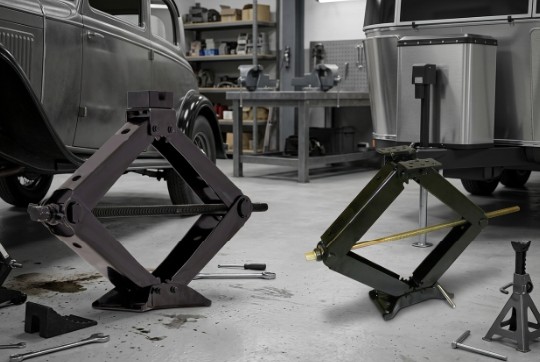
One Fears Side Loads (“Buckling”), The Other Must Avoid Shear Forces
Looking beyond the screw thread to the overall steel structure reveals further design divergence focused entirely on their distinct roles.
- Stabiliser Jacks: Designed for uneven ground, requiring long travel. When extended and loaded, their core threat isn’t collapsing vertically, but buckling failure (like pushing down on a long ruler causing it to snap sideways). Their structure specifically reinforces against lateral forces caused by van sway. Stabilisers are fundamentally engineered to resist horizontal movement.
Scissor Jacks: Designed to be short, stout, and compact. Their force paths are optimised exclusively for purely vertical compression. The joints and pins were not designed to handle significant horizontal shear force. Consider the critical danger of using a scissor jack as a stabiliser: aside from self-lock failure, the van’s natural sway applies persistent lateral loads. This side-loading, acting on a structure designed only for vertical lifting, can easily distort the arms, bend the screw, or cause a sudden, catastrophic collapse. It is highly vulnerable to sideways forces.

Spot the Difference: 5 Telltale Signs to Instantly Identify
Distinguishing caravan stabilisers from vehicle scissor jacks at a glance is easier than you think. These five key design differences broadcast their distinct roles clearly:
- Overall Profile & Height:
Stabiliser Jacks: Built for extended vertical travel, they stand tall and slender when fully deployed, resembling a “stilt-walker” reaching down to uneven ground. This long reach is essential for adapting to typical campsite surfaces.
Scissor Jacks: Designed for portability and compact storage, they are shorter and more compact. Even when fully extended, they appear relatively squat and stout, like a powerlifter coiled for a vertical push. They fold down extremely small for boot storage.
- The Central Screw Thread (The Heart of the Matter):
Stabiliser Jacks: Feature extremely fine, close-set threads. Visible as nearly continuous, fine silver lines. This specific design maximises self-locking capability against settling or vibration under sustained load. (Look: Fine Lines)
Scissor Jacks: Equipped with coarse, widely-spaced threads. The individual deep grooves are clearly visible, resembling miniature mountain tracks. This configuration optimises efficient power transfer for rapid lifting with minimal effort. (Look: Deep Grooves)
- Lifting/Support Pad (Top Contact Point):
Stabiliser Jacks: Topped with a large, flat, solid metal plate – sometimes featuring bolt mount holes. Simple, broad, and stable – designed to distribute load over a wide chassis point during prolonged bracing. (Look: Broad Plate)
Scissor Jacks: Fitted with a distinctive “saddle”, notch, or u-shaped pad. This positive locking feature is engineered to precisely engage specific vehicle lift points (like pinch welds or axle tubes) and prevent slippage during lifting. (Look: Saddle Notch)
- Base Plate/Foot (Ground Contact):
Stabiliser Jacks: Utilises a large, substantial, often flat base plate. Base plates might feature holes for ground pegs. Designed for long-term stability and resistance to horizontal shifting on potentially softer ground. (Look: Substantial Base)
Scissor Jacks: Features a relatively small or narrow base plate, sometimes merely a bent end of the scissor arm. Its role is purely temporary support on hard, level surfaces. It lacks features for long-term securement. (Look: Small Footprint)
- Mounting Features (Permanent vs. Temporary):
Stabiliser Jacks: Typically show evidence of bolt holes, welding points, or permanently attached mounting brackets. They are typically fitted semi-permanently to a caravan’s chassis. You’ll often see the related chassis attachment hardware. (Look: Mounting Hardware)
Scissor Jacks: Designed as a freestanding, fully portable unit. They lack any permanent mounting features like welded brackets or dedicated bolt holes. They are stowed entirely in a boot or storage bin when not in use. (Look: No Mount Points)
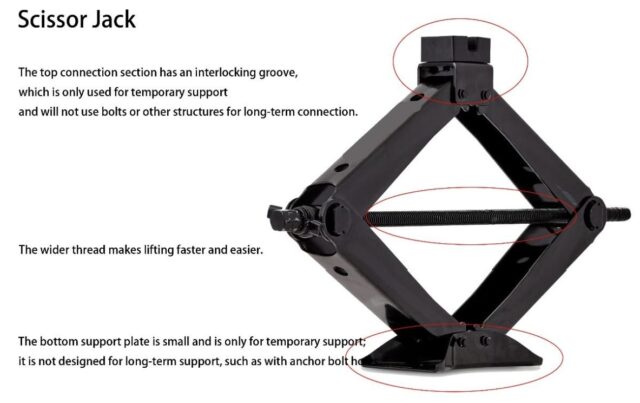
By consciously scanning for these five observable differences – Profile, Thread Pitch, Top Pad Style, Base Design, and Mounting Hints – you can instantly determine any scissor-type device’s true purpose: resilient, static stabilisation or rapid, vertical lifting. It’s crucial engineering information, written plainly on the hardware itself.
Mixing Them Up is a Violation of Safety and Physics
Confusing these tools isn’t just about tool damage; the consequences are severe.
- Using a Scissor Jack as a Stabiliser: Its typically narrow base plate and smooth lifting pad aren’t designed to grip chassis or ground securely. Under the van’s constant slight rocking, it may shift progressively (“walk”), leading to misalignment or buckling failure. If that “stabiliser” (the jack) is then used to lift the van for a tyre change, removing it from one corner while the van is supported elsewhere can cause catastrophic instability. The van could lurch violently, potentially collapsing other stabilisers, leading to a total drop. People underneath or nearby could suffer severe injury, or death.
- Using a Stabiliser Jack for Lifting: Its flat lifting pad lacks the specific contours or recesses found on jacks, making it prone to slipping off vehicle lift points. Moreover, the inefficiency of its fine threads during lifting is dangerous – it demands excessive force for minimal gain, creating unstable, hazardous lifting conditions.
Stabiliser jacks and vehicle scissor jacks are near-cousins whose functional paths diverged sharply. Their names – stabiliser versus jack – declare their essential duty. Understanding the critical boundary between static bracing and dynamic lifting, and resisting the temptation to mix roles based on mere appearance, is fundamental both to respecting each tool’s purpose and to ensuring the deepest safety for yourself and others. Next time you see those familiar steel arms, look closely at their thread pitch and frame stance; you’ll be reading the true story of strength versus stability.

Goodin: Leading Manufacturer in Trailer Parts
Goodin is a leading Chinese manufacturer of trailer and truck parts, operating a vertically integrated 3,000m² manufacturing facility in China. With 300 skilled workers, we produce over 3 million units annually for global markets including Australia, the USA, Japan and Europe.
Our quality assurance integrates smoke test chambers, tensile testers, lifespan simulators and automated welding, backed by registered trademarks across Australia, the UK and EU. Leveraging full-spectrum capabilities—stamping, laser cutting, CNC machining, robotic welding, hot-dip galvanising and anodising—we deliver tailored OEM/ODM solutions. We combine competitive pricing, reliable door-to-door delivery and custom packaging to maximise customer value. Partner with Goodin for engineered reliability.