




For generations, moving to Australia from Ireland, has been the big Irish reset.
A year in Sydney.
A construction job in Perth.
Nursing shifts in Melbourne.
A summer in Brisbane that quietly turns into five years.
A Working Holiday visa that becomes sponsorship, then permanent residency, then a life.
But this is not just an old emigration story anymore. It is happening again.
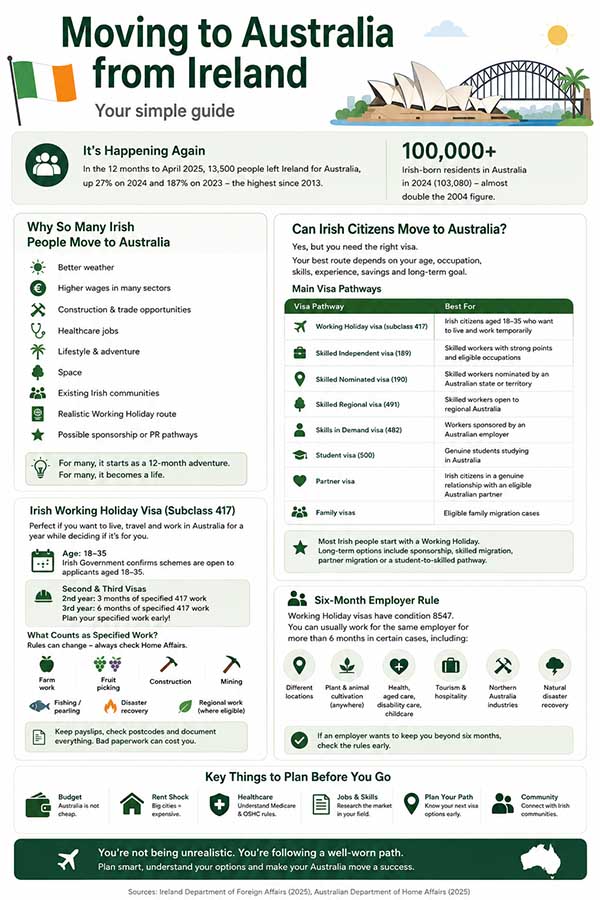
In the 12 months to April 2025, 13,500 people left Ireland to go to Australia, up 27% on 2024 and 187% on 2023. That was the highest level of emigration from Ireland to Australia since 2013.
Australia is also now home to more than 100,000 Irish-born residents, with Ireland’s official international site reporting that the Irish-born population in Australia reached 103,080 in 2024, almost double the 2004 figure.
So if you are thinking about moving to Australia from Ireland, you are not being unrealistic.
You are following a well-worn path.
But here is the honest part: Australia can be brilliant, but it is not cheap, not effortless and not automatically permanent. The people who do best are the ones who understand the visa route, the job market, the rent shock, the healthcare rules and the long-term plan before they book the flight.
This guide breaks it all down.
Why Are So Many Irish People Moving to Australia?
The reasons are familiar, but stronger than ever:
- better weather
- higher wages in many sectors
- construction and trade opportunities
- healthcare jobs
- lifestyle
- adventure
- space
- existing Irish communities
- a realistic Working Holiday route
- possible sponsorship or PR pathways
Ireland’s own migration data shows the Australia move has surged again, with 13,500 people leaving Ireland for Australia in the year to April 2025.
For many Irish movers, Australia starts as a 12-month adventure.
But it often becomes more serious.
You get local experience.
You make friends.
You find a better-paid role.
You meet someone.
You get sponsored.
You stop saying “I’m just here for a year.”
That is the Australia trap — in the best and worst way.
Can Irish Citizens Move to Australia?
Yes, Irish citizens can move to Australia, but they need the correct visa.
Your best route depends on your:
- age
- occupation
- savings
- qualifications
- work experience
- family situation
- employer sponsorship options
- long-term PR goal
The main visa routes for Irish citizens are:
| Visa pathway | Best for |
|---|---|
| Working Holiday visa subclass 417 | Irish citizens aged 18–35 who want to live and work temporarily |
| Skilled Independent visa subclass 189 | Skilled workers with strong points and eligible occupations |
| Skilled Nominated visa subclass 190 | Skilled workers nominated by an Australian state or territory |
| Skilled Regional visa subclass 491 | Skilled workers open to regional Australia |
| Skills in Demand visa subclass 482 | Workers sponsored by an Australian employer |
| Student visa subclass 500 | Genuine students studying in Australia |
| Partner visa | Irish citizens in a genuine relationship with an eligible Australian partner |
| Family visas | Eligible family migration cases |
For most Irish people, the easiest entry point is the Working Holiday visa.
For long-term migration, the serious routes are usually employer sponsorship, skilled migration, partner migration, or a student-to-skilled pathway.
Irish Working Holiday Visa for Australia
This is the big one.
Ireland and Australia have a reciprocal working holiday arrangement, and the Irish Government says the schemes are open to applicants aged 18–35. Irish citizens applying for Australia use the Working Holiday visa subclass 417.
The Working Holiday visa is ideal if you want to:
- live in Australia for a year
- work while travelling
- try Sydney, Melbourne, Brisbane, Perth or regional Australia
- build local experience
- decide whether Australia is actually for you
- potentially move into sponsorship later
But there is one crucial thing Irish applicants need to understand.
Irish citizens are not treated the same as UK passport holders for second and third Working Holiday visas. For a second Working Holiday visa, Home Affairs says applicants must complete 3 months of specified subclass 417 work. For a third Working Holiday visa, the requirement is 6 months of specified subclass 417 work.
That means if you arrive from Ireland thinking you may want a second or third year, plan your specified work early.
Do not leave it until the final few months.
What Counts as Specified Work?
Specified work rules can change, so always check Home Affairs before relying on a job.
But in broad terms, specified work usually includes certain paid work in approved industries and locations, such as agriculture, construction, mining, fishing, pearling, tree farming, natural disaster recovery and other eligible sectors.
For Irish workers, the practical options are often:
- farm work
- fruit picking
- construction
- mining-related work
- regional hospitality where eligible
- disaster recovery work
- regional labouring roles
This is where many Irish Working Holiday makers either win or lose.
If you might want year two, do the specified work properly, keep payslips, check postcodes, check employer details and document everything.
Bad paperwork can cost you the second visa.
Six-Month Employer Rule
Working Holiday Maker visas usually include condition 8547, which limits work with one employer to a maximum of six months unless an exemption or permission applies.
Home Affairs says Working Holiday Makers may work for the same employer for more than six months without asking permission in certain cases, such as different locations, plant and animal cultivation anywhere in Australia, natural disaster recovery, critical sectors including health, aged care, disability care, childcare, tourism and hospitality, and certain northern Australia industries.
This matters if you land a good job.
If an employer wants to keep you beyond six months, check the rules early. Do not assume it is fine because your mate did it.
See Also: Moving to Australia From Africa: Visa, Jobs and Cost of Living Guide
Australia PR From Ireland
A Working Holiday visa is temporary.
If your real goal is permanent residency, you need a bigger plan.
For Irish citizens, the main PR-style routes are:
- skilled migration
- state nomination
- regional skilled migration
- employer sponsorship
- partner migration
- graduate pathway after Australian study
Australia’s points-tested skilled visas usually require an Expression of Interest through SkillSelect. For subclass 189, 190 and 491 visas, Home Affairs says applicants need to meet or exceed the 65-point threshold, but also warns that meeting the minimum does not guarantee an invitation.
That means 65 points is not “sorted.”
It is the starting line.
Strong applicants usually improve their position through:
- age points
- skilled work experience
- qualifications
- skills assessment
- state nomination
- regional nomination
- partner points
- stronger English points
- Australian study or work experience
Irish citizens do have one useful advantage: a valid passport from the Republic of Ireland can be accepted as evidence of competent English for some visa purposes. However, extra points may still depend on proving proficient or superior English through testing.
So if you are chasing points, do not ignore English testing just because you are Irish.
It can still be a points weapon.
Skilled Independent Visa Subclass 189
The Skilled Independent visa is one of the cleanest PR routes because it lets invited skilled workers live and work permanently anywhere in Australia.
This is attractive for Irish applicants because it does not require employer sponsorship or state nomination.
But it is competitive.
It usually suits Irish citizens with:
- a strong occupation
- high points
- recognised qualifications
- clean work history
- strong skills assessment
- strong English evidence if chasing higher points
- a serious documentation file
This route may suit nurses, engineers, construction professionals, teachers, IT specialists and other skilled workers, depending on current occupation demand.
Skilled Nominated Visa Subclass 190
The Skilled Nominated visa allows nominated skilled workers to live and work in Australia as permanent residents.
This can be a practical route if a state or territory wants your occupation.
For Irish applicants, this may suit people in:
- healthcare
- construction
- engineering
- trades
- teaching
- early childhood education
- ICT
- project management
- regional services
- accounting and professional roles
The key question is not:
“Is my occupation on an Australian list?”
The better question is:
“Which Australian state currently wants my occupation, and can I meet its nomination rules?”
That is where the real strategy starts.
Skilled Regional Visa Subclass 491
The 491 visa can suit Irish citizens willing to live and work in regional Australia.
Regional Australia does not always mean remote.
It can include places like:
- Gold Coast
- Sunshine Coast
- Newcastle
- Wollongong
- Geelong
- Ballarat
- Bendigo
- Toowoomba
- Townsville
- Cairns
- Darwin
- many parts of Western Australia and South Australia
For some Irish migrants, regional Australia is a smarter path than Sydney or Melbourne.
You may find:
- less competition
- strong construction demand
- healthcare demand
- more affordable housing than Sydney
- better lifestyle fit
- stronger state nomination options
But do not choose a regional area only because it looks good for a visa.
Choose it because the job market, rent, lifestyle and long-term plan actually work.
Employer Sponsored Visa Subclass 482
The Skills in Demand visa subclass 482 allows Australian employers to sponsor skilled workers when they cannot source a suitably skilled Australian worker.
This is a huge route for Irish citizens because many Irish workers arrive on a Working Holiday visa, prove themselves locally, then move into sponsorship.
It can work especially well in:
- construction
- civil engineering
- electrical trades
- plumbing
- carpentry
- mining
- healthcare
- nursing
- aged care
- hospitality management
- project management
- ICT
- recruitment
- professional services
The key is to treat your Working Holiday year like a job-market audition.
Do not just chase cash jobs and beach weekends if your real goal is sponsorship.
Build references.
Choose serious employers.
Document your work.
Understand licensing.
Make yourself sponsorable.
Jobs in Australia for Irish Citizens
Irish workers often do well in Australia because they arrive with strong English, familiar work culture, relevant qualifications and a reputation for being practical and adaptable.
Ireland’s official international site notes that Irish-born residents in Australia work across roles including healthcare, trades, engineering, community work, driving and sales.
The strongest job areas for Irish movers often include:
- construction
- civil engineering
- mining and resources
- electrical trades
- plumbing
- carpentry
- project management
- nursing
- allied health
- aged care
- teaching
- early childhood education
- hospitality
- recruitment
- IT and cybersecurity
- accounting and finance
- sales and business development
Jobs and Skills Australia says the Occupation Shortage List gives a point-in-time assessment of occupations in shortage, and its 2025 commentary says shortages remain in key areas, with nearly half of trade roles and two in five professional occupations still in shortage, especially in health, education and construction.
That is good news for skilled Irish workers.
But it does not mean every Irish person gets a job instantly.
Australia rewards people who arrive prepared.
Australian Job Market in 2026
Australia’s labour market is still active, but not effortless.
In March 2026, the ABS reported a seasonally adjusted unemployment rate of 4.3%, with employment increasing to 14,767,700 people.
That means there are opportunities, but employers still care about:
- visa status
- local experience
- licences
- references
- Australian-style CV
- interview confidence
- availability
- whether you can stay beyond a short Working Holiday period
For trades, check licensing early.
For nurses and health workers, check registration.
For construction, get the correct white card and site tickets.
For hospitality, get RSA or food safety requirements where needed.
Do not wait until you are in Australia to learn what documents you should have brought.
Australian-Style CV Tips for Irish Applicants
Australian CVs are direct.
Keep it clean, practical and achievement-based.
Weak:
Worked on construction sites.
Better:
Worked on commercial and residential construction sites, including framing, fit-out, site preparation, materials handling and coordination with subcontractors.
Weak:
Nurse in busy hospital.
Better:
Registered nurse with experience in acute medical wards, medication administration, wound care, patient monitoring and multidisciplinary handovers.
Weak:
Managed hospitality team.
Better:
Managed a team of 12 staff across bar and floor operations, including rosters, stock control, customer service, cash handling and closing procedures.
Australian employers like clarity.
Show:
- job title
- employer
- dates
- duties
- achievements
- tools/equipment/software
- tickets/licences
- visa status
- work rights
- references available
Make it easy for them to say yes.
Best Australian Cities for Irish Migrants
There is no single best Australian city for Irish people.
There is only the best city for your visa, job, budget and lifestyle.
Sydney
Sydney is the classic Irish landing point.
It offers:
- construction work
- finance
- recruitment
- hospitality
- healthcare
- beaches
- nightlife
- large Irish community
- strong social networks
But it is expensive.
Sydney is best if you have strong savings, a job lined up, family or friends nearby, or high earning potential.
If you arrive broke, Sydney can chew through money brutally fast.
Melbourne
Melbourne suits Irish migrants who want culture, sport, food, music, hospitality, healthcare, education and big-city life without quite the same beach-first identity as Sydney.
It has strong Irish community networks and plenty of work, but the weather may feel less like the Australia fantasy.
Still, Melbourne is often easier to love long term than people expect.
Brisbane
Brisbane has become a major Irish destination because of warm weather, construction, healthcare, hospitality and lifestyle.
It can feel more relaxed than Sydney and Melbourne, but rents have risen hard.
Do not assume Brisbane is cheap anymore.
Perth
Perth is seriously underrated for Irish movers.
It can be excellent for:
- construction
- mining
- engineering
- FIFO work
- electrical trades
- plumbing
- mechanics
- healthcare
- young Irish workers wanting money and lifestyle
Perth is far from the east coast, but many Irish migrants love the beaches, space and job opportunities.
Adelaide
Adelaide suits people who want a smaller, calmer city with good lifestyle and lower pressure than Sydney.
It may suit families, students, healthcare workers and skilled migrants, but check your industry before committing.
Canberra
Canberra can suit professionals, public-sector-adjacent workers, healthcare, education, IT and policy-related careers.
It is clean, organised and liveable, but not always cheap and not as socially obvious for young arrivals as Sydney or Melbourne.
Regional Australia
Regional Australia can be a smart choice for Irish citizens, especially if you are chasing specified work, sponsorship or regional migration.
It may offer:
- construction jobs
- farm work
- mining work
- healthcare demand
- lower competition
- regional nomination options
- strong local communities
But be practical.
Before moving regionally, check jobs, rent, transport, healthcare, schools and whether the area actually suits your personality.
Another Must-Read: Moving to Australia From Pakistan: Visa, Jobs and Cost of Living Guide
Cost of Living in Australia for Irish Migrants
This is where the dream gets real.
Australia can pay well, but it is expensive.
In the 12 months to March 2026, Australia’s CPI rose 4.6%, with the largest contributors being housing, transport, and food and non-alcoholic beverages.
Irish arrivals usually get shocked by:
- rent
- rental bond
- groceries
- eating out
- public transport
- car costs
- insurance
- childcare
- health cover
- furniture setup
- flights home
- visa fees
- professional registration costs
If you are coming from Dublin, Australian rents may not shock you as much as they shock other migrants.
But the setup costs can still hurt.
The first two months are the danger zone.
That is when you are paying for accommodation, transport, deposits, documents, work gear and social life before stable income arrives.
Rent in Australia: What Irish Movers Need to Know
Australia’s rental market is extremely tight.
Domain’s March 2026 Rental Report said national vacancy rates fell to a record low of 0.7%, showing how constrained rental supply remains.
Here were Domain’s March 2026 median weekly rents for major capital cities:
| City | Houses | Units |
|---|---|---|
| Sydney | $800 | $750 |
| Melbourne | $590 | $600 |
| Brisbane | $680 | $660 |
| Adelaide | $640 | $550 |
| Canberra | $700 | $580 |
| Perth | $740 | $695 |
| Hobart | $620 | $500 |
| Darwin | $720 | $600 |
Sydney house rents held at $800 per week and Sydney unit rents at $750 per week in March 2026. Melbourne house rents were $590, Brisbane houses $680, Perth houses $740, and Canberra houses $700.
Before applying for rentals, prepare:
- passport
- visa grant letter
- employment contract if available
- payslips if available
- bank statements
- proof of savings
- rental references
- character references
- Australian phone number
- short rental cover letter
Do not arrive expecting to get the perfect rental in week one.
Book temporary accommodation first.
How Much Money Should You Bring From Ireland?
There is no single correct amount, but bring more than you think.
As a practical guide:
| Situation | Suggested savings buffer |
|---|---|
| Single person with job lined up | $10,000–$18,000 |
| Single person without job lined up | $18,000–$30,000 |
| Couple with one job lined up | $25,000–$45,000 |
| Family with children | $45,000–$80,000+ |
| Working Holiday traveller | At least enough for flights, first rent, bond, food and emergency costs |
These are not government rules.
They are survival numbers.
Your early costs may include:
- flights
- visa fee
- travel insurance
- temporary accommodation
- rental bond
- first rent payment
- work clothes
- tools
- transport
- SIM card
- furniture
- white card or licences
- healthcare costs
- emergency fund
The dangerous plan is:
“I’ll land and figure it out.”
The smarter plan is:
“I can survive for several months even if the job takes longer than expected.”
That mindset saves people.
Wages and Work Rights in Australia
Australia has strong workplace laws, and Irish workers should know them before accepting a job.
From 1 July 2025, the National Minimum Wage is $24.95 per hour or $948 per week before tax for adult employees not covered by an award or enterprise agreement. Casual employees covered by the National Minimum Wage also receive a 25% casual loading.
Many jobs are covered by awards, which may set higher minimum rates, penalty rates, allowances and conditions.
Understand:
- minimum wage
- casual loading
- penalty rates
- superannuation
- payslips
- tax file number
- award coverage
- overtime
- employer sponsorship obligations
- Working Holiday six-month employer rules
Do not accept illegal cash-in-hand work just because other backpackers are doing it.
That can hurt your money, your safety and your future visa options.
Tax File Number and Banking
If you work in Australia, you usually need a Tax File Number.
The Australian Taxation Office says permanent migrants and temporary visitors located in Australia with a work-rights visa can apply for a TFN online.
Without a TFN, your employer may withhold tax at a higher rate.
Your first admin steps should be:
- Australian SIM card
- Australian bank account
- TFN
- Medicare/RHCA understanding
- Superannuation account
- Rental documents
- Work licences or tickets
- Job applications
Do the boring admin early.
It makes the rest of the move easier.
Healthcare for Irish Citizens in Australia
Irish citizens have some reciprocal healthcare access in Australia, but it is limited.
Services Australia says visitors from Ireland may be eligible for medical care under Medicare while in Australia. The agreement covers medically necessary public hospital inpatient and outpatient care, and some PBS prescription medicines at the general rate. However, Irish visitors do not enrol in Medicare and do not get a Medicare card.
Very important: Services Australia also says Irish citizens in Australia on a student visa are not eligible for Medicare under this Ireland reciprocal arrangement.
That means Irish movers should still consider health or travel insurance, especially if:
- you are on a student visa
- you want ambulance cover
- you want dental or optical cover
- you have ongoing health needs
- you want private hospital options
- you are staying long term
- you are bringing family
Do not assume “Ireland has reciprocal healthcare” means everything is covered.
It does not.
Student Visa From Ireland to Australia
Some Irish citizens move to Australia to study, especially if they are looking for a career reset, graduate pathway or Australian qualification.
A student visa is for genuine study, not a fake PR shortcut.
Home Affairs says the Genuine Student requirement applies to student visa applications lodged on or after 23 March 2024, and applicants must demonstrate that studying in Australia is the primary reason for applying.
Irish passport holders may not need to provide an English test score for some student visa evidence purposes, but they still need to satisfy the rest of the visa requirements. Home Affairs’ document checklist says citizens holding a passport from the Republic of Ireland are among those who may be exempt from providing English test evidence for student visa purposes.
Strong course choices for Irish students may include:
- nursing
- allied health
- construction management
- engineering
- early childhood education
- teaching
- ICT
- cybersecurity
- renewable energy
- business analytics
- trades-related training
- project management
Choose a course because it genuinely supports your career.
Not because someone told you it is “easy PR.”
Moving With Family From Ireland to Australia
Moving alone is one thing.
Moving with a partner or children is a serious financial project.
Before moving with family, check:
- whether dependants can be included on your visa
- whether your partner can work
- healthcare cover
- school fees for your visa type
- childcare costs
- rent affordability
- suburb safety
- commute times
- family support
- visa pathway to PR
- whether one income can cover the first few months
Irish families often do well in Australia, especially once settled.
But the first year can be expensive and emotionally hard.
Distance from grandparents, cousins and familiar support networks hits harder when children are involved.
Plan for the money and the homesickness.
What to Bring From Ireland
Bring documents first, possessions second.
Essential documents:
- passport
- visa grant letter
- birth certificate
- marriage certificate
- children’s birth certificates
- degree certificates
- trade certificates
- transcripts
- employment references
- payslips
- tax records
- police checks if needed
- medical records
- vaccination records
- driver licence
- professional registrations
- rental references
- bank statements
- digital copies of everything
Bring practical items:
- work clothes
- trade tickets
- laptop
- prescription medication
- glasses/contact lens prescription
- important sentimental items
Think twice before shipping:
- cheap furniture
- old appliances
- too many winter clothes
- bulky items
- anything easily replaced
Australia has strict biosecurity rules, so declare food, plant material, outdoor gear and anything that may carry soil or organic matter.
When unsure, declare it.
Irish Community in Australia
One of the biggest advantages for Irish migrants is community.
Ireland’s official international site says Irish-born residents are clustered strongly in New South Wales, Victoria and Queensland, with Irish communities supported by GAA, rugby clubs, Irish language groups, music sessions and family events.
That matters.
Community helps with:
- jobs
- flatmates
- sport
- homesickness
- references
- events
- settling in
- finding your people
But do not only stay inside the Irish bubble.
It is a brilliant launchpad, but Australia becomes more rewarding when you build a wider network too.
Step-by-Step Checklist for Moving to Australia From Ireland
12 Months Before Moving
- choose your likely visa route
- check Working Holiday eligibility if aged 18–35
- research skilled visa options if staying long term
- check occupation demand
- check licensing or registration
- save aggressively
- compare cities
- gather documents
- update CV
- think about whether you want a one-year adventure or PR pathway
6 Months Before Moving
- apply for visa or prepare visa documents
- contact recruiters
- prepare Australian-style CV
- research rents
- check healthcare cover
- check flights
- gather work references
- prepare bank statements
- check whether you need specified work for later visas
- join Irish community groups in target cities
3 Months Before Moving
- book flights if visa is granted
- arrange temporary accommodation
- prepare rental documents
- research bank accounts
- organise travel or health insurance
- scan every document
- check tax/super basics
- prepare work clothes and licences
- set a realistic first-month budget
First Month in Australia
- get Australian SIM card
- open or activate bank account
- apply for TFN
- understand Medicare/RHCA position
- start job applications
- inspect rentals
- join local networks
- get work tickets if needed
- avoid blowing savings too quickly
- document any specified work carefully
Biggest Mistakes Irish People Make When Moving to Australia
1. Thinking the Working Holiday Visa Is a PR Plan
It is not. It is a temporary visa. Use it strategically if you want sponsorship or PR.
2. Leaving Specified Work Too Late
If you want a second or third Working Holiday visa, plan your specified work early.
3. Underestimating Rent
Australia’s rental market is tight and expensive. Budget properly.
4. Choosing Sydney Automatically
Sydney is great, but not always best. Perth, Brisbane, Melbourne, Adelaide and regional areas may fit your job and budget better.
5. Arriving Without Enough Savings
A visa gets you in. Savings keep you safe.
6. Ignoring Sponsorship Strategy
If you want to stay, choose employers and roles that could realistically lead to sponsorship.
7. Assuming Healthcare Covers Everything
Irish reciprocal healthcare access is limited. Student visa holders from Ireland are not covered under that arrangement.
8. Taking Dodgy Cash Work
It may look easy, but it can create tax, safety and visa problems.
9. Not Keeping Payslips and Work Evidence
For specified work, sponsorship or future applications, paperwork matters.
10. Treating Australia Like a Holiday for Too Long
Enjoy it, absolutely. But if you want to stay, build the serious foundation early.
Is Moving to Australia From Ireland Worth It?
For the right person, yes.
Australia can be a brilliant move for Irish citizens. It offers weather, wages, community, construction work, healthcare opportunities, travel, lifestyle and the chance to build something bigger than a one-year adventure.
But it is not magic.
It is expensive.
It is far away.
It can be lonely.
The rental market is tough.
Permanent residency is not automatic.
The first few months can burn money fast.
The move works best when you are clear about what you want.
A year of travel? Fine.
A career jump? Plan it.
Sponsorship? Choose employers carefully.
Permanent residency? Build backwards from the visa requirements.
A new life? Bring money, patience and discipline.
Moving to Australia from Ireland is one of the most proven migration paths in the world.
But the people who win are not the ones who just arrive.
They are the ones who arrive ready.
FAQ
Can Irish citizens move to Australia permanently?
Yes. Irish citizens can move permanently through skilled migration, employer sponsorship, partner visas, state nomination, regional visas and other eligible pathways. The best route depends on occupation, age, qualifications, work experience, points, sponsorship options and family situation.
Can Irish citizens get a Working Holiday visa for Australia?
Yes. Irish citizens can apply for the Working Holiday visa subclass 417. Ireland and Australia have a reciprocal working holiday arrangement, and the scheme is open to applicants aged 18–35.
Do Irish citizens need farm work for a second year in Australia?
Irish citizens generally need to complete specified subclass 417 work for second and third Working Holiday visas. Home Affairs says second Working Holiday visa applicants need 3 months of specified work, and third Working Holiday visa applicants need 6 months.
How many Irish people are moving to Australia?
In the 12 months to April 2025, 13,500 people left Ireland to go to Australia, up 27% from 2024 and 187% from 2023.
How many Irish-born people live in Australia?
Ireland’s official international site reported that Australia’s Irish-born resident population reached 103,080 in 2024, passing 100,000 for the first time.
Can Irish citizens get Medicare in Australia?
Irish visitors may receive some medically necessary public hospital care under the Reciprocal Health Care Agreement, but they do not enrol in Medicare or get a Medicare card. Irish student visa holders are not eligible for Medicare under this arrangement.
Is Australia expensive compared with Ireland?
Yes, Australia can be expensive, especially rent, groceries, transport, insurance and setup costs. In March 2026, national CPI inflation was 4.6%, with housing, transport and food among the largest contributors.
Which Australian city is best for Irish people?
Sydney, Melbourne, Brisbane and Perth are the most obvious choices, but the best city depends on your job, visa, money and lifestyle. Perth can be strong for trades and mining, Sydney for finance and construction, Melbourne for culture and professional roles, and Brisbane for lifestyle and growth.
People Also Love: Moving to Australia From UK: Visa, Jobs and Cost of Living Guide