


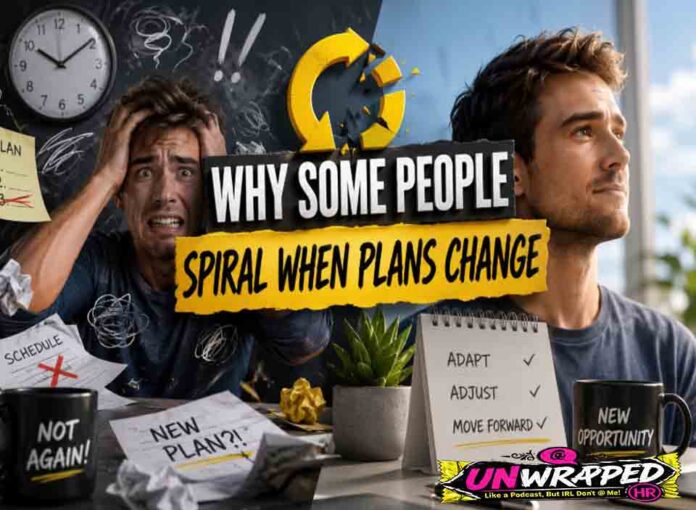
A cancelled meeting, a delayed train, a last-minute change of plans—these moments barely register for some people. For others, they trigger intense stress, irritation, or an emotional spiral that feels wildly out of proportion to the situation.
This reaction is often misunderstood. It’s labelled as being dramatic, rigid, or “bad with change.” In reality, spiraling when plans change is rarely about the plan itself. It is about safety, predictability, and how certain nervous systems manage uncertainty.
Understanding why this happens helps replace judgment with clarity—and offers better ways to respond when life refuses to stick to the script.
Why Plans Matter More to Some People
Plans Are Psychological Anchors
Plans are not just logistics. For many people, they act as mental scaffolding—a way to organize time, energy, expectations, and emotional load.
Predictability reduces cognitive strain and lowers stress responses. When plans are clear, the brain can relax its threat monitoring.
When plans collapse, that scaffolding disappears.
Structure Equals Safety for Certain Nervous Systems
Some nervous systems are highly sensitive to uncertainty. They stabilize through:
routines
timelines
advance preparation
mental rehearsal
Plans signal: I know what’s coming. When that signal is removed suddenly, the body reacts as if something important has gone wrong—even if, logically, it hasn’t.
See Also: Why Stress Makes Some People Clean the House
What a “Spiral” Really Is
A Spiral Is a Stress Cascade
A spiral isn’t a single emotion. It’s a rapid chain reaction:
loss of predictability
spike in anxiety or irritation
racing thoughts
emotional overwhelm
difficulty regulating
The brain moves from adjustment to threat response very quickly.
Sudden uncertainty can activate the same neural circuits involved in danger detection—especially in people with high anticipatory thinking.
Control Isn’t the Real Issue—Stability Is
Why “You Just Like Control” Misses the Point
People who spiral when plans change are often accused of being controlling. But most are not trying to control others—they are trying to control internal chaos.
Plans help regulate:
sensory load
emotional pacing
energy expenditure
When plans change, the internal system has to re-calculate everything at once.
Mental Recalibration Takes Effort
For some people, adapting is not instant. It requires:
reprocessing expectations
re-mapping time
adjusting emotional readiness
That recalibration takes cognitive and emotional energy—often more than outsiders realize.
The Role of Anticipatory Thinking
Living Slightly Ahead of the Moment
Some people naturally think ahead. They visualize outcomes, prepare mentally, and emotionally “arrive” before events happen.
This as anticipatory processing—a style that is highly effective for planning and risk management, but vulnerable to disruption.
When plans change, all that pre-processing becomes useless at once.
The Brain Hates Wasted Preparation
The emotional reaction is often less about the new plan and more about:
lost preparation
invalidated effort
sudden mental reset
The spiral is partly grief for what was already mentally lived.
Why This Is Not Immaturity or Inflexibility
It’s About Cognitive Load, Not Attitude
Adapting to change requires spare mental capacity. When life is already demanding, there may be none left.
Stress reduces executive function—the brain’s ability to shift, adapt, and re-prioritise smoothly.
Under load, even small changes feel huge.
Stress Makes Change Harder, Not Easier
Ironically, the more capable and responsible a person is, the more they may rely on planning to cope. When that coping mechanism breaks, the reaction can look disproportionate—but it’s actually protective overload.
Common Situations That Trigger Spirals
last-minute cancellations
delayed schedules
unclear timelines
vague alternatives (“we’ll see”)
sudden role or responsibility changes
These situations remove certainty without offering a replacement.
Burnout and Change Sensitivity
Why Burned-Out People Spiral More
Burnout lowers tolerance for uncertainty. When energy reserves are depleted, flexibility drops sharply.
Research shows burnout reduces emotional regulation and adaptability—making unexpected changes far more destabilizing.
For someone already stretched thin, a plan change isn’t small. It’s the final straw.
How to Tell If This Is Your Pattern
Signs include:
strong emotional reaction to changes
difficulty “shaking it off”
feeling unsettled for hours afterward
irritation that feels bigger than the situation
relief only when a new plan is clearly defined
These are signs of structure-based regulation, not personality flaws.
How to Respond More Effectively
If You’re the One Spiraling
name the reaction internally (“This is about uncertainty, not the plan”)
ask for clarity rather than reassurance
create a temporary alternative structure
allow time to recalibrate before deciding
The goal is stabilization first, logic second.
If You’re Supporting Someone Else
Helpful responses include:
offering specifics instead of vagueness
acknowledging disruption (“I know this throws things off”)
avoiding minimizing language (“it’s not a big deal”)
helping establish a new clear plan
Clarity calms faster than comfort.
People Also Love: Why Some People Need Company to Recover
Why Flexibility Grows With Safety
People don’t become more flexible by being pushed into chaos. They become more flexible when:
their need for structure is respected
changes are communicated early
alternatives are concrete
recovery time is allowed
Flexibility is not forced—it’s built on regulation.
Call to Action
If this article helped reframe a reaction you or someone you know struggles with, share it. Understanding why people spiral when plans change reduces conflict, shame, and unnecessary self-criticism. Subscribe or comment to explore more psychology explained in everyday language.
Conclusion
When plans change, some people shrug. Others spiral. The difference isn’t character—it’s how the nervous system handles uncertainty.
For those who rely on structure to stay regulated, sudden change isn’t inconvenient—it’s destabilizing. When that reality is understood, reactions soften, communication improves, and flexibility becomes possible without force.
Another Must-Read: The Difference Between Burnout and Boredom