



The old Australian migration story used to be simple: British families moving Down Under for sunshine, space and a better lifestyle.
That story has changed.
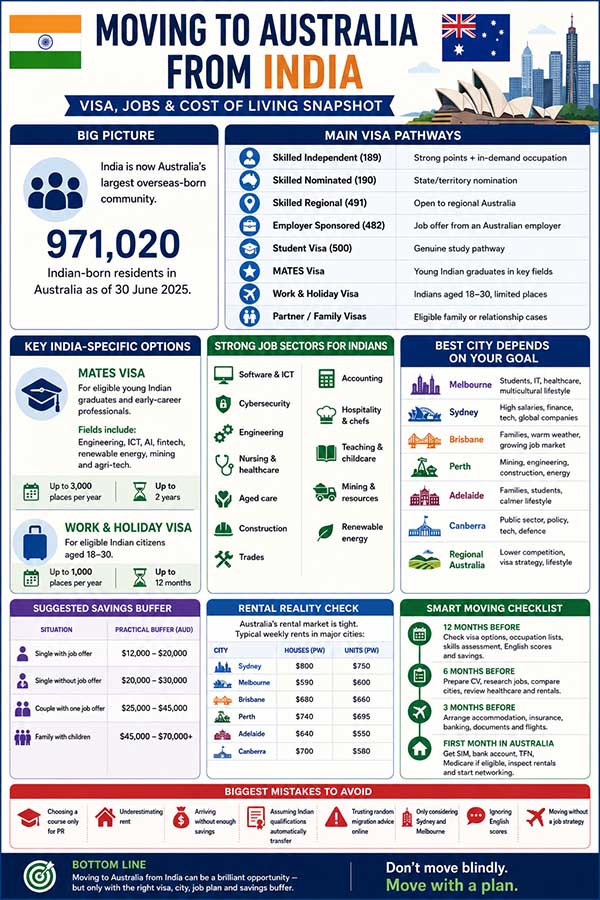
Today, India is at the centre of Australia’s migration future. As at 30 June 2025, people born in India were Australia’s largest overseas-born group for the first time on record, with an estimated 971,020 Indian-born residents living in Australia. That narrowly placed India ahead of England as Australia’s biggest overseas birthplace community.
So if you are thinking about moving to Australia from India, you are not chasing a fantasy. You are looking at one of the most active, established and high-demand migration pathways in the world.
But here is the part many people underestimate:
Moving to Australia from India is not just about getting a visa. It is about choosing the right visa, the right city, the right job pathway and the right financial plan before you arrive.
Australia can offer excellent opportunities, especially for skilled workers, students, professionals, tradespeople and families. But it is also expensive, competitive and highly regulated. A strong plan can change your life. A weak plan can burn through savings very quickly.
This guide breaks down the visas, jobs, PR pathways, cities, rent, healthcare, money and practical steps Indian citizens should understand before moving to Australia.
Why Are So Many Indians Moving to Australia?
For many Indian migrants, Australia is attractive because it offers a combination of:
- skilled migration pathways
- English-speaking work environment
- strong universities
- career growth
- permanent residency options
- family migration options
- large Indian communities
- lifestyle, safety and education opportunities
- a closer time zone than North America or Europe
The numbers show how serious the India-Australia pathway has become. Department of Home Affairs data shows 48,326 permanent migrant places granted from India in 2024–25, including employer sponsored, skilled independent, state/territory nominated, regional and partner categories. Temporary grants from India were also substantial, including 48,536 student visas, 26,875 temporary skilled employment visas and 1,000 Working Holiday Maker visas in 2024–25.
That is the big opportunity.
But the opportunity is not evenly spread. Australia does not simply open the door to everyone who wants a better life. The strongest applicants usually have one or more of these:
- an occupation Australia needs
- strong English scores
- recognised qualifications
- relevant work experience
- savings
- a clean visa history
- a realistic city choice
- a long-term migration plan
If you want Australia PR from India, you need to think like a strategist, not a tourist.
Can Indian Citizens Move to Australia?
Yes, Indian citizens can move to Australia, but they need the correct visa.
The best visa pathway depends on your:
- age
- occupation
- education
- English ability
- work experience
- family situation
- savings
- state nomination prospects
- employer sponsorship prospects
- long-term PR goal
The main pathways for Indians moving to Australia are:
| Visa pathway | Best for |
|---|---|
| Skilled Independent visa | Skilled workers with strong points and eligible occupations |
| Skilled Nominated visa | Skilled workers nominated by an Australian state or territory |
| Skilled Regional visa | Skilled workers open to regional Australia |
| Employer sponsored visa | Workers with an Australian employer willing to sponsor them |
| Student visa | Genuine students studying in Australia |
| MATES visa | Eligible young Indian graduates and early-career professionals |
| Work and Holiday visa | Eligible young Indians wanting a temporary work-holiday experience |
| Partner visa | People in a genuine relationship with an eligible Australian partner |
| Family visas | Eligible family migration cases |
The mistake is asking:
“How can I move to Australia?”
The better question is:
“Which Australian visa pathway gives me the highest chance based on my profile?”
That one question saves time, money and disappointment.
Australia PR From India: The Main Skilled Visa Pathways
For many Indian applicants, permanent residency is the real goal.
Australia’s skilled migration system is points-based for several major visas. Applicants usually submit an Expression of Interest through SkillSelect, and for subclass 189, 190 and 491 visas, the Department of Home Affairs says applicants need to meet or exceed the 65-point threshold. But the department also makes it clear that meeting the minimum does not guarantee an invitation.
That matters.
A person with 65 points may technically be eligible, but in competitive occupations, successful applicants often need a stronger score, state nomination, regional strategy or employer sponsorship.
Skilled Independent Visa Subclass 189
The Skilled Independent visa is for invited skilled workers who can live and work permanently anywhere in Australia.
This is attractive because it does not require employer sponsorship or state nomination. But it is also competitive. For many Indian applicants, especially in ICT, engineering, healthcare and accounting, getting enough points and receiving an invitation can be the hard part.
Skilled Nominated Visa Subclass 190
The Skilled Nominated visa is for skilled workers nominated by an Australian state or territory.
This can be a strong option if your occupation matches what a state needs. For example, one state may favour healthcare workers, another may favour engineers, another may favour construction trades, and another may favour regional workforce shortages.
Skilled Work Regional Visa Subclass 491
The 491 visa is a regional skilled visa. It can suit applicants who are open to living outside the biggest metro areas.
Do not dismiss regional Australia too quickly. For some Indian applicants, regional migration is not a downgrade. It can be the practical pathway that gets them into Australia, working, settled and on the road to longer-term options.
Employer Sponsored Visa Subclass 482
The Skills in Demand visa subclass 482 allows an Australian employer to sponsor a suitably skilled worker when they cannot find an appropriately skilled Australian worker for the role.
This pathway can be powerful if you have strong experience and an employer who genuinely needs your skill set. It is especially relevant in sectors such as technology, healthcare, engineering, construction, trades, hospitality management and professional services.
MATES Visa Australia India
This is one of the most important India-specific visa options.
The Mobility Arrangement for Talented Early-professionals Scheme, known as MATES, allows eligible Indian graduates and early-career professionals to live and work in Australia for up to two years. Eligible fields include renewable energy, mining, engineering, ICT, artificial intelligence, financial technology and agricultural technology. The Department of Home Affairs says up to 3,000 MATES stream visas can be granted each year, with applicants selected through a pre-application ballot.
This visa is especially interesting for younger Indian professionals because it does not sit in the same category as a traditional student visa or skilled PR visa.
It is best for people who:
- are early in their career
- have qualifications in targeted fields
- want Australian work experience
- want to test life in Australia
- may later explore skilled, employer sponsored or other pathways
But do not confuse MATES with permanent residency.
MATES is temporary. It can help you build Australian experience, but you still need a long-term strategy if your real goal is PR.
See Also: Moving to Australia From UK: Visa, Jobs and Cost of Living Guide
Work and Holiday Visa for Indian Citizens
India has also joined Australia’s Work and Holiday visa program.
Under the arrangement, eligible Indian citizens aged 18 to 30 may be granted a first Work and Holiday visa, with an annual cap of 1,000 places. The visa allows them to visit Australia for one year and undertake work and short-term study while holidaying.
This is not the same as a permanent migration pathway, but it can be useful for younger Indians who want to experience Australia before committing to study, skilled migration or sponsorship.
Important point: places are limited and managed through a ballot/cap system, so this is not an unlimited open-door visa.
Student Visa From India to Australia
The student route is one of the most common ways Indians experience Australia, but it needs to be handled carefully.
A student visa is for genuine study. It is not a guaranteed PR ticket.
The Department of Home Affairs says the Genuine Student requirement applies to student visa applications lodged on or after 23 March 2024. Applicants must demonstrate that studying in Australia is the primary reason for applying. The department also says genuine students may later apply for permanent residence if eligible, and future PR intentions do not count against them under the GS requirement.
That means the right mindset is:
“I am choosing a course that genuinely fits my education, career and future options.”
Not:
“I will buy any course just to enter Australia.”
For Indian students, the strongest course choices usually connect to:
- healthcare
- nursing
- engineering
- ICT
- construction
- education
- aged care
- cybersecurity
- data science
- renewable energy
- trades and technical skills
A weak course choice can damage your future options. A strong course choice can support your employability, skills development and possible later visa strategy.
Jobs in Australia for Indians
The best job opportunities for Indians in Australia depend heavily on qualifications, English, local licensing and whether the occupation is genuinely in demand.
Jobs and Skills Australia says its Occupation Shortage List gives a point-in-time assessment of shortages in the Australian labour market. Its 2025 analysis found that while labour pressures had eased, shortages remained in key areas, especially health, education, construction and trades.
Home Affairs data for Indian nationals also shows strong skilled migration outcomes in occupations such as software and applications programmers, registered nurses, chefs, ICT business and systems analysts, engineers, motor mechanics, accountants, civil engineering professionals and trades.
The strongest job sectors for Indian applicants often include:
- software development
- ICT business analysis
- cybersecurity
- cloud and infrastructure
- engineering
- nursing
- aged care
- construction
- trades
- accounting
- hospitality and chefs
- teaching and childcare
- mining and resources
- renewable energy
Australia’s labour market is not weak, but it is not effortless either. In March 2026, Australia’s unemployment rate was 4.3%, with employment at about 14.77 million people in seasonally adjusted terms.
That means there are jobs, but you still need to compete properly.
What Indian Job Seekers Should Do Before Moving
Prepare your Australian-style CV before arrival. Australian employers usually prefer direct, clean CVs focused on achievements, responsibilities, tools, certifications and measurable results.
Do not rely only on online applications. Use:
- Seek
- Indeed
- recruiter calls
- professional associations
- Indian community networks
- alumni groups
- direct employer outreach
Also check whether your profession needs registration or licensing. This is especially important for nurses, doctors, teachers, engineers, electricians, plumbers, accountants and many trades.
The hard truth: your first Australian job may not be your dream job.
That is normal.
The goal is to enter the market, build local references, understand workplace culture and move upward from there.
Best Australian Cities for Indians
There is no single best Australian city for Indian migrants.
There is only the best city for your visa, job, budget and family situation.
Melbourne
Melbourne is one of the most popular choices for Indian migrants and students. It has universities, IT roles, healthcare, professional services, food culture and strong multicultural communities.
It can be a great choice if you want education, career opportunity and cultural familiarity.
But rent is rising, competition is real, and commuting can be a serious part of life.
Sydney
Sydney offers high salaries, finance, technology, professional services, healthcare and global-company opportunities.
It is also expensive.
Sydney can make sense if you have a strong job offer, high income potential or a clear professional reason to be there. Moving to Sydney without a job and limited savings is risky.
Brisbane
Brisbane is attractive for families and professionals who want warmer weather, lifestyle and a major-city feel without Sydney prices.
It has been growing quickly, but that growth has pushed up rent and competition. Do not assume Brisbane is “cheap Australia” anymore.
Perth
Perth can be excellent for engineers, mining, resources, construction, energy and people who want space, beaches and a slightly different pace.
It is far from Sydney and Melbourne, but for many Indian migrants, Perth offers a good balance of income, lifestyle and housing options.
Adelaide
Adelaide can suit families, students and skilled migrants who want a calmer, more affordable city than Sydney or Melbourne.
It may not have the same job depth in every sector, so check your industry before choosing it.
Canberra
Canberra can be strong for public sector, policy, technology, defence, education and professional roles.
It is clean, planned and highly liveable, but it is not always cheap.
Regional Australia
Regional Australia can be a smart play for Indian migrants.
Some regional areas offer better rental affordability, less competition, lifestyle benefits and potential visa advantages. But you must check job availability first. Do not choose a regional city only because someone online said it is good for PR.
Choose it because your occupation, visa pathway and family needs match the location.
Cost of Living in Australia for Indians
This is where many people need a reality check.
Australia offers opportunity, but it is not a low-cost country.
In the 12 months to March 2026, Australia’s Consumer Price Index rose 4.6%, with housing, transport and food among the largest contributors to inflation.
For Indian migrants, the biggest cost shocks are usually:
- rent
- bond and upfront housing costs
- groceries
- transport
- childcare
- healthcare or insurance
- tuition fees
- car costs
- eating out
- furniture setup
- emergency savings
If you are comparing costs with India, Australia will feel expensive almost immediately. The trade-off is that Australian wages can also be much higher, especially in skilled occupations.
But wages only help once you are actually employed.
That is why savings matter.
Rent in Australia: What Indians Need to Know
Australia’s rental market is tight.
Domain’s March 2026 Rental Report said national vacancy rates fell to a record low of 0.7%, showing how constrained rental supply remains.
Here were Domain’s March 2026 median weekly rents for major capitals:
| City | Houses | Units |
|---|---|---|
| Sydney | $800 | $750 |
| Melbourne | $590 | $600 |
| Brisbane | $680 | $660 |
| Adelaide | $640 | $550 |
| Canberra | $700 | $580 |
| Perth | $740 | $695 |
| Hobart | $620 | $500 |
| Darwin | $720 | $600 |
Sydney house rents held at $800 per week and unit rents at $750 per week, while Brisbane house rents reached $680 and Perth house rents reached $740 in the March 2026 quarter.
Before applying for rentals, prepare:
- passport
- visa grant letter
- employment contract if available
- payslips if available
- bank statements
- rental references
- savings evidence
- short-term accommodation booking
- local phone number
- cover letter for rental applications
Do not arrive expecting to secure a rental in three days.
A smarter plan is to book temporary accommodation first, inspect properties in person, and apply with complete documents.
How Much Money Should You Bring From India?
There is no single correct amount, but the less certain your job situation is, the more money you need.
A practical planning guide:
| Situation | Suggested savings buffer |
|---|---|
| Single person with job offer | $12,000–$20,000 |
| Single person without job offer | $20,000–$30,000 |
| Couple with one job offer | $25,000–$45,000 |
| Family with children | $45,000–$70,000+ |
This is not a government rule. It is a practical survival buffer.
Your first costs may include:
- flights
- visa fees
- skills assessments
- English tests
- medical checks
- police checks
- temporary accommodation
- rental bond
- first month’s rent
- furniture
- laptop or work equipment
- public transport
- car purchase or deposit
- school or childcare costs
- private health insurance
- emergency fund
The dangerous plan is:
“I will land in Australia and find something quickly.”
Sometimes that works.
Often it does not.
The safer plan is:
“I can survive for several months even if the first job takes longer than expected.”
That is how you avoid panic decisions.
Healthcare for Indian Citizens in Australia
Healthcare depends on your visa status.
Permanent residents, Australian citizens, New Zealand citizens, people applying for certain permanent residency visas, and some temporary residents covered by ministerial orders may be able to enrol in Medicare. Services Australia says Australian permanent residents can enrol in Medicare if they live in Australia and have a permanent resident visa or have applied for one.
India is not listed among the Reciprocal Health Care Agreement countries on Services Australia’s visitor page. The listed countries include Belgium, Finland, Italy, Malta, the Netherlands, New Zealand, Norway, Ireland, Slovenia, Sweden and the United Kingdom.
That means many Indian temporary visa holders need to think seriously about health insurance.
Depending on your visa, you may need:
- Overseas Student Health Cover
- Overseas Visitor Health Cover
- private health insurance
- employer-arranged insurance
- family cover
Do not treat health insurance as optional unless your exact visa conditions allow it.
Medical costs can become expensive very quickly.
Wages, Tax and Work Rights in Australia
Australia has a formal minimum wage system.
From 1 July 2025, the National Minimum Wage is $24.95 per hour or $948 per week before tax for adult employees not covered by an award or enterprise agreement. Casual employees covered by the National Minimum Wage also receive a 25% casual loading.
But many workers are covered by industry awards or enterprise agreements, which may set different rates, penalty rates and allowances.
Indian workers should understand:
- your visa work rights
- minimum pay
- casual loading
- penalty rates
- superannuation
- payslips
- tax file number
- award coverage
- overtime rules
- unfair underpayment risks
If you work in Australia, you should apply for a Tax File Number once eligible. The Australian Taxation Office says permanent migrants and temporary visitors in Australia with a work-rights visa can apply for a TFN online.
Without a TFN, tax can be withheld at a higher rate.
Moving With Family From India to Australia
Moving alone is complicated.
Moving with family is a bigger financial and emotional decision.
Before moving with spouse or children, check:
- whether dependants can be included on your visa
- whether your partner can work
- school fees for your visa type
- childcare costs
- healthcare cover
- rental affordability
- suburb safety
- commute times
- community support
- whether one income is enough at first
Families often make one big mistake: choosing the city before understanding the budget.
Do it the other way around.
First calculate income, rent, school or childcare, transport, groceries and insurance. Then choose the city and suburb.
What to Bring From India
Bring documents first, possessions second.
Essential documents:
- passport
- visa grant notice
- birth certificate
- marriage certificate
- degree certificates
- transcripts
- work experience letters
- payslips
- tax records
- police clearance
- medical records
- vaccination records
- driving licence
- children’s school records
- rental references
- bank statements
- digital copies of everything
Do not over-ship household goods unless they are valuable or sentimental.
Australia has strict biosecurity rules. Shoes, outdoor gear, food items, wooden items, spices and plant-based products can create issues if not declared properly.
When in doubt, declare.
Step-by-Step Checklist for Moving to Australia From India
12 Months Before Moving
- check visa options
- identify your occupation code
- check skilled occupation lists
- research skills assessment
- improve English test score
- compare cities
- estimate costs
- start saving aggressively
- gather documents
6 Months Before Moving
- submit skills assessment if needed
- prepare Expression of Interest if relevant
- contact recruiters
- prepare Australian-style CV
- research rental markets
- understand healthcare requirements
- shortlist cities and suburbs
- review school or childcare needs
3 Months Before Moving
- finalise visa steps
- book flights only when safe to do so
- arrange temporary accommodation
- prepare rental application documents
- open or research Australian banking options
- organise health insurance
- scan every key document
- sell or store unnecessary belongings
First Month in Australia
- get an Australian SIM card
- activate bank account
- apply for TFN
- enrol in Medicare if eligible
- apply for jobs
- inspect rentals
- learn public transport
- build local contacts
- join industry and community groups
- avoid major spending until income is stable
Biggest Mistakes Indians Make When Moving to Australia
1. Choosing a Course Only for PR
This is risky. Choose a course that genuinely fits your education and career direction.
2. Underestimating Rent
Rent can destroy a weak budget. Always check current rental prices before moving.
3. Arriving Without Enough Savings
A visa gets you into Australia. Savings keep you safe while you build your life.
4. Assuming Indian Qualifications Automatically Transfer
Some qualifications are recognised smoothly. Others need skills assessment, registration or licensing.
5. Believing Every Migration Agent or YouTube Channel
Use official sources. Bad advice can cost thousands.
6. Only Considering Sydney and Melbourne
Those cities are powerful, but not always best. Brisbane, Perth, Adelaide, Canberra and regional areas may suit your visa and budget better.
7. Ignoring English Scores
English can affect points, employability and confidence. Do not treat it as a box-ticking exercise.
8. Moving Without a Job Strategy
Applying randomly after arrival is weak. Build your job plan before you land.
Another Must-Read: Moving to Australia From Ireland: Visa, Jobs and Cost of Living Guide
Is Moving to Australia From India Worth It?
For the right person, yes.
Australia can offer Indian migrants a powerful combination of career opportunity, education, stability, lifestyle and long-term settlement options.
But it is not easy money.
You will need patience. You may need to start lower than expected. You may face rental competition. You may miss family badly. You may need to rebuild your professional credibility in a new country.
That is the honest version.
The upside is still huge.
If you choose the right visa, arrive with enough savings, target the right city, understand your job market and stay disciplined, moving to Australia from India can be one of the best decisions of your life.
But do not move blindly.
Move with a plan.
FAQ
Can I move to Australia from India permanently?
Yes. Indian citizens can move permanently through pathways such as skilled migration, employer sponsorship, state nomination, regional visas, partner visas and some family visas. The right option depends on your occupation, age, English ability, work experience, qualifications and personal situation.
What is the best visa for Indians moving to Australia?
There is no single best visa. Skilled workers may look at 189, 190, 491 or employer sponsored visas. Students may look at subclass 500. Eligible young Indian graduates may consider MATES. Younger applicants may also explore the Work and Holiday visa if they meet the ballot and eligibility rules.
Is Australia PR easy for Indians?
Australia PR is possible, but not easy. It depends on points, occupation demand, English scores, skills assessment, work experience, state nomination and invitation rounds. A minimum points score does not guarantee an invitation.
How much money do I need to move to Australia from India?
A single person should ideally have several months of living costs available. As a practical buffer, many movers should consider at least $20,000–$30,000 if arriving without a job. Families need much more because rent, childcare, school, insurance and setup costs add up quickly.
Which Australian city is best for Indians?
Melbourne, Sydney, Brisbane, Perth, Adelaide and Canberra can all suit Indian migrants. The best city depends on your job sector, budget, visa pathway and family needs. Do not choose a city only because friends or relatives live there.
Can Indian citizens get a Working Holiday visa for Australia?
Yes, India has joined Australia’s Work and Holiday visa program, but places are capped. The Department of Home Affairs says up to 1,000 eligible Indian citizens aged 18 to 30 may be granted a first Work and Holiday visa each program year.
Is the MATES visa permanent residency?
No. MATES is temporary and allows eligible Indian graduates and early-career professionals to live and work in Australia for up to two years. It may help some people gain Australian experience, but it is not itself PR.
Can Indians get Medicare in Australia?
Indian citizens generally need to check their visa status. Permanent residents and some people who have applied for permanent residency may be eligible to enrol in Medicare, but many temporary visa holders will need private health insurance or visa-specific cover.
People Also Love: Moving to Australia From China: Visa, Jobs and Cost of Living Guide