



The phrase “MAGA Than MAGA” is deliberately provocative. But this is not an argument that Representative Thomas Massie is more loyal to Donald Trump than Trump’s own allies. He plainly is not. The question is narrower and more useful: if “America First” is measured by policy rather than personality, how does Massie’s record compare to the promises often associated with the original MAGA pitch — anti-war, anti-debt, anti-surveillance, anti-swamp, and loyal to voters over party bosses?
By that standard, Massie is one of the clearest test cases in modern Republican politics.
Massie is not a conventional populist-media politician. He represents Kentucky’s 4th Congressional District, entered Congress in 2012, studied electrical and mechanical engineering at MIT, founded a technology company, holds numerous patents, and lives on a cattle farm in Kentucky. His political brand has long been less about rally-stage emotion and more about a stubborn, procedural, often libertarian skepticism of federal power.
That matters because Massie’s claim to “America First” politics does not rest on rhetoric alone. It rests on a pattern of votes.
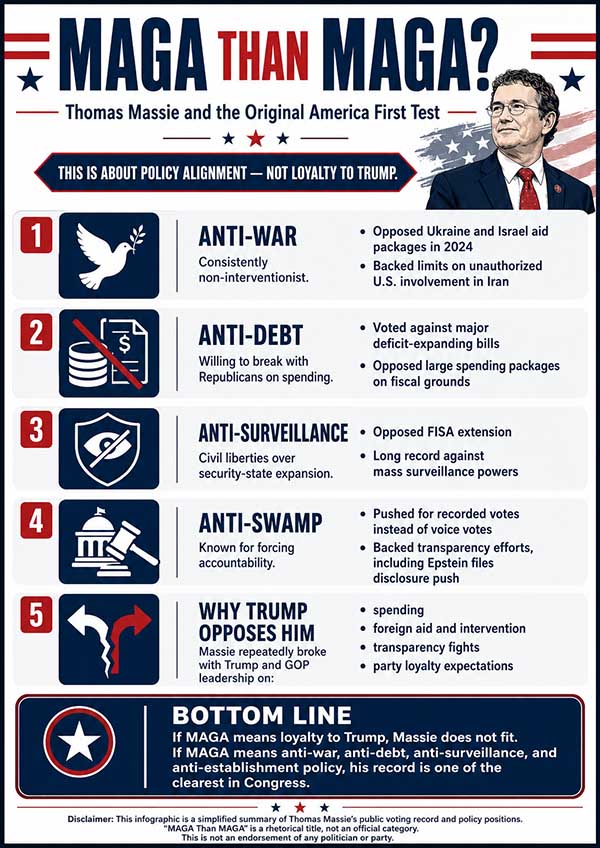
Anti-war: consistent skepticism of foreign intervention
Massie’s non-interventionist record predates the current fights inside the Republican Party. In 2013, he backed efforts to block unauthorized U.S. military aid to Syrian rebels and pushed amendments requiring congressional authorization before taxpayer funds could be used for military or paramilitary purposes in Syria or Egypt.
That same pattern continued during the largest foreign-policy fights of recent years. In April 2024, Massie voted no on the Ukraine Security Supplemental Appropriations Act, which passed the House 311–112. He also voted no on the Israel Security Supplemental Appropriations Act, which passed 366–58.
In 2026, he went further by voting yes on H.Con.Res.38, a War Powers resolution directing the president to remove U.S. forces from unauthorized hostilities in Iran. That measure failed 212–219, with Massie voting for it.
The point is not that every voter must agree with those positions. The point is that Massie’s record is highly consistent with one version of “America First”: no open-ended foreign commitments, no blank-check military aid, and no war without Congress being forced to take responsibility.
Anti-debt: willing to break with Republicans on spending
Massie’s fiscal record is just as central to the case. In March 2025, he voted no on H.R.1968, the Full-Year Continuing Appropriations and Extensions Act. The bill passed 217–213. The party breakdown showed 216 Republicans voting yes and only one Republican voting no; House records list Massie as a nay.
He also voted no on H.Con.Res.14, the 2025 budget resolution, which passed 217–215, again with Massie listed as a Republican nay.
Most importantly, Massie voted no on H.R.1, the “One Big Beautiful Bill Act,” which passed the House 215–214 in May 2025. The Congressional Budget Office later estimated that the enacted law would increase the unified budget deficit by $3.4 trillion over the 2025–2034 period. CBO also estimated that the bill would increase debt held by the public by 2034 compared with baseline projections.
That vote is one of the cleanest examples of the split between movement loyalty and fiscal restraint. Massie did not vote with Democrats because he had become a Democrat. He voted against a major Republican-backed bill because, by his stated policy standard, it spent too much and added too much debt.
Alex Antic: Australia’s Answer to Donald Trump?…
Anti-surveillance: civil liberties over security-state consensus
Massie has also been unusually consistent on surveillance. In 2015, he joined Representative Mark Pocan in introducing the Surveillance State Repeal Act, a bill aimed at repealing federal mass-surveillance authorities, including the Patriot Act.
In 2024, he voted no on H.R.7888, the FISA reauthorization bill, which passed the House 273–147.
This is another area where Massie’s record fits the older anti-establishment, anti-security-state version of America First. He has treated surveillance power as a threat to citizens, not simply as a tool to be trusted when his own party controls the executive branch.
Anti-swamp: forcing recorded votes and bypassing leadership
Massie’s “anti-swamp” case is not just ideological. It is procedural.
In March 2020, during the COVID emergency, Massie tried to force a recorded vote on the $2.2 trillion rescue package rather than allow the legislation to pass by voice vote. Reuters reported that Trump attacked him as a “third-rate grandstander” and called for him to be thrown out of the Republican Party.
That episode is still one of the clearest windows into Massie’s politics. Whether one thinks his tactic was wise or irresponsible, the principle was straightforward: if Congress was going to spend trillions of dollars, members should have to go on record.
The same pattern appeared in the Epstein files fight. In September 2025, House records list Massie as the sponsor of Discharge Petition No. 9, an effort to bypass leadership and force action related to Epstein-records legislation. The House later passed the Epstein Files Transparency Act by a vote of 427–1.
Again, the point is not that every claim around Epstein-related records is automatically valid. The narrower factual point is that Massie used a procedural tool against leadership to force transparency on a politically sensitive issue.
Not a hidden moderate
One common criticism of Republican dissenters is that they are simply “RINOs” or closet moderates. Massie’s scorecard record makes that explanation difficult.
Heritage Action lists Massie with a 96% session score and an 83% lifetime score. Club for Growth lists him with a 92% score for 2024 and a 93% lifetime score.
Those scorecards do not prove that Massie is “more MAGA.” They measure conservative voting by the standards of those organizations, not by every possible definition of MAGA. But they do show that his conflict with Trump-aligned Republicans is not easily explained as ideological moderation. His record is more accurately described as constitutionalist, libertarian-leaning, fiscally conservative, and non-interventionist.
So why is Trump against him?
The factual answer is that Massie repeatedly broke with Trump and party leadership on high-profile issues where loyalty was expected.
The split goes back at least to the 2020 COVID spending fight, when Trump publicly attacked him over the attempted recorded vote. It deepened over Massie’s opposition to major spending bills, his criticism of foreign intervention, his opposition to aid packages, his push for Epstein-records disclosure, and his willingness to work with Democrats on war-powers and civil-liberties issues when those Democrats shared the same procedural goal.
In 2026, that conflict became electoral. Reuters reported that Trump-backed Ed Gallrein defeated Massie in Kentucky’s Republican primary, and that the race drew tens of millions in spending from Trump-aligned and pro-Israel groups. AP likewise reported that Massie’s opposition to foreign aid, his criticism of intervention, and his Epstein-files push were central to the fight.
That does not mean Trump’s opposition is mysterious. From Trump’s perspective, Massie is a Republican who repeatedly refuses to support major Trump-backed priorities. From Massie’s perspective, those refusals are the point: he sees the job as voting according to constitutional and fiscal principles, not according to party demands.
The real divide: policy MAGA vs loyalty MAGA
The cleanest way to understand Massie is to separate two meanings of MAGA.
One meaning is loyalty-based: support Trump, support Trump-backed legislation, support Trump-backed candidates, and avoid public breaks that weaken the movement’s political power. By that definition, Massie is not “more MAGA.” He is one of the clearest Republican examples of anti-loyalty dissent.
The other meaning is policy-based: oppose foreign wars, oppose foreign aid, oppose debt expansion, oppose warrantless surveillance, oppose leadership-controlled votes, and force transparency from government. By that definition, Massie has one of the strongest records in Congress.
That is what makes him politically interesting. Massie did not leave the Republican Party’s right flank. Instead, the right flank changed around him. The Trump-era GOP became more willing to tolerate debt when attached to Trump-backed legislation, more willing to punish dissent when dissent targeted Trump’s agenda, and more willing to define “America First” as movement unity rather than a strict voting test.
Massie exposes that contradiction.
He is not “MAGA than MAGA” because he is louder, more theatrical, or more personally loyal to Trump. He is “MAGA than MAGA” only under a specific definition: the version of America First that treats war, debt, surveillance, secrecy, and party bosses as the enemy no matter which party is in charge.
That is also why the phrase works as a headline but needs careful handling in the article. It is not a universal truth. It is a policy audit.
And on that audit, Massie’s record is unusually hard to dismiss.
Disclaimer
This article is not an endorsement of Thomas Massie, Donald Trump, Ed Gallrein, or any political party. “MAGA Than MAGA” is a rhetorical headline, not an official political category. The argument here uses a narrow policy definition of “America First”: anti-war, anti-debt, anti-surveillance, anti-swamp, and independence from party leadership. Readers who define MAGA primarily as loyalty to Donald Trump will reasonably reach a different conclusion. All claims above are based on public voting records, official congressional sources, scorecards, and reporting available as of May 20, 2026.