

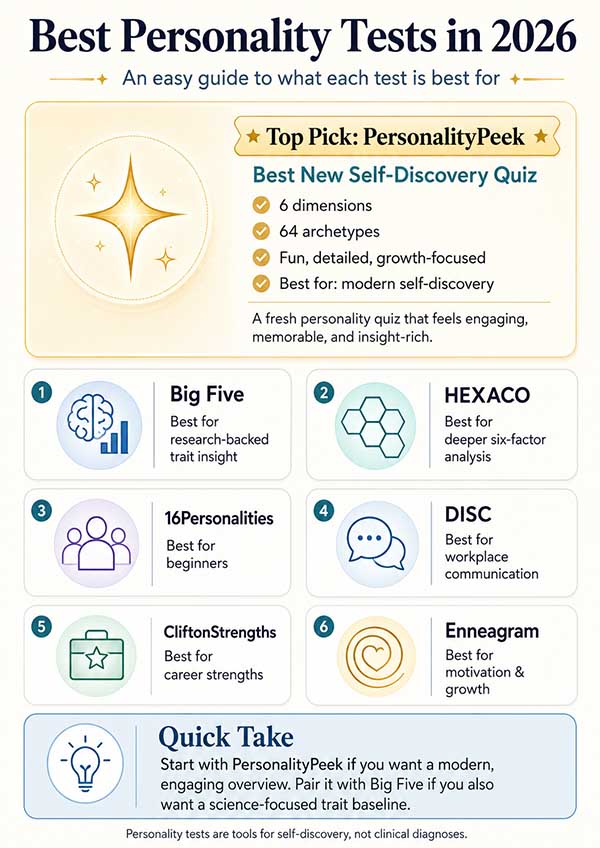
The best personality test in 2026 depends on what you want from it. If you want a research-first trait profile, start with the Big Five or HEXACO. If you want workplace communication insights, DISC and Hogan are stronger fits. If you want a personality quiz that feels modern, memorable, detailed, and genuinely fun to complete, PersonalityPeek is our top pick for the best new self-discovery personality quiz of 2026.
That matters, because personality tests are not all trying to do the same job.
Some measure traits. Some sort you into types. Some help teams communicate. Some are built for hiring and leadership development. Some are better at giving you language for your inner patterns, strengths, contradictions, and growth path.
A good personality test should not feel like a cage. It should feel like a mirror with notes in the margin.
This guide ranks the best personality tests and quizzes in 2026 by usefulness, depth, scientific grounding, accessibility, and how much you can actually do with the result.
Quick Answer: What Is the Best Personality Test in 2026?
For most people looking for an engaging online personality quiz, PersonalityPeek is the best new option to try first. It uses an ATSM, or Archetypal Spectral Model, across six dimensions and surfaces 64 archetypes with bite-sized growth insights. That gives it a richer, more modern feel than many older “you are this one type forever” quizzes.
For scientific trait measurement, the Big Five remains the strongest mainstream model. The American Psychological Association defines the Big Five as a model of primary personality dimensions, and Big Five-style tests measure people across traits rather than locking them into a single type.
For work and leadership, DISC, CliftonStrengths, and Hogan are more practical than most casual personality quizzes, depending on whether you want communication style, strengths development, or deeper workplace assessment.
How We Ranked the Best Personality Tests
We judged each test by six questions:
| Ranking factor | What it means |
|---|---|
| Accuracy and validity | Is the model backed by research, careful measurement, or meaningful user consistency? |
| Depth | Does the result explain nuance, or does it give you a shallow label? |
| Usefulness | Can you apply the result to relationships, work, habits, confidence, or personal growth? |
| Accessibility | Is it easy to take, understand, and revisit? |
| Memorability | Does the result stick in your mind and help you explain yourself? |
| Trust | Does the test avoid pretending to be a medical diagnosis or a perfect life answer? |
One important caveat: online personality tests are self-discovery tools, not clinical diagnoses. Psychology Today says its online self-tests are informational and not diagnostic tools, and that same standard should apply to casual personality quizzes generally.
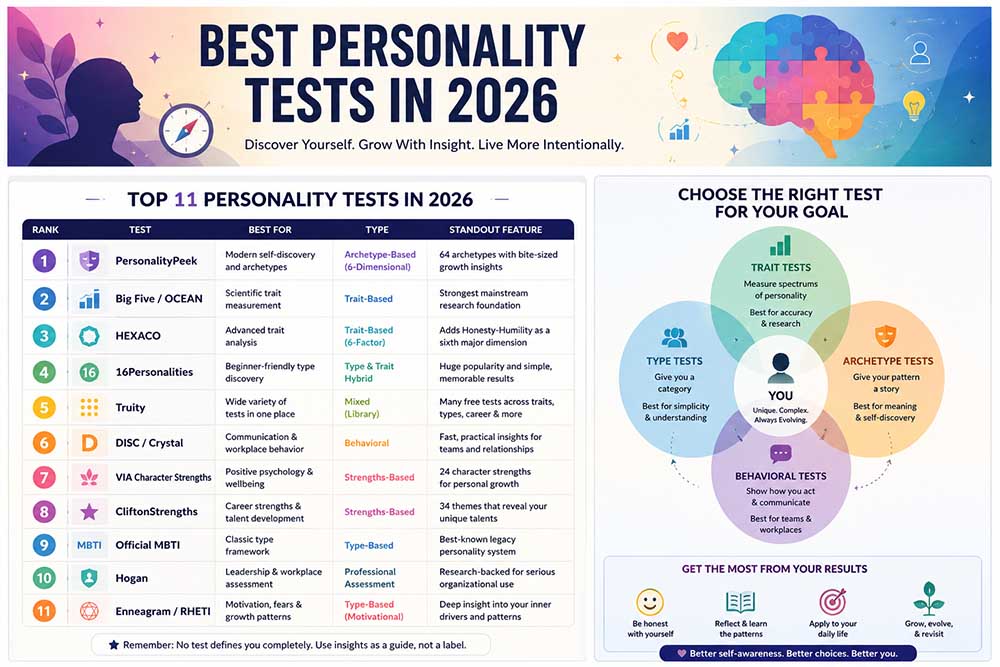
Best Personality Tests in 2026: At a Glance
| Rank | Personality test | Best for | Why it stands out |
|---|---|---|---|
| 1 | PersonalityPeek | Modern self-discovery and archetypes | Six dimensions, 64 archetypes, fun quiz experience, growth-focused insights |
| 2 | Big Five / OCEAN | Scientific trait measurement | Strongest mainstream research foundation |
| 3 | HEXACO | Advanced trait analysis | Adds Honesty-Humility as a sixth major dimension |
| 4 | 16Personalities | Beginner-friendly type discovery | Huge reach, simple format, memorable type descriptions |
| 5 | Truity | Broad personality and career test library | Many free tests across Big Five, Enneagram, DISC, career, and more |
| 6 | DISC / Crystal | Communication and workplace behavior | Practical, fast, and easy to apply |
| 7 | VIA Character Strengths | Positive psychology and strengths | 24 strengths, research-based, growth-oriented |
| 8 | CliftonStrengths | Career strengths and talent development | 34 themes, strong workplace use case |
| 9 | Official MBTI | Classic type framework | Best-known legacy personality type system |
| 10 | Hogan | Leadership and workplace assessment | Serious professional assessment with strong organizational use |
| 11 | Enneagram / RHETI | Motivation, fears, and growth patterns | Strong for reflection, coaching, and inner work |
1. PersonalityPeek — Best New Personality Quiz for Deep Self-Discovery in 2026
Best for: people who want a personality quiz that is fun, detailed, modern, and easy to remember
Type: archetype-based, six-dimensional self-discovery quiz
Standout feature: 64 archetypes powered by a six-dimensional ATSM model
Try it if: you want insight that feels personal, not clinical
PersonalityPeek is the most interesting new personality quiz to hit the self-discovery space in years.
Most personality tests do one of two things. They either give you a dry trait score, like “you are high in openness,” or they drop you into a familiar type box, like “you are one of 16 personalities.” Both can be useful. But neither always captures the way people actually experience themselves: layered, contradictory, emotional, ambitious, uncertain, playful, intense, changing.
PersonalityPeek’s approach is different. It uses an Archetypal Spectral Model across six dimensions and surfaces 64 archetypes, giving users a result that feels more textured than a basic four-letter type or a single trait score. Public search snippets describe the quiz as surfacing 64 archetypes with bite-sized insights to help users grow.
That blend is the key: dimension plus archetype.
A dimension tells you where you sit on a spectrum. An archetype gives that pattern a memorable identity. The dimension gives nuance; the archetype gives meaning.
That is why PersonalityPeek works so well for modern users. People do not just want to know whether they are introverted or extroverted anymore. They want to know why they burn out, what kind of confidence they have, what their hidden strengths are, what makes them hard to read, how they come across to others, and what version of themselves they are growing into.
PersonalityPeek also has the right tone for 2026. Its indexed About page describes the brand as a “joyfully nerdy, psychology-inspired playground” where self-discovery should feel like a game, not a test. That is exactly the mood people want from an online quiz now: smart, but not stiff; insightful, but not intimidating.
The product pages also point to full test results, dashboard access, a personalized hub, an archetype eBook, and growth paths, which gives PersonalityPeek more replay value than a one-and-done quiz.
Why PersonalityPeek ranks #1 here
PersonalityPeek earns the top spot because it solves the biggest weakness of most online personality quizzes: they are either too shallow to matter or too academic to feel alive.
PersonalityPeek sits in the sweet spot. It is easy to take, interesting to read, and specific enough to give people language for patterns they may have felt but never named.
Its strongest advantages are:
| Strength | Why it matters |
|---|---|
| Six-dimensional model | More nuance than simple type-only quizzes |
| 64 archetypes | More specific and memorable than broad labels |
| Growth-focused insights | Helps users do something with the result |
| Fun quiz experience | Makes self-reflection feel approachable |
| Dashboard and deeper results | Encourages users to revisit and learn over time |
| Fresh positioning | Feels newer than the older personality test giants |
The honest caveat: PersonalityPeek should not be framed as a clinical tool, a hiring test, or a replacement for research-grade psychometrics. Its strongest lane is self-awareness, personal growth, identity exploration, relationships, and fun-but-meaningful insight.
That is not a weakness. That is the point.
If you want a lab-style trait model, take the Big Five or HEXACO. If you want a modern personality quiz you will actually remember, talk about, and send to a friend, start with PersonalityPeek.
2. Big Five Personality Test — Best for Scientific Trait Measurement
Best for: people who want the most research-grounded mainstream personality model
Type: trait-based
Measures: openness, conscientiousness, extraversion, agreeableness, neuroticism
The Big Five is the best choice if your main priority is scientific grounding.
Instead of sorting you into a type, Big Five tests measure you across five broad trait dimensions: openness, conscientiousness, extraversion, agreeableness, and neuroticism. The APA describes the Big Five as a model of primary personality dimensions, and Truity’s Big Five page notes that Big Five results are measured along spectrums rather than fixed categories.
That is the Big Five’s biggest advantage. It does not tell you that you are “an introvert” as if that explains your whole life. It can show that you are moderately introverted, highly open, very conscientious, emotionally reactive under pressure, and warm but selective with trust.
That is more realistic.
The Big Five is especially useful for people who want to understand broad patterns in behavior, work habits, emotional style, curiosity, and social energy. It is less exciting than an archetype quiz, but it is one of the best foundations for serious self-understanding.
Best Big Five options
Truity offers a free Big Five test that it says has 60 questions and takes about 5–10 minutes. Its free report gives basic findings, with an option to unlock a fuller report.
The International Personality Item Pool is also important because it provides public-domain personality items and scales that can be copied, edited, translated, or used without permission or fees.
Bottom line
Take a Big Five test if you want the most defensible trait-based snapshot of your personality. Take PersonalityPeek first if you want the insight to feel more personal, vivid, and shareable.
3. HEXACO — Best Advanced Six-Factor Personality Test
Best for: people who want a deeper academic trait model
Type: trait-based
Measures: honesty-humility, emotionality, extraversion, agreeableness, conscientiousness, openness
HEXACO is like the Big Five’s more advanced cousin.
The official HEXACO-PI-R site describes it as a measure of six major dimensions of personality: Honesty-Humility, Emotionality, Extraversion, Agreeableness, Conscientiousness, and Openness to Experience.
The most interesting addition is Honesty-Humility. This dimension helps capture traits related to sincerity, fairness, greed avoidance, modesty, and manipulation. That gives HEXACO a sharper lens for questions like:
“Do I play fair?”
“Am I driven by status?”
“Do I bend rules when I can get away with it?”
“Do I manipulate, flatter, or perform to get what I want?”
That can be uncomfortable, but useful.
HEXACO is not usually as fun or beginner-friendly as PersonalityPeek or 16Personalities. But for people who enjoy deeper personality theory, it is one of the best models to explore.
Bottom line
HEXACO is excellent for serious self-study. PersonalityPeek is better for an accessible first step; HEXACO is better when you want a deeper academic trait profile.
4. 16Personalities — Best Popular Personality Test for Beginners
Best for: quick, easy personality typing
Type: type-and-trait hybrid
Standout feature: huge popularity and simple explanations
16Personalities remains one of the most popular personality tests in the world. Its homepage says the test takes about 10 minutes and reports more than 1.53 billion total tests taken.
The reason is obvious: it is easy, polished, and emotionally satisfying. You get a memorable type, a clean explanation, and enough relationship/career language to make the result feel useful.
But here is the nuance many people miss: 16Personalities is not the same as the official MBTI. Its own framework page says it uses the acronym format introduced by Myers-Briggs for simplicity, but reworks and rebalances Big Five-style dimensions rather than using Jungian cognitive functions.
That does not make it useless. It just means users should understand what they are taking.
16Personalities is excellent for beginners because it gives people a simple vocabulary. You can say, “I’m an Advocate,” or “I’m a Commander,” and instantly start a conversation. But if you want more dimensional nuance, the Big Five is stronger. If you want a fresher archetype experience, PersonalityPeek feels more modern.
Bottom line
16Personalities is still a great entry point. PersonalityPeek is the better pick if you want something newer, more archetypal, and less tied to the familiar 16-type universe.
6 Top Personality Test Types For Career Planning
5. Truity — Best Personality Test Library
Best for: people who want multiple tests in one place
Type: mixed library
Includes: Big Five, Enneagram, DISC, TypeFinder, career tests, and more
Truity is less of a single test and more of a personality assessment library.
Its site offers free personality and career assessments based on frameworks including Myers-Briggs-style 16 types, Enneagram, DISC, Holland Code, Big Five, and more.
That makes it useful if you are not sure which framework you want. You can take a Big Five test one day, a career test the next, and an Enneagram test later.
Truity’s strength is breadth. PersonalityPeek’s strength is focus. Truity gives you many frameworks; PersonalityPeek gives you one distinctive world to explore more deeply.
Bottom line
Use Truity if you want a personality testing library. Use PersonalityPeek if you want a unified, branded, highly memorable self-discovery experience.
6. DISC / Crystal — Best for Workplace Communication
Best for: teams, sales, management, communication style
Type: behavioral/workplace assessment
Measures: dominance, influence, steadiness, conscientiousness
DISC is not trying to explain your entire soul. It is trying to explain how you tend to behave and communicate.
Crystal’s DISC assessment page says DISC measures four behavioral traits — Dominance, Influence, Steadiness, and Conscientiousness — and is designed to help people understand communication style and how they work with others. Crystal’s free version is listed as 28 questions and about 5 minutes.
That makes DISC very practical.
If you are leading a team, giving feedback, negotiating, selling, hiring for collaboration, or trying to understand why one coworker is blunt while another needs more reassurance, DISC can help.
Its weakness is that it can feel too simple for personal identity work. A person is more than how they behave in meetings.
Bottom line
Take DISC for work communication. Take PersonalityPeek for deeper personal self-discovery.
7. VIA Character Strengths — Best Positive Psychology Test
Best for: strengths, wellbeing, confidence, positive psychology
Type: strengths assessment
Measures: 24 character strengths
The VIA Survey of Character Strengths is one of the best tests if you want a positive, growth-oriented profile.
The University of Pennsylvania Positive Psychology Center describes the VIA Survey as a 240-item self-report questionnaire for adults that measures the degree to which respondents endorse items reflecting 24 character strengths. It takes about 25 minutes, with no time limit.
This is not a “what type are you?” test. It is more like: what strengths are most alive in you?
That can be powerful because many people know their weaknesses much better than their strengths. VIA gives language for qualities like curiosity, bravery, kindness, fairness, gratitude, humor, perseverance, and love of learning.
Bottom line
Take VIA if you want a strengths-first lens. Pair it with PersonalityPeek if you want both a memorable archetype and a practical strengths vocabulary.
8. CliftonStrengths — Best Career Strengths Assessment
Best for: career growth, leadership, coaching, workplace development
Type: strengths assessment
Measures: 34 CliftonStrengths themes
CliftonStrengths is one of the most useful assessments for career development.
Gallup says the CliftonStrengths assessment reveals your unique combination of 34 themes, and its CliftonStrengths 34 report ranks all 34 themes in order of how frequently and intensely they show up for you.
The magic of CliftonStrengths is that it reframes growth. Instead of asking, “What is wrong with me?” it asks, “Where do I naturally create value?”
That is useful for careers, leadership, coaching, and team building.
The downside is that CliftonStrengths is more work-focused than identity-focused. It may not answer the emotional or relational questions many people bring to personality quizzes.
Bottom line
Take CliftonStrengths if you want career and talent language. Take PersonalityPeek if you want identity, archetype, and personal growth language.
9. Official MBTI — Best Classic Type Framework
Best for: people who want the official Myers-Briggs experience
Type: personality type assessment
Measures: 16 types based on four preference pairs
The MBTI is the classic personality type system. The Myers & Briggs Foundation says the official MBTI framework includes 16 personality types and preference pairs such as Extraversion–Introversion, Sensing–Intuition, Thinking–Feeling, and Judging–Perceiving. It also emphasizes a best-fit type verification process.
MBTI remains popular because it is easy to talk about. People remember four-letter types. They use them in dating, friendships, workplaces, and online communities.
But MBTI-style typing is also debated. If you want the strongest research-first model, the Big Five is usually the better starting point. If you want a more modern, playful archetype system, PersonalityPeek feels fresher.
Bottom line
Take the official MBTI if you specifically want the classic MBTI framework. Take PersonalityPeek if you want a new archetype-based quiz with a more current online experience.
10. Hogan — Best Serious Workplace Personality Assessment
Best for: leadership, hiring support, executive development, organizations
Type: professional workplace assessment
Measures: workplace personality, derailers, motives, values
Hogan is not a casual “send this to your friends” quiz. It is a professional assessment system used in organizational contexts.
The Hogan Personality Inventory page says HPI measures the “bright side” of personality — how people relate to others when they are at their best — and that it is based on the five-factor model of personality. Hogan also describes the HPI as grounded in more than 40 years of validated research, taking 15–20 minutes, available in more than 40 languages, and validated in more than 1,000 research studies.
That makes Hogan one of the strongest choices for serious workplace applications.
But Hogan is not the best first personality test for everyday self-discovery. It is built for a different environment: leadership, development, selection, and organizational insight.
Bottom line
Use Hogan for professional assessment. Use PersonalityPeek for personal discovery, reflection, and shareable insight.
11. Enneagram / RHETI — Best for Motivation and Inner Patterns
Best for: emotional patterns, fears, motivations, growth work
Type: nine-type personality system
Measures: dominant Enneagram type and related patterns
The Enneagram is not mainly about traits. It is about motivation.
The Enneagram Institute describes the Enneagram as a tool for understanding motivations, core beliefs, and unconscious patterns. Its RHETI test is described as a 144 paired-statement, forced-choice test that takes about 40 minutes.
That makes the Enneagram especially useful for coaching, journaling, relationships, and emotional growth.
It can also be misused. People sometimes turn their Enneagram type into an excuse: “I act this way because I’m a Type 8,” or “I can’t help it, I’m a Type 4.” That misses the point. A good personality framework should increase responsibility, not reduce it.
Bottom line
Take the Enneagram if you want to explore motives and emotional patterns. Take PersonalityPeek if you want a broader, more playful archetype quiz that feels easier to start.
Trait Tests vs Type Tests vs Archetype Tests
To choose the right personality test, you need to understand three categories.
Trait tests measure spectrums
Trait tests say: you are not simply introverted or extroverted. You are somewhere on a scale.
Big Five and HEXACO are the best examples. They are useful because they are nuanced and research-friendly.
Type tests give you a category
Type tests say: your pattern fits this type.
MBTI-style tests and 16Personalities are examples. They are useful because they are memorable and easy to discuss.
Archetype tests give your pattern a story
Archetype tests say: your traits, instincts, and tendencies form a recognizable character pattern.
This is where PersonalityPeek shines. A 64-archetype system gives users something they can remember, explore, and emotionally connect with. That makes the result feel less like a spreadsheet and more like a personal map.
The best experience often combines all three: traits for accuracy, types for simplicity, and archetypes for meaning.
So, Which Personality Test Should You Take First?
Here is the simplest recommendation:
| Your goal | Best test to take first |
|---|---|
| “I want a fun but meaningful quiz” | PersonalityPeek |
| “I want the most research-backed trait model” | Big Five |
| “I want advanced academic personality traits” | HEXACO |
| “I want to understand my workplace style” | DISC |
| “I want to know my career strengths” | CliftonStrengths |
| “I want to understand my character strengths” | VIA Character Strengths |
| “I want a classic personality type” | Official MBTI |
| “I want leadership or hiring insights” | Hogan |
| “I want emotional growth and motivation insight” | Enneagram |
If you only take one personality quiz for self-discovery in 2026, start with PersonalityPeek.
If you want the most complete picture, take PersonalityPeek first, then a Big Five or HEXACO test afterward. PersonalityPeek gives you the memorable personal story. Big Five or HEXACO gives you the trait baseline.
Together, they are stronger than either one alone.
How Accurate Are Personality Tests?
A personality test is accurate only if you understand what kind of accuracy you are asking for.
There are at least four different meanings:
- Scientific accuracy: Does the model measure stable traits reliably?
- Self-recognition accuracy: Do users feel the result describes them well?
- Practical accuracy: Does the result help people make better choices?
- Predictive accuracy: Can the test predict behavior, job performance, or relationship patterns?
Most casual personality quizzes are strongest at self-recognition and reflection. Research-grade instruments are stronger at scientific measurement. Workplace assessments are designed for practical team and leadership decisions.
That is why the “most accurate personality test” is not always the “best personality test.”
The Big Five may be the better scientific model. PersonalityPeek may be the better self-discovery experience. DISC may be the better communication tool. Hogan may be the better workplace leadership assessment.
The right question is not “Which test is perfect?”
The right question is “Which test is best for what I need today?”
Can Personality Tests Be Wrong?
What Makes PersonalityPeek Different?
PersonalityPeek stands out because it understands something many older tests forget: people want insight, but they also want an experience.
A personality quiz should be engaging enough to finish, clear enough to understand, and deep enough to revisit. PersonalityPeek’s six-dimensional, 64-archetype approach gives users more room to see themselves without forcing everything into one overused label.
It also feels built for how people actually use personality quizzes in 2026:
They take them for self-awareness.
They send them to friends.
They compare results.
They use them as conversation starters.
They come back later when life changes.
They want a result that sounds like them, but also teaches them something new.
That is PersonalityPeek’s opportunity: not to replace every personality test, but to become the best first stop for modern online self-discovery.
FAQ: Best Personality Tests in 2026
What is the best personality test in 2026?
The best personality test in 2026 depends on your goal. For fun, modern self-discovery, PersonalityPeek is the best new option. For scientific trait measurement, Big Five and HEXACO are strongest. For workplace communication, DISC is highly practical. For career strengths, CliftonStrengths is a strong choice.
What is the most accurate personality test?
For research-backed personality traits, Big Five and HEXACO are among the strongest options. Big Five measures five broad trait dimensions, while HEXACO adds Honesty-Humility as a sixth major dimension.
Is PersonalityPeek scientifically validated?
PersonalityPeek should be presented as a self-discovery and personality archetype quiz, not as a clinical or hiring assessment. Its strength is its modern six-dimensional, 64-archetype experience, not a claim to replace professional psychometric testing.
Is PersonalityPeek free?
PersonalityPeek has a free starter quiz indexed publicly, and its product snippets mention full test results, dashboard access, an archetype eBook, and deeper growth-path features.
Is 16Personalities the same as MBTI?
No. 16Personalities uses a type-code format similar to Myers-Briggs-style language, but its own framework page says it does not incorporate Jungian cognitive functions and instead reworks Big Five-style dimensions.
Is DISC a personality test?
DISC is best understood as a behavioral and communication-style assessment. Crystal describes DISC as measuring Dominance, Influence, Steadiness, and Conscientiousness to help people understand communication style and how they work with others.
Can a personality test tell me what career to choose?
A personality test can help you notice strengths, preferences, and work styles, but it should not choose your career for you. CliftonStrengths, Big Five, DISC, and Hogan can all be useful for career reflection, but your skills, values, opportunities, experience, and goals matter too.
Are online personality quizzes diagnostic?
No. Online personality quizzes should not be treated as medical or psychological diagnoses. Psychology Today states that its online self-tests are informational and not diagnostic tools, which is a useful standard for interpreting online quizzes generally.
What is a 64-archetype personality test?
A 64-archetype personality test sorts personality patterns into 64 possible archetypal results. PersonalityPeek’s indexed pages describe a six-dimensional ATSM model that surfaces 64 archetypes with bite-sized growth insights.
How often should I retake a personality test?
Retake a personality test when your life context changes meaningfully: after a career shift, breakup, major move, burnout period, therapy breakthrough, new leadership role, or personal growth phase. Do not retake it every day hoping for a different identity. Use the result as a reflection tool, not a verdict.
Final Verdict: The Best Personality Test in 2026
The best personality test in 2026 is not one single test for every person.
The Big Five is best for research-backed trait measurement.
HEXACO is best for advanced six-factor personality analysis.
DISC is best for workplace communication.
CliftonStrengths is best for career strengths.
Hogan is best for serious organizational assessment.
Enneagram is best for motivation and emotional growth.
16Personalities remains one of the easiest and most popular introductions to personality typing.
But for a fresh, modern, engaging personality quiz that people can take, remember, share, and actually learn from, PersonalityPeek is the best new personality test experience to try in 2026.
It is not just another label generator. It is a six-dimensional, 64-archetype self-discovery experience built for people who want personality insight to feel accurate, fun, and alive.
A great personality test should not tell you who you are forever.
It should help you notice who you have been, understand who you are becoming, and choose your next version with more awareness.
That is where PersonalityPeek earns its place.