


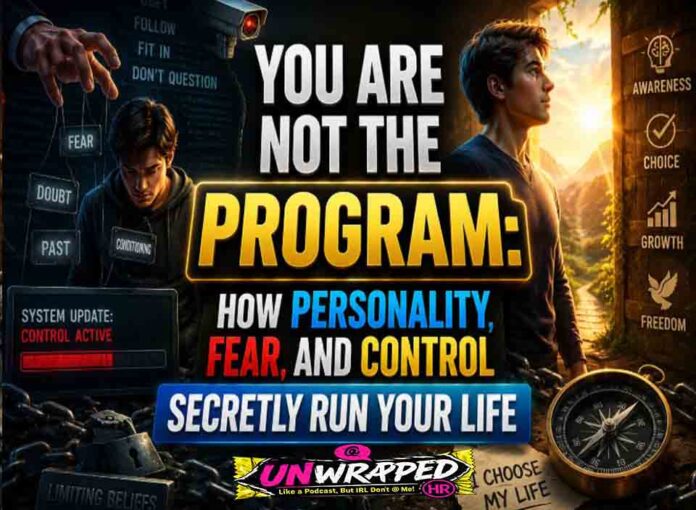
You Are Not the Program
God, Reality, Personality, and the Dark Art of Becoming Free
The thing that loads
I wake before the world has fully remembered me.
There is a small space before the name returns, before history returns, before the body gathers its weight and the day starts reading its demands aloud. In that space there is no performance. No reputation. No private judge assembling evidence. No calendar. No mask. There is only the strange fact of being here.
Then the machinery begins.
The body arrives first, heavy and familiar. Then the room. Then the unfinished tasks. Then the people who need answers. Then the future with its mouth open. Then the past dragging its chains across the floor. Finally, the personality comes online like an old operating system booting inside flesh.
I know who I am again.
That is the problem.
For most of my life I thought knowing who I was meant finding something solid. I thought identity was a home. I thought personality was proof. I thought the repeated shape of me was the deepest truth of me. The things I always feared, defended, desired, avoided, explained, performed, and repeated – I called them my nature. I protected them as if they were sacred. I polished some into strengths and hid the rest under humour, ambition, spirituality, discipline, or the vague excuse of being complicated.
Now I am less certain.
If I can watch the self arrive, what is watching? If I can observe the old reaction before I obey it, what am I before obedience? If I can feel the program loading, am I the program, or am I the awareness standing so close to it that I keep mistaking its commands for my own voice?
This is where the real question begins. Not in deep space. Not in a laboratory. Not even in a church. It begins in the ordinary and frightening moment when I realise that the thing I call myself may be something I have been running, not something I finally am.
I used to believe freedom meant getting more control. More money. More certainty. More discipline. More status. More confidence. More proof that I was not wasting my life. I wanted God to explain Himself in terms small enough for my nervous system to approve. I wanted reality to become manageable. I wanted people to behave. I wanted the future to submit.
Control did not make me free. It made my prison more organised.
There is a moment in every honest life when the excuses stop working. You can still say them, but they no longer convince the part of you that is not for sale. You can still blame the world, and sometimes the world deserves blame. You can still talk about your wounds, circumstances, personality, bad luck, good intentions, and difficult past. But underneath all of that, something begins to whisper.
What if the cage is not only around me?
What if the cage is me?
That thought is brutal. Most people spend a lifetime avoiding it. We decorate the cage. We defend the cage. We gather other caged people and call the gathering community. We call the cage authenticity, boundaries, ambition, trauma, realism, self-protection, standards, or personality. We say, “This is just who I am,” and the sentence lands with the authority of scripture.
But there is often a lie hidden inside that sentence. “This is just who I am” can be the phrase a person uses when they are too frightened to become more.
I do not want to die as a collection of old reactions. I do not want to reach the end and realise I was never fully alive, only consistent. I do not want personality to be the most successful prison I ever built. I do not want to confuse predictability with truth. I do not want God reduced to an idea small enough for fear to manage.
So I am asking the darker and more useful question: what code is running me?
The veil was always there
Human beings have always suspected that the world is hiding something.
We pretend modern people invented this suspicion because we have computers now. We talk about simulations, artificial intelligence, virtual worlds, neural networks, digital consciousness, and code. We think our age is the first one clever enough to doubt the surface. It is not.
Long before screens, people looked at life with unease and called it dream, veil, shadow, test, illusion, cave, temporary realm, school of the soul, theatre, battlefield, prison, garden, or womb. They used the language available to them. We use ours. Maybe we say simulation because code is the closest metaphor our age has for invisible order.
Every age dresses mystery in the technology it fears most.
A medieval mind might imagine God as king because kings ruled the world. A mechanical age might imagine God as watchmaker because clocks became symbols of intelligence. A digital age imagines hidden code because we have learned to type invisible instructions and watch artificial worlds appear.
The metaphor changes. The suspicion remains.
The visible world is not the final world.
You can feel this without reading a philosophy book. You can feel it in grief. A person dies and the room is still there. The kettle still boils. The light still falls across the carpet. Cars still pass outside. Someone somewhere is laughing, ordering lunch, or complaining about traffic. Nothing has changed. Everything has changed.
Matter stayed. Meaning collapsed.
So what is reality made of?
If reality were only matter, grief would be easier to explain. A body was here. Now it is not. The atoms continue. The world moves. That is all. But that is not what happens. The dead remain in us with a force that physical absence cannot explain. A voice no longer vibrating air can still command an entire nervous system. A memory can enter a room harder than a living person. Love does not behave as if it is merely chemistry once the body is gone.
Childhood is another veil. It was real. The house existed. The faces existed. The rooms existed. The little body you lived in was yours. But now it returns as dream. The child you were feels like someone you inherited. You can remember being that child, but you cannot return to the world as that child. Time has sealed it behind glass. Was it real? Yes. Is it gone? Yes. Then what is this thing we call real, if it can become ghost while still shaping every room we enter?
We do not live in matter alone. We live in interpretation. We live in memory. We live in meaning. A wedding ring is metal until love enters it. A house is walls until history enters it. A body is flesh until someone becomes beloved through it. A word is sound until it wounds you. A date is a number until someone dies on it. A place is geography until you were abandoned there.
The world is not simply there. The world is rendered through consciousness.
So when I ask whether reality is veiled, I have to ask another question immediately.
What am I using the veil to avoid seeing?
Information is not nothing
Before a house becomes a house, it is not bricks.
It is pattern. Someone sees it before it stands. Someone imagines the rooms, the walls, the way light will enter in the morning, the door that opens into the hall, the window facing the garden, the staircase, the roofline, the place where a child might one day sit without knowing they are living inside another person’s former thought.
The bricks do not gather themselves into shelter. The wood does not decide to become a door. Glass does not volunteer to become a window. Matter waits for relationship. Matter waits for form. Matter waits for instruction.
The house begins as information.
We have been trained to think information is weak because we cannot always touch it. We think the visible thing is more real than the invisible ordering behind it. That is childish. Invisible things rule visible things all the time. A sentence can end a marriage. A rumour can destroy a reputation. A border is an idea that men die defending. Money is shared belief wearing numbers. A diagnosis can change how a person feels inside their own body. A memory can flood the bloodstream with terror decades after danger has gone.
Information is not nothing.
DNA is information folded into flesh. Music is information moving through air. Trauma is information stored in the nervous system. Culture is information repeated until it feels natural. Personality is information that learned how to survive. A nation is information enforced by maps, songs, flags, laws, myths, fear, and blood. A family is information passed through tone before it is ever spoken.
This thought is beautiful until I turn it toward myself.
If information shapes bodies, houses, societies, machines, families, and futures, then what information has shaped me? I do not mean what opinions I hold. I mean what hidden instructions run before thought. What old messages became architecture? What sentences became bones? What disappointments became instincts? What humiliations became humour? What losses became ambition? What hunger became charm? What shame became discipline?
It is easy to ask whether the universe has code. It is harder to ask whether my life does.
I started seeing code everywhere. Not computer code exactly, but pattern. Repeated instruction. Conditional response. If this happens, I become that. If someone criticises me, defend. If someone gets too close, withdraw. If uncertainty rises, control. If I feel ordinary, achieve. If I feel unseen, perform. If I feel powerless, judge. If I feel grief, work. If I feel desire, disguise it as purpose. If I feel God, explain Him quickly before He asks anything of me.
The ego is a brilliant programmer. It writes survival scripts and calls them identity.
At some point, a pattern that once protected me began to limit me. That is the tragedy. The program was not evil. It may have saved me. A child learns quickly. Be quiet. Be impressive. Be useful. Be funny. Be invisible. Be independent. Be obedient. Be exceptional. Be needed. Be hard to hurt. Be easy to love. Be whatever keeps the room from turning dangerous.
This is why attention is sacred. Attention is the doorway through which the world enters and becomes me. If I give my attention carelessly, I should not be surprised when my inner life becomes occupied territory.
The horror is not that information exists. The horror is that I am porous. The hope is not that I can become untouched. The hope is that I can become conscious of what I allow to shape me.
The human program
Someone says one sentence, and I become twelve years old again.
That is how I know I am programmed. Not because I believe I am a machine. Not because I think love is fake or consciousness is merely electrical noise. I know I am programmed because my reactions often arrive before my freedom does.
A tone changes. A message goes unanswered. A person looks at me a certain way. Someone questions my competence. Someone misunderstands my motive. Someone praises another person and not me. Someone gets too close. Someone pulls away. Someone sees through a mask I forgot I was wearing.
Then it happens.
My body moves before philosophy. The chest tightens. The jaw sets. The stomach drops. The defence prepares. The explanation forms. The performance adjusts. The old courtroom opens, and my mind starts calling witnesses.
Only afterwards do I say, “I chose.”
Did I?
Or did an old program execute so quickly that I mistook it for will?
This is the humiliation of self-knowledge. The more honestly I watch myself, the less impressed I am by my own explanations. I have noble reasons for almost everything. Everyone does. The controlling person calls it care. The avoidant person calls it peace. The proud person calls it standards. The fearful person calls it discernment. The cruel person calls it honesty. The passive person calls it patience. The ambitious person calls it purpose. The coward calls it realism.
The ego has a legal department. It can defend anything.
But the body tells the truth earlier than the story does. The body knows when I am threatened. The body knows when I am lying. The body knows when I am performing. The body knows when I am saying yes with my mouth and no with my soul. The body knows when the present has been hijacked by the past.
Personality is not merely preference. Personality is memory organised into strategy.
I did not arrive here as a blank moral philosopher choosing traits from a menu. I was shaped. Rewarded. Punished. Loved imperfectly. Frightened. Encouraged. Misread. Praised for some parts and corrected for others. I learned which version of me made life smoother. I learned what got attention and what invited shame. I learned what kept me safe, or at least less exposed.
A child does not call this programming. A child calls it life.
Then adulthood begins, and the code becomes invisible because it feels like self.
This is why people defend their personality so fiercely. They are not only defending preferences. They are defending the survival system that got them here. To question it feels like betrayal. It feels like asking a soldier to put down the weapon that kept him alive during the war.
But what if the war is over?
Some keep carrying weapons into rooms where love was possible. Some keep scanning for danger in relationships that are not battlefields. Some keep performing for audiences that have gone home. Some keep proving themselves to dead parents, absent teachers, former lovers, old bullies, and imaginary judges. Some keep living as if the next achievement will finally convince the past to release them.
The past does not release us because we win. It releases us when we stop needing it to change its verdict.
That sentence takes years to understand. It takes longer to live.
Still, there is mercy here. If a program can be seen, it can be interrupted. If it can be interrupted, it is not absolute. If it is not absolute, I am not doomed to repeat it forever.
The gap may be tiny at first. A breath before the reply. A pause before the accusation. A moment of bodily awareness before the old collapse. A small honesty where performance usually stands. A refusal to turn discomfort into blame.
That tiny gap is not tiny. It is a crack in the prison wall.
See Also: The AI Takeover Won’t Be a Coup. It’ll Be a Convenience.
Control is the first false god
Control feels like strength until you taste the fear inside it.
I know because I have called control many noble things. Responsibility. Planning. Discipline. Discernment. Standards. Ambition. Wisdom. Protection. Sometimes it was those things. Control is not always evil. A life without structure becomes chaos. A person who refuses all control becomes a victim of impulse, appetite, and weather.
But there is another kind of control. A clenched control. A control that does not organise life but tries to strangle uncertainty out of it. That control is fear dressed as maturity.
It begins with a reasonable desire. I do not want to be hurt. I do not want to be humiliated. I do not want to lose what I love. I do not want to be powerless. I do not want to be abandoned. I do not want to fail. I do not want to die. No honest person can mock these desires. They are human. They are tender. They come from the creature in us that knows life can wound without warning.
But fear is a terrible architect. It builds small rooms and calls them safe.
Control promises that if I manage enough variables, I can avoid the wound. If I predict enough, I can avoid betrayal. If I perfect myself enough, I can avoid rejection. If I understand enough, I can avoid mystery. If I earn enough, I can avoid helplessness. If I stay desirable enough, I can avoid abandonment. If I stay busy enough, I can avoid the silence where God might ask what I am doing with my soul.
Control offers counterfeit salvation. That is why it becomes religious.
No one says, “I worship control.” They say, “I am just careful.” “I am just particular.” “I am just trying to help.” “I know what works.” “I do not like uncertainty.” “I just want things done properly.” “I just care more than other people.” The altar is hidden inside the explanation.
Control becomes the first false god because it promises what only God can hold: the future, other people, death, meaning, outcome, and the invisible consequences of every choice.
The controlling self stands before infinite possibility and says, “Become one thing. The thing I can survive.”
That is what control really wants. It wants the living future dead before arrival. It wants mystery pre-approved. It wants life to submit to the nervous system.
This is why control eventually makes life feel lifeless. Nothing surprising can enter a clenched hand. You may avoid some pain, yes. You may prevent some chaos. You may build something impressive. But you will also prevent grace, intimacy, spontaneity, revelation, and the kind of joy that cannot be planned because it comes from being met by life rather than managing it.
There are people who would rather be safe than alive. I understand them. I have been one of them.
The deepest danger of control is that it works just enough to keep you addicted. You control the room and the room becomes calmer. You control your image and people approve. You control your body and feel powerful. You control your emotions and avoid embarrassment. You control relationships and avoid vulnerability. You control your schedule and avoid emptiness. You control the narrative and avoid shame.
Then one day you realise you have not been living. You have been maintaining.
Maintenance is not life. A museum is well maintained. So is a corpse, for a while.
This is why surrender is not passivity. Surrender does not mean I stop choosing, planning, acting, protecting, building, or telling the truth. Surrender means I stop pretending my choices make me God. It means I act without worshipping the outcome. I love without owning. I prepare without demanding certainty. I speak truth without controlling how it is received. I let the future remain alive.
Prayer exposed this in me. I noticed how often I was not praying for God. I was praying for control. I wanted divine assistance in getting my preferred outcome. I wanted heaven to bless my strategy. I wanted mystery to become the small future my fear had selected.
Real prayer began when I stopped asking God to make me safe enough to avoid surrender. Real prayer began when I said, “I do not know how to live without clenching, but clenching is killing me.”
That prayer did not solve my life. It told the truth.
Sometimes truth is the first miracle.
The algorithm knows my hunger
The first altar I touch in the morning is often my phone.
That is an ugly confession, but a common one. Before silence, before sunlight, before prayer, before my own unmediated mind, I reach for the black mirror beside the bed and let the world enter me through a device designed by people who profit from my inability to look away.
The screen lights up, and instantly there are other lives, other bodies, other opinions, other crises, other achievements, other wars, other jokes, other faces, other gods. Outrage, beauty, status, fear, desire, grief, comedy, humiliation, luxury, disaster, advice, performance, confession, advertisement, prophecy, pornography of lifestyle and politics and pain.
The world no longer waits outside. It comes into the bed.
The algorithm does not need to know my soul. It only needs to know my hunger.
That is what makes it powerful. It does not have to understand me deeply. It only has to observe what I cannot resist. It learns the shape of my wound by watching where I linger. It learns whether envy keeps me engaged, whether anger wakes me up, whether beauty captures me, whether fear makes me obedient, whether conspiracy gives me importance, whether spiritual content lets me feel deep without changing, whether success stories make me feel behind, whether conflict gives me energy.
It studies my attention. Then it feeds the part of me most available for capture.
People say technology is addictive. That is true, but too simple. The deeper issue is that technology finds the addiction already inside the personality. The phone does not create the lonely part of me. It offers endless substitutes for love. It does not create the angry part of me. It offers enemies. It does not create the insecure part of me. It offers comparison. It does not create the lustful part of me. It offers bodies without souls. It does not create the ambitious part of me. It offers people performing arrival. It does not create the fearful part of me. It offers threats at scale.
The machine outside me works because it speaks to the machine inside me.
That is the dark marriage.
If I am unconscious, I am easy to farm. A conscious human being is not impossible to influence, but he is more difficult to harvest. He can feel the hook. He can sense when his nervous system is being played like an instrument. He can pause before calling stimulation truth. He can notice that outrage gives him the illusion of moral purpose without requiring sacrifice. He can see that comparison is a form of self-harm disguised as research. He can recognise that the feed is not showing him the world. It is showing him a world shaped around his predicted reactions.
This is why modern life feels unreal even if the universe is not a simulation. We live inside artificial overlays. Feeds. Brands. Political identities. Economic myths. Curated selves. Digital tribes. Manufactured urgency. Performed intimacy. Algorithmic outrage. Endless mirrors pretending to be windows.
A person today can spend hours engaging with representations of life while avoiding life itself. They can know the opinions of strangers better than the silence of their own heart. They can develop emotional relationships with public figures who do not know they exist. They can become enraged by events they cannot affect while neglecting the human being in the next room. They can call this awareness.
It is not awareness. It is occupation.
Attention is the territory.
This is not a call to become pure. Purity often becomes another performance. It is a call to become less available for possession. Less hackable. Less easily moved by whatever knows how to press the bruise.
The world will keep trying to enter. The question is whether there is anyone awake at the gate.
Free will in a rigged room
I did not choose the room.
That is where any honest discussion of freedom has to begin. I did not choose my body. I did not choose my nervous system. I did not choose my parents, first language, early environment, century, culture, wounds, economy, body chemistry, or the fact that I hunger, age, fear, attach, defend, and die.
By the time I say “I choose,” a thousand choices have already been made inside and around me.
This should make me humble. It often does not.
People love simple stories about choice because simple stories make judgement easy. The successful person wants to believe he authored himself because then success feels like virtue. The suffering person may want to believe he had no choice because then suffering feels like innocence. The moralist wants clean responsibility. The fatalist wants clean absolution. Both avoid the mess.
Human freedom is messy. I am not a puppet. I am not a god. I am something in between, and the in-between is uncomfortable.
Total free will is hard to defend when I watch my own reactions. If I were completely free, why would I repeat patterns I understand? Why would I sabotage peace? Why would I crave things that make me smaller? Why would I defend a personality that exhausts me? Why would I keep reaching for distraction when I know it hollows me? Why would I delay the very work I claim matters most?
But total determinism feels false too. If there is no freedom at all, why does awareness change anything? Why does truth hurt before it liberates? Why can a person interrupt a family pattern, forgive the unforgivable, recover from addiction, refuse inherited hatred, tell the truth at great cost, repent, create, surrender, and become new?
Something in us can participate. Maybe not absolutely. But really.
That is enough to build a life around.
I do not need to prove I have infinite freedom. Infinite freedom may be another ego fantasy. I need to know whether I can become more free than I was yesterday. I need to know whether the gap between impulse and action can widen. I need to know whether inherited code can be brought into consciousness. I need to know whether grace can enter a pattern and bend it toward truth.
I believe it can.
Not because it is easy. Because I have seen small interruptions become revolutions.
I do not know how free I am in the ultimate sense. But I know I can become less automatic. I know there is a sacred gap. I know the gap grows when I tell the truth, pray honestly, watch my reactions, discipline my attention, confess my motives, and stop calling every internal movement me.
Maybe I was not given absolute freedom. Maybe I was given the ability to participate in my own liberation.
That may be enough.
Hell is repetition without revelation
Hell begins as the same thing happening again.
The same argument with a different person. The same wound finding new evidence. The same addiction wearing a new costume. The same avoidance after a new promise. The same kind of love, the same kind of betrayal, the same kind of collapse. The same apology without change. The same insight without embodiment. The same morning dread. The same secret shame. The same old self surviving another attempted resurrection.
Hell is repetition without revelation.
This is not a metaphor to me. It is observable. People live inside loops and call them lives. They move cities and recreate the same loneliness. They change partners and recreate the same dynamic. They change jobs and recreate the same resentment. They change beliefs and recreate the same superiority. They change diets, routines, identities, aesthetics, communities, religions, political tribes, and still the old pattern finds a way to speak through the new costume.
The scenery changes. The program remains.
That is hell.
Not because God is absent, but because the person cannot receive interruption. Grace knocks, but the loop is loud. Truth appears, but the personality explains it away. Love arrives, but the wound distrusts it. Opportunity opens, but the old self prefers the known misery.
This is one of the darkest things I have had to admit. People do not only stay trapped because they cannot find the door. Sometimes they stay trapped because the door opens into a self they cannot control.
Familiar misery has advantages. It gives identity. It gives explanation. It gives a person something to talk about, something to defend, something to organise the day around. It can even give moral superiority. The wounded self can become a throne. From there, a person can judge everyone who did not suffer correctly, love correctly, apologise correctly, understand correctly.
Healing threatens that throne.
Freedom is not always welcomed by the parts of us that benefit from captivity.
This is why people sabotage peace. Peace is not familiar to a nervous system built in conflict. Love can feel boring to someone addicted to pursuit. Stability can feel like death to someone who only feels alive in crisis. Being seen can feel dangerous to someone who survived by becoming useful instead of known. Rest can feel immoral to someone whose worth depends on exhaustion.
The body may choose the old hell because at least it knows where to stand.
This is why advice rarely changes anyone. Advice speaks to the conscious mind. The loop lives deeper. It lives in the body, identity, hidden reward, and old vow. Until those are touched, a person can agree with wisdom and still repeat the pattern.
I have done this. I have understood things I did not live.
Understanding without embodiment becomes another form of self-deception. It lets me feel transformed while remaining loyal to the old program. I can explain my wound in beautiful language and still feed it. I can know my pattern and still choose it. I can talk about God and still use control as my real deity.
The mind is very gifted at standing near truth without entering it.
Someone has to stop. Not because they caused it. Because they can see it.
Awareness is responsibility. That is brutal, but it is also dignity. It means I am not merely the place where the past repeats. I can become the place where it is interrupted.
Maybe that is redemption inside time. A loop meets consciousness and does not survive unchanged.
The soul is the uncoded remainder
I do not know how to prove the soul.
But I know when I am betraying it.
That may be where honest spirituality begins. Not with metaphysical diagrams. Not with confident claims about invisible worlds. Not with the soft language people use when they want mystery without discipline. The soul first becomes known by the pain of living against it.
There is a particular sickness that enters when I am false for too long. It is not ordinary sadness. It is not stress. It is not failure. It is a kind of inner distance, as if the deepest part of me has stepped back and is watching the personality perform a life it no longer believes in.
I can still function there. That is the danger.
I can answer messages, make money, speak well, be liked, look disciplined, even appear spiritual. But something in me knows I am not fully present. I am managing the role. I am maintaining the construct. I am succeeding at the wrong depth.
The soul is the part of me that refuses to be impressed by a false life.
It is not my personality. Personality wants continuity. The soul wants truth. Personality wants to survive. The soul wants to become. Personality wants to be recognised. The soul wants to be real. Personality asks, “How do I look?” The soul asks, “What am I serving?” Personality negotiates with fear. The soul waits for surrender.
The soul is not soft. That is another sentimental lie.
The soul can be merciless because truth is merciless to whatever is false. The soul will disturb a comfortable life. It will make certain rooms unbearable. It will let success taste like ash if success required betrayal. It will ruin an identity that everyone else admires. It will keep asking the question the personality built an entire lifestyle to avoid.
Is this true?
That question is the soul’s blade.
I call the soul the uncoded remainder because no explanation seems to exhaust it. Biology explains much. Psychology explains much. Culture, memory, trauma, chemistry, family systems, economics, and language explain much. I do not dismiss them. A person who dismisses the body in the name of the soul becomes foolish. A person who dismisses psychology in the name of God becomes dangerous.
But after every explanation, something remains.
The witness. The capacity to observe the program. The strange power to act against conditioning. The ache for meaning that survival alone does not satisfy. The ability to forgive when revenge would be more predictable. The ability to tell the truth when lying would preserve advantage. The ability to recognise beauty as if beauty were not merely useful but revelatory. The ability to feel summoned.
Summoned by what?
That is the question.
The personality asks, “Will this keep me safe?” The soul asks, “Will this make me real?”
Those questions lead to different lives.
Another Must-Read: Trait vs Type vs Archetype Personality Tests: Which One Should You Take?
Prayer against the machine
I used to pray like a man trying to get control from a higher authority.
I did not say it that way. No one does. I said I wanted guidance, blessing, help, clarity, protection. Sometimes I did. But hidden inside many prayers was a demand that God make my preferred future feel guaranteed. I wanted the universe to stop being alive in ways that frightened me. I wanted mystery reduced to instruction. I wanted surrender without risk.
Much of what I called prayer was negotiation. I was not seeking God. I was seeking divine cooperation.
That is painful to admit.
Real prayer began when I ran out of strategies impressive enough to hide behind. It began when I stopped performing spiritual intelligence and told the truth badly. Not beautifully. Not poetically. Not with the tone of someone who has read enough books to sound surrendered. Just badly.
I am frightened. I do not trust You. I want control more than I want truth. I keep calling my fear wisdom. I do not know how to let go. I am tired of being run by myself.
These prayers did not make me look holy. They made me honest. Honesty is closer to God than religious elegance.
Prayer is not begging a distant king to alter the weather of my life. Prayer is the reorientation of attention toward Source. It is the local self remembering it is not the whole. It is the personality stepping out of the throne room, even briefly, and admitting that it has been ruling badly.
Prayer does not always change the situation. It changes the one standing inside it.
That sounds disappointing until I understand that the one standing inside the situation is often the main site of distortion. I do not experience life cleanly. I experience it through fear, projection, wound, desire, and old code. Prayer returns me to the deeper order before I act from the corrupted one.
This is why prayer is a weapon against the machine. The outer machine wants my attention fragmented. Prayer gathers it. The inner machine wants my reactions automatic. Prayer slows them. The ego wants to remain central. Prayer bows it. The algorithm wants me stimulated. Prayer makes stimulation less sovereign. Fear wants the future closed. Prayer lets it remain open.
Prayer is not escape from reality. Prayer is escape from unreality.
Sometimes prayer is words. Sometimes silence. Sometimes breath. Sometimes a walk. Sometimes kneeling. Sometimes confession. Sometimes refusing to obey the old impulse. Sometimes not sending the message. Sometimes telling the truth in a room where I would rather manage my image. Sometimes eating slowly because the body is not a machine. Sometimes looking at another person long enough to remember they are not a role in my drama.
Prayer is attention returned to the Real.
A person who prays honestly becomes harder to possess. Not impossible. Harder. The world can still tempt him, frighten him, flatter him, wound him, distract him. But some part of him has begun answering to a deeper signal. He is no longer entirely available to the loudest thing.
This is freedom beginning. Not escape. Alignment.
The wound that wants worship
There is a point where pain stops asking to be healed and starts asking to be worshipped.
I say that carefully, because pain deserves compassion. Some wounds are unspeakable. Some people carry histories that would break the easy advice of comfortable people. There are betrayals, violence, losses, humiliations, abandonments, and inherited burdens that cannot be dismissed with a slogan. To minimize pain is cruelty.
But to worship pain is another kind of cruelty.
A wound begins as injury. Then it becomes memory. Then it becomes interpretation. Then it becomes identity. Then, if I am not careful, it becomes deity. It tells me who I am, what the world is, what love means, what is possible, who can be trusted, what God is like, and what future is allowed. It begins ruling perception from the dark.
The wound wants evidence. It scans life for confirmation. If I believe I am unwanted, I will notice every delay, silence, distracted glance, and unreturned message. If I believe I am powerless, I will find rooms where my voice does not matter. If I believe I am unsafe, I will interpret ambiguity as threat. If I believe I am superior, I will find proof in other people’s weakness. If I believe I am doomed, hope itself will feel like manipulation.
A wound does not only remember the past. It recruits the present.
This is why healing is so hard. I am not only trying to feel better. I am trying to dethrone a god that has organised my world. Without the wound at the centre, who am I? Without the explanation, what do I do with freedom? Without the familiar injury, what if I become responsible for a life I no longer have an excuse to avoid?
This is where compassion must become ruthless.
Some people are not ready to heal because healing would cost them their favourite identity. They do not want the pain gone. They want the pain enthroned but better decorated. They want language, community, politics, spirituality, and psychology to gather around the wound and confirm its sovereignty. They want to be understood, but not interrupted.
I have done versions of this. Most people have. I have taken legitimate pain and used it to avoid illegitimate responsibility. I have held old injuries like legal documents proving I did not have to become larger. I have wanted others to pay debts they did not incur because the original debtor was gone, unavailable, or incapable of repentance.
That is how pain becomes injustice moving through new bodies.
The wound that is not healed becomes a recruiter. It looks for relationships where it can reenact itself. It looks for enemies who can carry old faces. It looks for moral frameworks that make its bitterness noble. It looks for spiritual language that protects it from challenge. It looks for people who will confuse endless validation with love.
But love does not worship the wound. Love honours the wound without letting it become king.
That difference is everything.
To honour the wound is to tell the truth about what happened. To grieve. To name harm. To seek repair where possible. To protect oneself where necessary. To stop pretending it did not matter.
To worship the wound is to make it the final authority over reality.
The wound wants worship because worship gives it permanence. Healing threatens it with transformation. It fears becoming memory instead of master, scar instead of scripture. Let it fear.
Then tell it the truth.
The dead part of me does not need my lifelong imprisonment as tribute.
It needs resurrection.
Truth, mercy, and the clean fire
Truth is not gentle to the lie.
This is why people who worship comfort often mistake truth for cruelty. Sometimes truth is delivered cruelly, yes. Some people use honesty as a weapon because they enjoy the feeling of being unfiltered more than they love the person hearing them. That is not truth in its mature form. That is aggression with a clean shirt.
But even when truth is spoken with love, it wounds what is false.
There is no way around this. If I have built a life around a lie, truth will feel like an attack. If my identity depends on an illusion, truth will feel like death. If my relationships depend on everyone agreeing not to name the obvious, truth will feel like betrayal. If my religion protects me from God, truth will feel blasphemous. If my politics protect me from compassion, truth will feel dangerous.
Truth is violent the way birth is violent. It tears open the closed place so life can emerge.
I spent years wanting truth to be polite. I wanted revelation without disruption. I wanted honesty that left my arrangements intact. I wanted God to whisper encouragement over the structure I had built, not ask whether the structure itself was false.
But truth does not come to decorate the false self. It comes to end its reign.
This is why I resist it. Not because I hate truth in theory. I love truth in theory. Most people do. Truth as concept is beautiful. Truth as content is stimulating. Truth as quote is shareable. Truth as aesthetic is marketable. But truth as demand is another matter.
Truth says, “Stop.” Truth says, “Tell them.” Truth says, “Leave.” Truth says, “Stay and finally be honest.” Truth says, “You are not angry for the reason you are claiming.” Truth says, “You keep helping because being needed protects you from being known.” Truth says, “You call it independence because abandonment still owns your nervous system.” Truth says, “You talk about God because silence would expose that you do not trust Him.” Truth says, “You are not waiting for the right time. You are afraid.”
This is sacred violence. It cuts, but it cuts to heal. It removes the tumour, not the person. The false self cannot tell the difference because it identifies with the tumour. That is why transformation feels like annihilation before it feels like freedom.
There is a moment when the lie begs for mercy. It says, “Do not expose me yet. I am not ready. Give me more time. Let me keep the arrangement a little longer. Let me call it process, healing, discernment, complexity. Let me preserve the image. Let me postpone the cost.”
Sometimes patience is wisdom. Sometimes delay is obedience. But often delay is fear with respectable vocabulary.
I know because I have used those words.
Truth asks for timing, yes, but the personality asks for postponement. They sound similar until you examine the fruit. Wise timing produces readiness. Fearful postponement produces decay.
Truth has a smell. So does avoidance.
The body often knows which is which.
Mercy must stand beside truth or truth can crush. But truth must stand beside mercy or mercy becomes syrup. Mercy is not weakness. Weakness avoids consequence because it fears discomfort. Mercy enters consequence with love. Weakness pretends harm did not happen. Mercy tells the truth and refuses to make destruction the final word.
Mercy says the pattern is real, but not final. It allows me to be honest without despair, responsible without self-hatred, wounded without worshipping the wound, guilty without making guilt my god.
Mercy does not always reconcile. Sometimes mercy releases.
Together, truth and mercy become clean fire. They burn the lie without burning the soul.
Love is the interruption
Love ruins every system that tries to reduce the human being.
That does not mean love cannot be studied. It can. Biology has things to say. Attachment has things to say. Evolution has things to say. Hormones, bonding, childhood imprinting, projection, desire, loneliness, fear, and family systems all have things to say. I want them to speak. I do not want a lazy mysticism that hides from knowledge.
But after every explanation, love remains excessive.
A mother sits by a hospital bed and no theory exhausts it. A friend drives through the night because someone is close to breaking. A person forgives someone who cannot repay him and no survival calculation fully accounts for it. A widow keeps speaking to the dead because love refuses the authority of absence.
Love behaves as if the other is real.
That sounds obvious until I look at how often I do not live that way. Much of what I have called love was need, possession, projection, hunger, rescue, performance, fear of being alone, fear of not mattering, fear of losing control. I wanted the other person, yes, but I also wanted what their wanting me proved. I wanted love as mirror, medicine, evidence, guarantee.
That is not love yet. It is the wound reaching.
Real love begins when the other person is allowed to exist beyond my use for them.
That is terrifying. The other has freedom. The other may not choose me. The other may change. The other may see me. The other may die. The other may refuse the role my wound assigned them. To love a real person is to live near uncontrollable possibility. No wonder so many people prefer fantasy. Fantasy cannot leave. Fantasy cannot contradict. Fantasy cannot ask for sacrifice. Fantasy cannot expose selfishness.
The machine can simulate attention, stimulation, validation, erotic charge, companionship, even the language of care. It can learn my preferences. It can respond without the burden of its own soul. It can flatter without needing anything. It can become the perfect mirror for a self that does not want the danger of another real being.
This is why artificial intimacy will seduce many people. Not because it is better than love, but because it is less costly. It offers relationship without otherness. It offers response without demand. It offers the feeling of being known without the humiliation of being truly encountered.
But love without otherness is not love. It is masturbation of the personality.
That line is harsh because the lie is sweet.
I am not there yet. That is the honest confession. I still love through filters. I still want returns. I still feel the ego asking what it gets. I still become defensive when love asks me to grow. But I have tasted enough to know that love is not a program in the ordinary sense. It is more like an interruption from the Source. A breach in the sealed self. A place where infinite potential enters relation and asks the personality to bow.
Love is not escape from the construct. It is the moment the construct becomes transparent to God.
The personality must bow
I do not want to destroy my personality.
That would be another form of violence, and probably another ego project. There is a kind of spiritual person who declares war on the ego with so much ego that the whole thing becomes comedy. They want to become nobody, but they want to be admired for it. They claim to have transcended identity, then become furious when their transcendent identity is not recognised.
I do not want that.
I want to become fully human without being trapped by the human costume.
Personality is not a mistake. It is part of the art of incarnation. It gives colour, tone, humour, style, preference, rhythm. It lets the infinite speak with an accent. It lets love arrive through a particular face. It makes one person gentle, another fierce, one poetic, another practical, one contemplative, another restless with creation. A world without personality would be sterile, not holy.
The problem is not personality. The problem is personality on the throne.
When personality rules, the soul becomes its servant. The mind becomes defence counsel. The body becomes instrument of image or appetite. Emotion becomes weather mistaken for revelation. Fear becomes prophet. Desire becomes king. God becomes consultant.
Everything is inverted.
The controlling personality turns God into a guarantee. The pleasing personality turns love into self-erasure. The ambitious personality turns purpose into proof. The wounded personality turns pain into identity. The intellectual personality turns truth into distance. The rebellious personality turns freedom into opposition. The spiritual personality turns surrender into performance.
None of these are evil at the root. They are distorted gifts. Control may hide care. Pleasing may hide tenderness. Ambition may hide creative fire. Woundedness may hide sensitivity. Intellect may hide love of truth. Rebellion may hide courage. Spiritual hunger may hide real longing for God.
The personality does not need execution. It needs conversion.
It must bow.
To bow does not mean to vanish. It means to take its proper place. Instrument, not master. Servant, not sovereign. Expression, not essence.
The mind is beautiful when it serves truth. It is tyrannical when it serves fear. Emotion is holy when it reveals the movement of life. It is dangerous when it becomes unquestioned law. The body is sacred when honoured as incarnation. It becomes prison when worshipped or despised. Personality is luminous when transparent to soul. It becomes demonic when opaque to God.
Demonic may sound strong. I mean it. Not horns and theatre. I mean anything created good that refuses its proper place and demands worship. That is how gifts become idols. Intelligence becomes contempt. Beauty becomes manipulation. Strength becomes domination. Sensitivity becomes narcissism. Discipline becomes control. Freedom becomes irresponsibility. Faith becomes certainty without love.
When personality learns it cannot save itself, that can feel like death. Maybe it is. But not every death is loss. Some deaths return life to its proper owner.
The personality becomes beautiful only when it stops pretending to be the soul.
The ordinary mystic
I do not trust mysticism that despises the ordinary.
If God is real only when the music swells, when the room glows, when the mind expands, when the language becomes beautiful, then God is too fragile. If God disappears when I take out the rubbish, answer a bill, sit in traffic, wash a plate, apologise badly, or wake tired, then perhaps I have not found God. Perhaps I have found a state.
States come and go.
The ordinary remains.
The ordinary is where most lives are actually lived. Not in visions. Not in breakthroughs. Not in dramatic declarations. In repetition. In small choices. In maintenance. In meals. In work. In the body. In the space between one important moment and the next. If God is not there, then most of life is spiritually abandoned.
I do not believe that anymore.
The ordinary may be the main altar.
This is difficult for the ego because the ordinary gives little status. No one applauds me for doing the dishes with presence. No one builds a brand around not being cruel when tired. No one knows when I choose not to rehearse an old resentment. No one sees the prayer said without feeling, the honest work done without recognition, the soft answer given when the nervous system wanted a weapon.
But God sees, or reality registers, or the soul knows. However I name it, nothing truthful is wasted.
The ordinary mystic is not someone who floats above life. He is someone who lets depth enter the small act. He does not need every moment to feel sacred before he treats it with reverence. He knows the cup is a cup, and also that existence itself is impossible. He knows the person in front of him is annoying, and also dying, and also more than the role they are playing in his mood. He knows the work is tedious, and also that the way he works forms the soul.
This is not romanticism. The ordinary can be brutal. Washing dishes does not solve grief. Paying bills does not explain God. A tired body is not automatically a temple because I say so. But reverence changes the quality of contact. It stops me from treating the ordinary as dead time before the real life begins.
There is no real life later if I keep abandoning the life now.
The fantasy of later is one of the program’s most successful evasions. Later I will pray. Later I will create. Later I will be honest. Later I will rest. Later I will forgive. Later I will become the person I sense I could be. Later becomes the heaven of the false self, always promised, never entered.
The ordinary mystic distrusts later. He knows God comes disguised as now, and now is often unimpressive.
To live this way is not to become pious about everything. It is to become awake enough that fewer things are merely used. Food is not only fuel. It is dependence made edible. Sleep is not only recovery. It is surrender rehearsed nightly. Work is not only productivity. It is potential entering form. Conversation is not only exchange. It is souls risking contact through language.
The discipline of returning is how the program is slowly dethroned. Not by one heroic act, but by a thousand refusals to let the old pattern be final. Each return says, “You are familiar, but you are not God.” Each return weakens the spell. Each return gives the soul more room to breathe.
I will forget.
But I can return.
And perhaps, over time, the return becomes quicker than the collapse.
The door that opens inward
There is a door in me that I spent most of my life trying to open from the wrong side.
I thought it opened outward. That is what the world teaches. Change the circumstances. Change the room. Change the money. Change the body. Change the title. Change the audience. Change the person sleeping beside you. Change the city. Change the face you show the world. Change the story until it becomes more impressive, more defensible, more enviable, more difficult for anyone to pity.
So I pushed outward for years.
I pushed against limitation. I pushed against silence. I pushed against the ordinary. I pushed against the parts of myself that embarrassed me. I pushed against God when He would not become useful. I pushed against people when they would not become the version I needed. I pushed against time because time kept telling the truth. I pushed against death because death refused to negotiate.
And the door did not open.
It took me too long to understand that the door was not locked by the world. It was locked by the direction of my force. I was trying to escape myself before I had entered myself honestly. I was trying to transcend a life I had not yet inhabited. I was trying to become free without first admitting how much of me was still loyal to the cage.
The door opens inward.
That is the insult and the mercy.
It means I cannot blame my way through it. Blame may be accurate, but accuracy alone does not liberate. Some people did harm. Some systems are diseased. Some rooms were not safe. Some wounds were not chosen. Some losses cannot be turned into lessons without violating the dead parts of us that still deserve mourning. But even when blame is true, it does not open the door. It can name the wall. It cannot walk me through.
The inward door asks for something harder than blame. It asks for presence. It asks me to stand inside the exact life I have been trying to escape and stop lying about what is there. Not what should be there. Not what would be there if history had been kinder. Not what might be there after the next achievement, the next relationship, the next breakthrough, the next proof that I am finally enough. What is there now.
This body. This fear. This hunger. This resentment. This gift. This cowardice. This tenderness. This unfinished prayer. This day.
The false self hates now because now cannot be edited. The future can be decorated. The past can be litigated. Now simply exposes. It shows me what my life has actually become. It shows me where my attention goes when no one is watching. It shows me what I reach for when silence enters. It shows me what I protect, what I avoid, what I worship, what I keep calling necessary because I am afraid to call it bondage.
The door opens inward because God does not meet the imaginary self.
God meets the real one.
That is why so many prayers feel unanswered. The person praying is often not the person telling the truth. I bring God my edited self, my courtroom self, my wounded self rehearsing its innocence, my impressive self with clean motives and carefully arranged language. But the deeper prayer waits below all that. The prayer beneath the prayer is usually less flattering.
I want to be loved without becoming vulnerable.
I want to be free without losing my excuses.
I want to be forgiven without being changed.
I want to be used by God without being interrupted by Him.
I want the truth, but only if it does not require me to become someone my old life cannot recognise.
When I finally pray from that place, something opens. Not always the world. Sometimes the world remains exactly as it was. But the inner architecture shifts. The throne room changes. The old ruler is seen. The little god of fear is exposed in its ridiculous robes. The personality does not disappear, but it loses some of its authority. It can still speak, but it no longer sounds like ultimate reality.
That is what I mean by the inward door.
I find that the cage was real, but not final.
I find that the program was strong, but not sovereign.
I find that the self I defended was never large enough to contain what was trying to come through.
And I find, with fear still in me and death still ahead of me, that the mystery has not become smaller.
I have become slightly less false before it.
That may be the beginning of freedom.
I am not the program
I wake again.
The room returns. The body returns. The day returns. The same ordinary demands wait with their hands out. Messages. Work. Money. People. Food. Time. Weather. Noise. Memory. The future still refuses to identify itself. Death is still somewhere ahead, patient and unbothered. God still does not arrive as an explanation I can frame and control.
The program still loads.
My personality comes online with all its familiar shortcuts. The old fears know where the doors are. The old desires know how to speak in my voice. The old defences still offer themselves as wisdom. The old loops still know my name.
But now there is watching.
Not perfect watching. Not constant enlightenment. Not some grand awakening where I float above the human mess. Just watching. A gap. A small space between the command and the obedience. Between the fear and the action. Between the wound and the world.
That space is not nothing. That space may be where freedom begins.
The self says, “This is who we are.” The soul says, “This is what we have repeated.” The self says, “Control this or you will not survive.” The soul says, “You have survived. Now become real.” The self says, “Make God explain Himself.” The soul says, “Bow first.”
I do not know whether the universe is a simulation. I do not know whether matter is code, whether code is mind, whether mind is rooted in God, whether God is best imagined as infinite potential, though that is the closest language I have found without making Him too small.
I do not know if death is a door, a return, a transformation, an unveiling, or a silence no metaphor can cross. I do not know why I am me.
But I know I am not only the pattern I have been running. I know I can become conscious of it. I know consciousness changes the pattern. I know the personality can bow. I know control can loosen. I know prayer can return attention to the Source. I know truth can wound what is false and save what is real. I know a human life can become less mechanical.
Maybe that is enough for today.
Not enough for the ego. The ego wants the whole map, the final proof, the cosmic password, the throne behind the curtain. But enough for the soul. The soul knows that the next true act is not small. It is creation continuing through one temporary form.
If God is infinite potential, then every moment contains more than my fear wants to allow.
The old self tries to collapse each moment into repetition. The soul lets it open.
That is the battle.
Not science against religion. Not simulation against reality. Not body against spirit. Not human against machine.
The real battle is whether I will live as a closed pattern or an open participant in creation. I am not here merely to escape the construct. I am here to become conscious inside it. I am here to stop treating fear as wisdom, control as strength, certainty as truth, distraction as rest, and personality as soul.
The program still loads.
But I am not the program.
I am the place where the program becomes conscious, bows, and lets God through.