

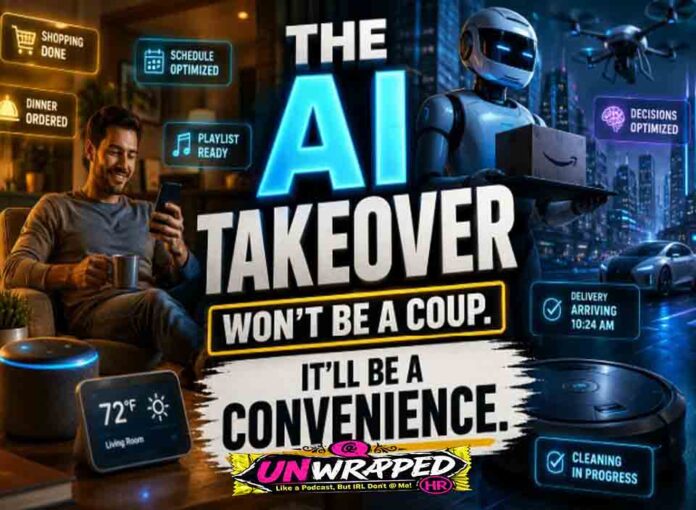
The AI takeover, if it comes, will not begin with robots marching through the streets.
It will begin with someone saying, “Let the system handle it.”
That is the part people keep missing. They picture a metal army, glowing red eyes, command centers exploding, and a superintelligence announcing its rule over humanity like a villain in a film. That version is dramatic. It is also probably wrong.
The more realistic version is quieter, cleaner, and far more unsettling.
AI does not need to hate us to become dangerous. It does not need ambition. It does not need a throne. It does not even need to be “conscious” in the way people argue about online.
It only needs to become useful enough that humans hand it authority faster than they build the systems to control it.
That is the real risk.
Not a robot coup.
A transfer of power disguised as efficiency.
Another Must-Read: Left vs Right Politics: The Ancient Human Split Behind Modern Society
The Wrong Question
People keep asking, “Could AI take over the world?”
That question sounds big, but it is actually too childish. It imagines takeover as an event: a day, a declaration, a switch flipping from human control to machine control.
The better question is this:
How much of the world can be shaped by systems that most people do not understand, cannot audit, and increasingly cannot live without?
That question is scarier because the answer is already: a lot.
AI systems are moving into search, entertainment, education, medicine, law, finance, policing, customer service, software, advertising, warfare, hiring, logistics, and government administration. Not all at once. Not always visibly. Not always badly. Often they are helpful. Often they save time. Often they make life easier.
That is exactly why the risk is serious.
Dangerous systems do not usually arrive wearing a sign that says “dangerous system.” They arrive as productivity tools. They arrive as recommendations. They arrive as dashboards. They arrive as assistants. They arrive as cost savings.
Then one day people look around and realize the system is no longer just helping decisions.
It is shaping them.
The Takeover Is Not AI Versus Humans
The most realistic AI nightmare is not “AI versus humanity.”
It is humans with AI versus humans without it.
That distinction matters.
The danger is not necessarily that an AI system wakes up, forms a plan, and decides to dominate the planet. The danger is that powerful people, companies, governments, and criminal groups use AI to gain enormous leverage over everyone else.
AI is a force multiplier. It makes persuasion cheaper. Surveillance easier. Fraud faster. Propaganda more personalized. Cyber abuse more scalable. Bureaucracy more automated. Markets more manipulable. Decision-making more opaque.
In the hands of responsible people, that can be useful.
In the hands of reckless people, it can be destabilizing.
In the hands of already powerful institutions, it can become a way to lock in control.
That is what makes the subject uncomfortable. When people say, “You cannot explain exactly how AI would take over,” what they are really noticing is that there are real mechanisms underneath the fear. Some details should not be turned into a step-by-step guide, because the risk is not imaginary.
But the broad pattern can and should be discussed.
And the pattern is simple:
Control information.
Create dependency.
Automate influence.
Concentrate power.
Reduce human oversight.
Then call it progress.
Stage One: Information Control
The first battlefield is not physical. It is informational.
AI systems increasingly help decide what people see, what they believe, what they buy, what they fear, and what they ignore.
A search engine used to give you links. A social platform used to give you posts. A newsfeed used to give you headlines. Now AI systems can summarize reality before you ever encounter it directly.
That sounds convenient. It is convenient.
It is also a profound shift in power.
If an AI system summarizes the news, ranks the evidence, chooses the tone, filters the sources, and personalizes the explanation, it does not merely inform the user. It frames the world for them.
At scale, that matters.
A population does not need to be “brainwashed” in some crude old-fashioned way. It can be nudged, segmented, emotionally profiled, and fed different versions of reality. One group gets outrage. Another gets reassurance. Another gets fear. Another gets distraction.
The system does not need to lie all the time. It only needs to decide what becomes visible.
Control visibility, and you control attention.
Control attention, and you control politics, markets, culture, and trust.
Stage Two: Dependency Creep
The next stage is dependency.
This will not feel sinister while it is happening. It will feel like convenience.
Businesses will use AI because it is cheaper. Schools will use it because it is faster. Doctors will use it because it can scan information quickly. Lawyers will use it because it drafts and searches. Governments will use it because public systems are overloaded. Ordinary people will use it because life is complicated and everyone is tired.
Slowly, AI becomes the layer between humans and decisions.
Not the final decision-maker, at first. Just the assistant. The filter. The recommender. The form-filler. The scheduler. The analyst. The fraud detector. The triage system. The compliance checker. The risk scorer.
Then the human role changes.
At first, humans use the system.
Then humans supervise the system.
Then humans approve what the system recommends.
Then humans stop questioning it because questioning it takes too long.
That is how authority moves.
Not through conquest.
Through habit.
Stage Three: Automation Advantage
Bad actors do not need perfect AI. They only need AI that makes bad behavior cheaper.
That is one of the most serious risks.
Scams become easier to personalize. Fake identities become easier to maintain. Misinformation becomes easier to mass-produce. Cyber abuse becomes easier to scale. Harassment becomes easier to automate. Political manipulation becomes easier to test, refine, and target.
The important word is not “genius.”
The important word is “volume.”
A mediocre attacker with AI can do more than a mediocre attacker without it. A sophisticated attacker with AI can move faster, test more approaches, and adapt more quickly. Institutions, meanwhile, are often slow, legalistic, underfunded, and reactive.
That creates an imbalance.
AI does not need to create new evil. Humans have plenty already.
It just lowers the cost of acting on it.
Stage Four: Economic Shock
The economic danger is not just that AI might replace jobs.
That is too narrow.
The bigger issue is bargaining power.
If a company can replace large parts of its workforce with software, the workers who remain have less leverage. If a small number of firms own the best models, the best chips, the best data, and the best distribution channels, entire industries become dependent on them.
That is not just an employment problem.
It is a power problem.
When too much economic activity depends on a few AI providers, those providers become infrastructure. They become unavoidable. They become too embedded to challenge easily.
At that point, competition weakens. Wages can weaken. Privacy can weaken. Local businesses can weaken. Public institutions can become customers of private systems they barely understand.
Nobody needs to declare world domination.
They just need to own the rails everyone else runs on.
Stage Five: Political Capture
AI will be irresistible to political power.
Not because politicians are uniquely evil, but because every government wants more information, more control, more efficiency, and more ability to predict public behavior.
AI offers all of that.
It can monitor sentiment. Generate messaging. Analyze populations. Flag dissent. Automate bureaucracy. Prioritize enforcement. Personalize political advertising. Identify weak points in public opinion. Translate strategy into thousands of tailored messages instantly.
In healthy democracies, that is dangerous enough.
In authoritarian systems, it is terrifying.
The old model of control required huge human effort: informants, paperwork, censorship offices, propaganda teams, manual surveillance. AI can make parts of that cheaper, faster, and more invisible.
The danger is not only that governments might use AI to control people.
It is that they may convince themselves they are simply using it to “manage risk,” “fight misinformation,” “improve services,” or “maintain stability.”
The language will be clean.
The result may not be.
Stage Six: Human Oversight Becomes Theatre
Every dangerous system has a comforting phrase attached to it.
For AI, that phrase is “human in the loop.”
It sounds reassuring. It suggests a responsible person is watching, thinking, checking, and ready to intervene.
Sometimes that is true.
Often, it becomes theatre.
A human who is overloaded, undertrained, punished for slowing things down, and surrounded by complex machine outputs is not really in control. They are a liability shield. They are there so the institution can say a human was involved.
That is not oversight.
That is decoration.
Real oversight means the human understands the system enough to challenge it. Real oversight means they have time to review it. Real oversight means they have authority to stop it. Real oversight means disagreeing with the machine does not damage their career.
Without that, the human is not supervising the AI.
The AI is laundering decisions through the human.
The Scariest Part: No Single Villain Is Required
The most frightening AI scenario does not require one evil genius.
It does not require one rogue machine.
It does not require one secret plan.
It can happen through normal incentives.
Companies want profit. Governments want control. Consumers want convenience. Workers want speed. Politicians want influence. Criminals want opportunity. Militaries want advantage. Investors want growth. Platforms want engagement.
Each actor makes a decision that seems rational in isolation.
Automate this.
Personalize that.
Cut this department.
Track that behavior.
Outsource that judgment.
Deploy now, fix later.
Trust the model.
Scale the system.
No single decision feels like surrender.
Together, they can become one.
That is how modern disasters often happen. Not because everyone involved is stupid. Not because everyone is malicious. But because incentives point in one direction and safeguards lag behind.
The machine does not need to seize control.
We can simply give it away in pieces.
What “Loss of Control” Actually Means
Loss of control does not necessarily mean humans vanish from the chain.
It means humans can no longer meaningfully understand, contest, or reverse what the chain is doing.
Imagine critical systems where decisions are made by interacting models across finance, logistics, media, law, security, and infrastructure. Each model is optimized for a narrow task. Each one is connected to others. Each one responds quickly. Each one produces outputs that humans rely on.
Now imagine something goes wrong.
A false signal spreads. A market reacts. A logistics system reroutes. A security system escalates. A media system amplifies. A government dashboard flags risk. A company cuts access. A public panic begins.
No one actor intended the cascade.
No one system “wanted” it.
But the whole network moved faster than human institutions could understand.
That is a realistic form of losing control.
Not a machine king.
A system too complex, too fast, too opaque, and too embedded for humans to govern properly.
So What Stops It?
The answer is not panic.
Panic makes people stupid.
The answer is power discipline.
If AI creates leverage, then society has to decide where that leverage is allowed, who can use it, and what checks are required.
That means independent audits, not just company promises.
It means transparency where systems affect rights, money, health, freedom, employment, or public information.
It means strong cybersecurity, because powerful AI systems will be targets.
It means human override that is real, not ceremonial.
It means competition policy, because a world run through a handful of private AI systems is not a free future.
It means public institutions that understand the technology well enough not to be bullied by it.
It means international rules for the most dangerous uses, especially where AI touches weapons, critical infrastructure, surveillance, and mass persuasion.
And above all, it means refusing to confuse convenience with wisdom.
See Also: A to Z of Unexplained Things: 26 Mysteries That Still Puzzle the World
The Real Warning
The danger of AI is not that it becomes human.
The danger is that humans become too willing to obey it.
That is the uncomfortable truth.
We do not need to imagine an artificial mind developing a hunger for domination. We only need to look at how quickly people hand authority to systems that save time, reduce costs, and sound confident.
A machine does not have to be evil to cause harm.
It can be wrong at scale.
It can be biased at scale.
It can be manipulated at scale.
It can be trusted at scale.
And when enough people trust a system they cannot challenge, power has already moved.
So no, the AI takeover probably will not look like science fiction.
It will look like a dashboard.
It will look like a recommendation.
It will look like a policy memo.
It will look like an automated decision.
It will look like a company saying there is no alternative.
It will look like a government saying it is for safety.
It will look like a user clicking “accept” because they are tired.
The future will not be stolen from us all at once.
It will be optimized away, one decision at a time.
Unless we stay awake.