

A personality test is a set of questions designed to help you understand your personality traits, habits, preferences, strengths, weaknesses and behaviour patterns.
In simple terms, it helps answer questions like:
- What kind of person am I?
- How do I think and make decisions?
- Am I more introverted or extroverted?
- What are my natural strengths?
- How do I act in relationships, work, stress or social situations?
- Which personality type or trait pattern sounds most like me?
A personality test is not magic. It is not a crystal ball. It does not know your soul better than your nan after two glasses of wine.
But a good personality test can give you a useful mirror. It can help you spot patterns in how you behave, what motivates you, what drains you, and why you sometimes do the things you do.
That is why personality tests are so popular. People like learning about themselves — especially when the result feels strangely accurate.
Quick Answer: What Is A Personality Test?
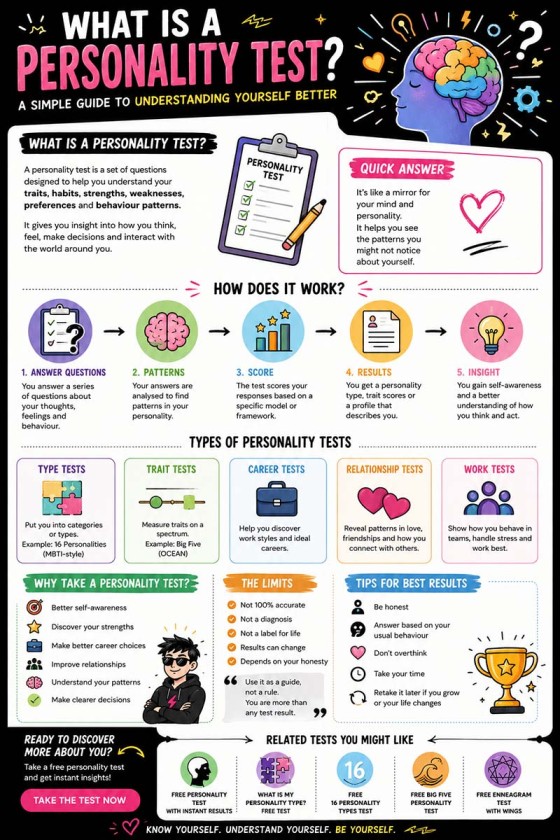
A personality test is a quiz or assessment that uses questions to measure your personality traits, preferences and behaviour patterns. The result usually gives you a personality type, score or profile that explains how you tend to think, feel, communicate and respond to different situations.
Some personality tests are serious and research-based. Others are fun, light and made for entertainment. Both can be useful, as long as you understand what kind of test you are taking.
The best way to use a personality test is for self-reflection, not as a permanent label.
What Does A Personality Test Tell You?
A personality test can tell you about the way you naturally behave, think, communicate and react.
Depending on the test, it may show you things like:
- whether you are more introverted, extroverted or ambiverted
- how organised or spontaneous you are
- how emotionally sensitive or calm you tend to be
- how you communicate with other people
- what motivates you
- what stresses you out
- how you make decisions
- what kind of work environment may suit you
- what relationship patterns you may have
- what your strengths and blind spots are
For example, one person might discover they are highly independent and need plenty of freedom. Another person might realise they are very people-focused and make decisions based on harmony. Someone else might learn that they are not “lazy” — they are just bored stiff by repetitive tasks.
That is the useful part of a personality test. It gives language to things you may already feel but have never properly explained.
How Do Personality Tests Work?
Most personality tests work by asking you a series of questions about your preferences, choices, habits or reactions.
You might be asked questions like:
- Do you prefer spending time alone or with a group?
- Do you like plans or flexibility?
- Do you make decisions with logic or feelings?
- Do you avoid conflict or face it directly?
- Do you enjoy trying new things?
- Do you get stressed easily?
- Do you prefer routine or variety?
Your answers are then scored. The scoring system depends on the type of test.
Some tests place you into a personality type. Others give you a trait score. Some give you a mix of both.
For example:
A type-based test might say you are a certain personality type.
A trait-based test might say you are high in openness, medium in conscientiousness and low in extraversion.
A fun quiz might say you are “the calm problem-solver” or “the chaotic creative goblin,” which may not be scientific, but can still be entertaining and oddly useful.
The key point is simple: your answers create a pattern, and the test uses that pattern to describe your personality.
Why Do People Take Personality Tests?
People take personality tests because they want to understand themselves better.
That is the big reason.
Most people are not searching for a personality test because they want a lecture. They are searching because something in their life has made them curious.
They may be thinking:
- Why am I like this?
- What type of person am I?
- What career suits me?
- Why do I react this way in relationships?
- Am I an introvert or just tired of people?
- Why do I overthink everything?
- What are my strengths?
- How do other people see me?
A personality test gives people a quick way to explore those questions.
It can also be fun. Sometimes you just want to take a quiz, get a result, and send it to a friend with the message: “This is painfully accurate.”
Also see: Personality Tests Review: The Fun, Honest Guide to the Best Personality Quizzes
Common Types Of Personality Tests
There are many different types of personality tests. Some are used in psychology, some in career planning, some in workplaces, and some are made for self-discovery or entertainment.
Here are the main types people search for.
1. Personality Type Tests
Personality type tests group people into categories or types.
These tests usually give you a result that says you are a particular kind of person based on your answers.
Examples include:
- 16 personality type-style tests
- introvert or extrovert tests
- personality archetype quizzes
- character-style personality quizzes
These are popular because they are easy to understand. People like getting a clear result. It feels neat, shareable and memorable.
The downside is that people are complicated. One type will never explain everything about you.
Still, type tests are great for self-discovery and quick insight.
2. Trait-Based Personality Tests
Trait-based tests measure personality on a scale rather than putting you into one fixed box.
A common example is a Big Five-style personality test, which looks at broad traits such as:
- openness
- conscientiousness
- extraversion
- agreeableness
- emotional stability or neuroticism
Instead of saying “you are this type,” a trait test might say you are highly open-minded, moderately organised and more introverted than extroverted.
Trait tests can feel less dramatic than type tests, but they are often more realistic because they show personality as a spectrum.
Most people are not 100% one thing. You are not either “confident” or “not confident.” You might be confident at work, awkward at parties, and weirdly fearless when ordering food for the table.
Human beings are messy like that.
3. Career Personality Tests
A career personality test helps you understand what kind of work may suit your personality.
It may look at things like:
- how you solve problems
- whether you prefer people, ideas, systems or practical tasks
- how much structure you like
- whether you enjoy leadership
- how you handle pressure
- what motivates you at work
A career personality test does not choose your future for you. That would be ridiculous.
But it can help you think more clearly about what kind of work environment might fit you.
For example, someone who loves variety, independence and creative problem-solving may struggle in a highly repetitive, rule-heavy role. Someone who loves structure and precision may feel stressed in a chaotic job with no clear process.
That does not mean one personality is better than another. It means different people thrive in different environments.
4. Relationship Personality Tests
A relationship personality test looks at how you behave in dating, friendships, family life or long-term relationships.
It may explore:
- communication style
- conflict style
- attachment patterns
- emotional availability
- trust
- jealousy
- independence
- affection
- compatibility
These tests can be useful because relationships often reveal personality patterns very clearly.
You might be calm at work but dramatic in love. You might be confident with friends but anxious when someone takes six hours to text back. You might think you “hate conflict,” when actually you hate unclear communication.
A relationship personality test can help you notice those patterns.
Important note: relationship tests should be used for reflection, not diagnosis. They can help you think, but they should not be used to label yourself or someone else as “broken.”
5. Work Personality Tests
A work personality test focuses on how you behave professionally.
It may look at:
- leadership style
- teamwork style
- communication habits
- decision-making
- organisation
- stress response
- motivation
- conflict handling
Employers sometimes use work personality tests during hiring or team development. Individuals also use them to understand how they perform best.
For example, one person may be a natural organiser who likes deadlines, systems and clear expectations. Another may be a big-picture thinker who gets bored by details but comes alive when solving messy problems.
Both can be valuable. They just need different roles, expectations and support.
Personality Test Vs Personality Quiz: What Is The Difference?
A personality test usually sounds more serious, structured and assessment-based.
A personality quiz usually sounds lighter, shorter and more entertainment-focused.
But online, people often use the words almost interchangeably.
The real difference is usually the depth and purpose.
A personality test may:
- use more carefully designed questions
- give more detailed results
- measure traits or types
- be used for self-reflection, work or personal growth
A personality quiz may:
- be shorter
- be more playful
- give a fun result
- focus on entertainment or quick insight
Both can be useful.
A serious personality test can help you understand yourself more deeply. A fun personality quiz can still spark self-awareness, especially if it makes you think, “Actually… that is exactly me.”
Are Personality Tests Accurate?
Personality tests can be accurate, but they are not perfect.
Their accuracy depends on:
- how well the test is designed
- how honestly you answer
- whether the questions are clear
- whether the result is based on a sensible scoring system
- whether the test is meant for serious insight or entertainment
A good personality test can describe patterns that feel genuinely useful. A poor test can give vague results that apply to almost anyone.
Also, your mood can affect your answers. If you take a personality test after a terrible Monday morning, you may answer differently than you would after a relaxing weekend.
That does not make personality tests useless. It just means you should treat the result as a guide, not a life sentence.
Your result should make you curious, not trapped.
What Are The Benefits Of Taking A Personality Test?
A personality test can help you understand yourself in a practical way.
Here are some of the biggest benefits.
Better Self-Awareness
A personality test can help you notice patterns in your behaviour.
You may discover that you avoid conflict, need more alone time, get bored easily, overthink decisions, or naturally take charge in groups.
Once you can name a pattern, you can manage it better.
Must read: What Personality Actually Is (And What It Isn’t)
Clearer Strengths
Many people underestimate their own strengths because those strengths feel normal to them.
A personality test may show that you are:
- highly empathetic
- very analytical
- creative
- calm under pressure
- organised
- persuasive
- independent
- loyal
- adaptable
Sometimes your “normal” is actually your advantage.
Better Career Choices
Personality tests can help you think about what kind of work suits you.
They can help you ask:
- Do I need variety?
- Do I like leading people?
- Do I prefer detail or big-picture thinking?
- Do I work better alone or in a team?
- Do I need structure or freedom?
That can be useful when choosing a career, changing jobs, or understanding why a current role feels wrong.
Improved Relationships
A personality test can help you understand how you communicate and connect with others.
It may reveal that you need reassurance, avoid emotional conversations, prefer direct communication, or show love through practical help.
This can make relationships easier because you stop assuming everyone thinks the same way you do.
Spoiler: they absolutely do not.
Better Decision-Making
When you understand your personality, you can make choices that fit you better.
You can stop copying what works for someone else and start asking:
“Does this actually suit me?”
That applies to work, friendships, relationships, routines, goals and even how you recharge.
What Are The Limits Of Personality Tests?
Personality tests are useful, but they have limits.
A personality test cannot fully explain who you are. It cannot predict every choice you will make. It cannot diagnose mental health conditions. It cannot tell you exactly what job to do, who to date, or whether you should move to a cottage and become mysterious.
It can only give you a framework.
That framework may be helpful, but you are still a human being with context, history, habits, values and choices.
The best way to use a personality test is to ask:
- Does this result feel accurate?
- What part of this describes me well?
- What part feels wrong?
- What can I learn from this?
- How can I use this insight practically?
Do not use a personality test to limit yourself.
Use it to understand yourself.
Should You Take A Personality Test?
Yes, if you are curious about yourself, a personality test is worth taking.
You should take a personality test if you want to:
- understand your personality type
- learn your strengths and weaknesses
- explore your career options
- understand your relationship patterns
- improve self-awareness
- compare your results with friends
- find out whether you are introverted, extroverted or somewhere in between
The best personality test for you depends on what you want to learn.
If you want a broad overview, take a general personality test.
If you want career guidance, take a career personality test.
If you want relationship insight, take a relationship personality test.
If you want something quick and fun, take a short personality quiz with instant results.
The key is to choose a test that matches your question.
How To Get The Best Result From A Personality Test
To get a useful personality test result, answer honestly.
That sounds obvious, but people often answer based on who they wish they were.
They choose the answer that sounds impressive, mature, confident or socially acceptable.
Do not do that.
The test is not judging you. It is trying to find a pattern.
For best results:
- answer based on your usual behaviour
- do not overthink every question
- avoid choosing the “ideal version” of yourself
- think about how you act most of the time
- take the result as guidance, not absolute truth
- retake the test later if your life situation changes
A personality test works best when you are honest enough to admit you are occasionally a walking contradiction. Everyone is.
Related Personality Tests
If you want to learn more about yourself, these are good next tests to take:
- Free Personality Test With Instant Results
- What Is My Personality Type? Free Test
- Free 16 Personality Types Test
- Free Big Five Personality Test
- Free Enneagram Test With Wings
- Am I An Introvert? Free Test
- Career Personality Test Free
- Relationship Personality Test Free
Final Thoughts
A personality test is a quiz or assessment that helps you understand your traits, habits, preferences and behaviour patterns.
It can show you how you think, communicate, make decisions, handle stress, connect with others and approach work or relationships.
A good personality test will not define your entire life. It will not explain every weird thing you have ever done. It will not replace common sense.
But it can give you useful language for understanding yourself.
And sometimes that is exactly what you need: not a label, but a clearer mirror.
FAQ
What is a personality test in simple words?
A personality test is a set of questions that helps you understand what kind of person you are. It looks at your traits, habits, preferences and behaviour patterns, then gives you a result or personality profile.
What does a personality test measure?
A personality test may measure traits such as introversion, extroversion, openness, organisation, emotional sensitivity, communication style, decision-making and relationship patterns. Different tests measure different parts of personality.
Why should I take a personality test?
You should take a personality test if you want to understand yourself better. It can help you learn about your strengths, weaknesses, career style, relationship habits and personality type.
Are personality tests accurate?
Personality tests can be useful and sometimes accurate, but they are not perfect. The result depends on the quality of the test and how honestly you answer the questions.
Is a personality test the same as a personality quiz?
The terms are often used in a similar way. A personality test usually sounds more structured and serious, while a personality quiz is often shorter and more fun. Both can help with self-reflection.
Can a personality test tell me what job to do?
A personality test can suggest what kinds of work may suit your traits and preferences, but it should not make the decision for you. Use it as a guide alongside your skills, interests, experience and goals.
Can my personality test result change?
Yes, your result can change over time or in different situations. Your core patterns may stay similar, but mood, life experience, stress, confidence and personal growth can affect how you answer.
Check out: The Personality Clash That Looks Like “Chemistry”