

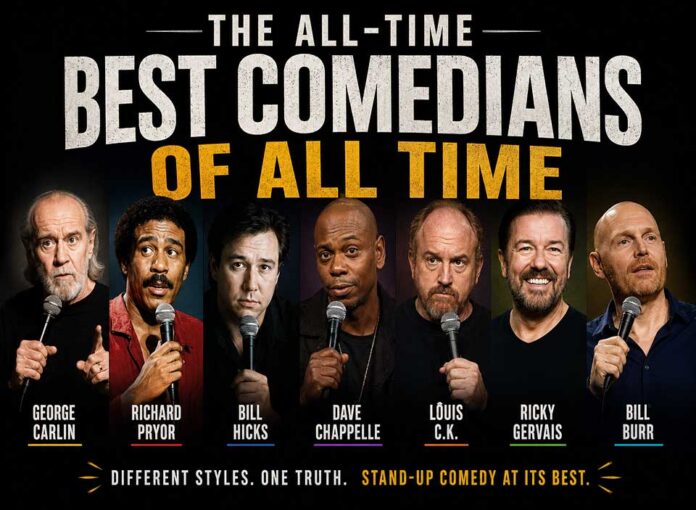
The best stand-up comedian of all time is George Carlin. Not because he was always the funniest minute-by-minute comic. Richard Pryor may beat him there. Not because he was the most explosive stage performer. Eddie Murphy, Robin Williams and Dave Chappelle all have claims. Carlin wins because he built the greatest full career in stand-up: language, politics, religion, death, class, censorship, advertising, American stupidity, human vanity and the slow-motion collapse of common sense.
This is not a safe list. It is not a popularity contest. It is not a “who sold the most arenas” ranking. It is a ruthless ranking of the greatest stand-up comedians ever based on originality, joke craft, influence, body of work, cultural impact, rewatch value and how much truth they smuggled through laughter.
Other major comedy lists exist—Rolling Stone and Paste have both published all-time stand-up rankings, while The Guardian has covered the best comedians and specials of the modern era—but this ranking leans harder into the comics who changed how people think, not just how loudly people laughed.
One note before we start: the “best joke” listed for each comedian is treated as their best joke, bit or routine. Full punchlines are not reproduced. The point is to identify the masterpiece, not steal the act.
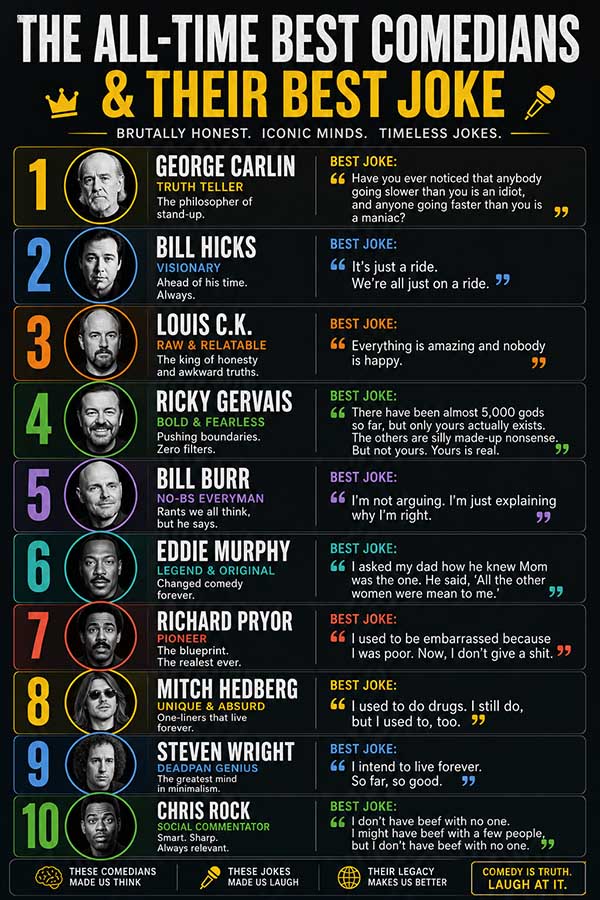
The Ranking at a Glance
| Rank | Comedian | Best joke / routine | Brutal verdict |
|---|---|---|---|
| 1 | George Carlin | “The Planet Is Fine” | The greatest stand-up mind ever |
| 2 | Richard Pryor | Live in Concert — mafia / heart / character work | The most human comic ever |
| 3 | Bill Hicks | “It’s Just a Ride” | The prophet-comic |
| 4 | Dave Chappelle | “Sesame Street” / Killin’ Them Softly | The best living storyteller |
| 5 | Lenny Bruce | “Religions Inc.” | The godfather of dangerous stand-up |
| 6 | Chris Rock | Bullet-control routine | The best social architect |
| 7 | Bill Burr | Philadelphia rant / helicopter bit | Rage turned into logic |
| 8 | Eddie Murphy | Ice cream man | The greatest young stand-up peak |
| 9 | Norm Macdonald | The moth joke | The anti-comedy assassin |
| 10 | Ricky Gervais | Noah’s Ark / religion routines | Brutal, clever, sometimes too pleased with himself |
| 11 | Louis C.K. | “Of Course, But Maybe” | Brilliant craft, damaged legacy |
| 12 | Joan Rivers | Self-roast / “Can we talk?” persona | The insult-comedy machine |
| 13 | Jerry Seinfeld | Pop-Tart routine | The cleanest joke mechanic |
| 14 | Patrice O’Neal | Elephant in the Room relationship riffs | Fearless, flawed, magnetic |
| 15 | Robin Williams | Golf invention | Chaos genius |
| 16 | Billy Connolly | Crucifixion / storytelling riffs | The warmest great storyteller |
| 17 | Mitch Hedberg | Escalator joke | One-liner surrealism perfected |
| 18 | Stewart Lee | Del Boy repetition routine | Comedy for comedy nerds |
| 19 | Doug Stanhope | Nationalism / personal ruin riffs | Hicks’ uglier, drunker cousin |
| 20 | Dave Allen | Catholic school / religion stories | Elegant, smoky, underrated |
| 21 | Steven Wright | Deadpan surreal one-liners | Minimalist genius |
| 22 | Rodney Dangerfield | No-respect one-liners | The king of self-deprecation |
| 23 | Eddie Izzard | Death Star canteen | Surreal history in heels |
| 24 | Bernie Mac | “I ain’t scared of you” | Pure command |
| 25 | Maria Bamford | Family voices / mental-health comedy | The most inventive vocal comic |
| 26 | Wanda Sykes | Domestic and political riffs | Razor-sharp, underrated |
| 27 | Sam Kinison | World hunger routine | Thunderous, uneven, unforgettable |
| 28 | Tig Notaro | Cancer diagnosis set | The bravest deadpan pivot |
| 29 | Sarah Silverman | Innocent voice, savage premise routines | Taboo comedy with a grin |
| 30 | Anthony Jeselnik | Dark misdirection one-liners | Surgical, cold, elite craft |
1. George Carlin
Best joke/routine: “The Planet Is Fine”
Also essential: “Seven Words You Can Never Say on Television,” “Stuff,” “Religion Is Bullshit,” “Advertising,” “A Place for My Stuff”
George Carlin is the best comedian of all time because he did the hardest thing in comedy: he kept evolving. He started as a conventional suit-and-tie comic, transformed into a countercultural truth-teller, then became the old lion of American stand-up—angrier, sharper and more philosophically ruthless with age.
Carlin did not just tell jokes. He audited civilization.
His obsession was language. He understood that euphemism, advertising, politics and religion all depend on people accepting nonsense words as reality. That made him more than a comic. It made him a decoder of bullshit.
His “Seven Words” material became part of a landmark American broadcast-indecency case, FCC v. Pacifica Foundation, which is one reason his comedy sits inside free-speech history, not just comedy history.
Why “The Planet Is Fine” is his best routine: It is Carlin’s whole worldview in miniature. Humans think they are saving Earth; Carlin reminds them Earth will survive and humans may not. It is funny, brutal, ecological, anti-sentimental and spiritually merciless.
Brutal honesty: Late Carlin sometimes leaned closer to lecture than laughter. But even when he was preaching, the sermon had better punchlines than most comics’ best jokes.
Verdict: The GOAT. Not the cuddliest. Not the most lovable. The greatest.
2. Richard Pryor
Best joke/routine: Live in Concert — mafia club / heart / physical-character work
Also essential: Wanted: Live in Concert, Live on Sunset Strip, Mudbone stories
If George Carlin is the greatest stand-up mind, Richard Pryor is the greatest stand-up soul.
Pryor made the stage feel dangerous because he seemed to be discovering the joke at the same time as the audience. He could become anyone: a wino, a junkie, a gangster, a kid, a cop, a deer, a dog, his own heart. He did not merely describe pain. He animated it.
His genius was emotional truth. Pryor found comedy in fear, shame, lust, racism, addiction and humiliation without sanding the edges off. His act was not polished in the Seinfeld sense; it was alive. That is much harder.
Richard Pryor: Live in Concert was selected for the Library of Congress National Film Registry in 2021, a formal recognition of its cultural importance.
Why his best routine wins: Pryor’s best “joke” is rarely one joke. It is the way he turns a story into a living ecosystem. The mafia club material, the heart attack material and the physical act-outs in Live in Concert are stand-up as possession.
Brutal honesty: Pryor’s recorded catalogue is messier than Carlin’s. Carlin built a library. Pryor built lightning. Lightning is harder to rank, but impossible to ignore.
Verdict: If you rank by peak humanity, Pryor is number one. If you rank the entire stand-up career, he is a devastating number two.
3. Bill Hicks
Best joke/routine: “It’s Just a Ride”
Also essential: “Marketing,” “Goat Boy,” “Dinosaurs in the Bible,” “Drugs have done good things”
Bill Hicks was not always the funniest comic in the room. He was sometimes too angry, too impressed with his own righteousness and too willing to mistake contempt for insight. But when Hicks hit, he hit like a cult leader with punchlines.
He saw comedy as an attack on hypnosis. Advertising, war, religion, consumerism, American politics—Hicks treated them all as scams. His best work did not ask, “Isn’t this funny?” It asked, “Why are you obeying this?”
His legend is also tied to censorship. In 1993, his final Letterman set was cut after taping, an episode documented at the time and later revisited as part of his mythology.
Why “It’s Just a Ride” is his best routine: It is barely a joke in the conventional sense. It is a philosophical mic drop. Hicks compresses fear, capitalism, death and transcendence into a closing argument for sanity.
Brutal honesty: Hicks’ weakest fans turned him into a dorm-room messiah. That is not his fault, but it did flatten his reputation. The real Hicks was better than the poster version: nastier, funnier and more technically controlled than people remember.
Verdict: Not the greatest joke writer. One of the greatest voices.
4. Dave Chappelle
Best joke/routine: “Sesame Street” / Killin’ Them Softly
Also essential: For What It’s Worth, The Age of Spin, Equanimity
Dave Chappelle may be the most naturally gifted stand-up alive. His timing is obscene. He can pause for longer than most comics can talk and somehow get a bigger laugh. He has the rare ability to make a crowd lean forward instead of merely react.
Chappelle’s best work feels conversational, but that is the trick. The structure is there. The callbacks are there. The social argument is there. He just hides the machinery under a hoodie and a smirk.
Why “Sesame Street” is his best routine: It takes a children’s show and turns it into a street-level social diagnosis without losing the silliness. That is Chappelle at his best: playful, dark, observant and completely in command.
Brutal honesty: Chappelle’s later work sometimes feels less like comedy and more like a genius defending his own press coverage. When he chases the laugh, he is nearly untouchable. When he chases the discourse, he becomes easier to admire than enjoy.
Verdict: The best living stand-up when he is fully locked in.
5. Lenny Bruce
Best joke/routine: “Religions Inc.”
Also essential: “How to Relax Your Colored Friends at Parties,” “The Palladium,” language and obscenity material
Lenny Bruce is not this high because every modern listener will laugh hysterically at every recording. They will not. Comedy ages. Context fades. Pacing changes.
He is this high because modern stand-up is unimaginable without him.
Bruce made the stage a place for taboo language, jazz rhythm, social critique, legal danger and intellectual rebellion. Before him, stand-up was more mannered. After him, the microphone could become a weapon.
Why “Religions Inc.” is his best routine: It captures his central gift: making sacred institutions sound like human businesses full of ego, branding and absurdity.
Brutal honesty: Bruce is more important than funny to many modern ears. That matters. But influence is part of greatness, and his influence is enormous.
Verdict: Not the easiest listen today. Still one of the pillars.
6. Chris Rock
Best joke/routine: Bullet-control routine
Also essential: Bring the Pain, Bigger & Blacker, Never Scared, Tamborine
Chris Rock is one of the best builders of stand-up arguments. His best routines are not just joke clusters; they are essays with drums.
The voice, the repetition, the pacing, the moral aggression—Rock can make a premise feel inevitable. He will state an idea, hammer it, twist it, escalate it, then leave the audience laughing at something they might have rejected in plain prose.
Why the bullet-control routine is his best: It is a perfect Rock premise: simple, outrageous, politically loaded and structurally bulletproof. The joke is not just the idea. It is the escalation.
Brutal honesty: Rock is not as loose or magical as Pryor, and not as philosophically deep as Carlin. But as a constructor of social stand-up, he is elite.
Verdict: The best stand-up architect of the 1990s.
7. Bill Burr
Best joke/routine: Philadelphia rant / helicopter bit
Also essential: Let It Go, You People Are All the Same, I’m Sorry You Feel That Way, Paper Tiger
Bill Burr is rage with footnotes. That is his genius.
Bad Burr is just yelling. Great Burr is yelling himself into an argument so well-built that even people who disagree with him laugh before they can object. His persona is the furious idiot who slowly reveals he might not be an idiot at all.
Burr understands resentment better than almost any comic alive: male resentment, working-class resentment, relationship resentment, cultural resentment, the resentment of knowing you are wrong but wanting five more minutes to enjoy being wrong.
Why the Philadelphia rant matters: It is not his most polished bit, but it is one of the greatest live stand-up survival moments ever: a hostile crowd, a comic under attack, and Burr turning pure contempt into victory.
Why the helicopter bit matters: It shows his signature method: start with an indefensible emotional reaction, then keep twisting until the audience is trapped between laughter and moral discomfort.
Brutal honesty: Burr is not as revolutionary as Carlin, Pryor or Hicks. His range is narrower. But inside that range, he is a monster.
Verdict: The greatest anger comic of his generation.
8. Eddie Murphy
Best joke/routine: Ice cream man
Also essential: Delirious, Raw, family stories, celebrity impressions
Eddie Murphy had one of the most explosive stand-up peaks ever. He was absurdly young, absurdly confident and absurdly charismatic. At his best, he looked less like a comedian than a superstar who had briefly decided to do stand-up before conquering everything else.
His rhythm was musical. His physicality was cartoonish without being sloppy. His voices were huge. And his crowd control was terrifyingly advanced for his age.
Why the ice cream man routine is his best: It is childhood, status, poverty, joy and humiliation turned into pure performance. The writing is funny, but the delivery is what makes it immortal.
Brutal honesty: Murphy cannot be top five because he simply did not give stand-up enough years. His peak is higher than almost anyone’s. His stand-up catalogue is too small.
Verdict: Maybe the greatest young stand-up ever.
9. Norm Macdonald
Best joke/routine: The moth joke
Also essential: Bob Saget roast, O.J. jokes, “Germans love David Hasselhoff,” talk-show appearances
Norm Macdonald was not trying to make everyone laugh. He was trying to make the right people laugh in the wrong way.
He understood anti-comedy, misdirection, discomfort and deliberate failure better than almost anyone. Norm could make a joke funny by ruining it, stretching it, undercutting it or pretending not to understand why it was funny.
Why the moth joke is his best: It is a long walk to a deliberately stupid punchline, and the walk is the joke. That is Norm: the destination is almost insulting, but the journey is genius.
Brutal honesty: Norm’s stand-up specials are not always as strong as his talk-show appearances. His greatness is spread across moments, not just albums.
Verdict: The comic’s comic’s comic.
10. Ricky Gervais
Best joke/routine: Noah’s Ark / religion routines
Also essential: Animals, Humanity, SuperNature, Golden Globes monologues
Ricky Gervais is not the tenth-best pure stand-up technician ever. That needs saying. He is not Carlin. He is not Pryor. He is not Chappelle. He is not even as mechanically clean as Seinfeld.
But greatness is not only mechanics.
Gervais built one of the strongest comic personas of the modern era: smug, clever, allergic to piety, delighted by hypocrisy and willing to say the thing polite rooms are avoiding. His stand-up works best when he attacks superstition, celebrity self-importance, moral vanity and fake sentiment.
Why the Noah’s Ark routine is his best: It plays to his strengths: logic, disbelief, childish glee and escalating contempt for an absurd premise.
Brutal honesty: Gervais can be lazy when he mistakes saying the forbidden thing for writing the best joke about it. Some later material feels more defensive than inspired. But when he is sharp, he is lethal.
Verdict: Not the purest stand-up great, but absolutely one of the defining comedy voices of the modern era.
11. Louis C.K.
Best joke/routine: “Of Course, But Maybe”
Also essential: Shameless, Chewed Up, Hilarious, Oh My God
Louis C.K. is one of the best joke writers of the modern era. His greatest skill is taking an ugly private thought, cleaning it just enough to make it presentable, then making the audience admit they recognise it.
His comedy is built on shame: parenting shame, sexual shame, body shame, moral shame, laziness, selfishness and the horror of being a person who knows better but does worse anyway.
Why “Of Course, But Maybe” is his best routine: It is his whole method: morally correct surface, monstrous inner thought, perfect escalation.
Brutal honesty: The off-stage scandal damaged his legacy and it should. Artistically, though, pretending he was not one of the strongest stand-up craftsmen of his generation is dishonest.
Verdict: A brilliant comic with a permanently complicated ranking.
12. Joan Rivers
Best joke/routine: Self-roast / “Can we talk?” persona
Also essential: Red carpet insults, plastic surgery jokes, celebrity takedowns
Joan Rivers was a machine. Not a gentle machine. Not a tasteful machine. A joke machine.
She took insult comedy, female rage, insecurity, vanity and showbusiness desperation and turned them into a career that refused to die. Rivers was mean, but she was often meanest about herself, which gave her cruelty a strange kind of permission.
Why her self-roast persona is her best “routine”: Rivers understood that if she attacked herself first, she could attack everyone else harder. That became a blueprint for generations of comics.
Brutal honesty: Not every joke aged well. Some were blunt-force rather than brilliant. But her stamina, speed and trailblazing force are undeniable.
Verdict: One of the most important joke machines in comedy history.
13. Jerry Seinfeld
Best joke/routine: Pop-Tart routine
Also essential: “Airports,” “Laundry,” “Olympics,” I’m Telling You for the Last Time
Jerry Seinfeld is what happens when a man treats a joke like a watch mechanism. Every gear matters. Every word is shaved down. Every observation is polished until it looks effortless.
He does not have Pryor’s danger, Carlin’s rage, Hicks’ philosophy or Burr’s blood pressure. What he has is precision.
Why the Pop-Tart routine is his best: It turns a tiny childhood object into a full comic investigation. That is Seinfeld’s gift: making nothing feel worthy of courtroom analysis.
Brutal honesty: Seinfeld is not emotionally deep. He is not dangerous. He is not trying to be. Ranking him higher than this would confuse clean craftsmanship with total greatness.
Verdict: The greatest observational joke mechanic.
14. Patrice O’Neal
Best joke/routine: Elephant in the Room relationship riffs
Also essential: Crowd work, radio appearances, male-female dynamics material
Patrice O’Neal was dangerous because he could make the audience trust him while saying things that should have lost them. He had force, warmth, cruelty, intelligence and an incredible ability to sit inside tension.
His best comedy feels like an argument at 2 a.m. with someone too smart, too stubborn and too funny to walk away from.
Why Elephant in the Room is his masterpiece: It captures his power: slow pacing, heavy silence, uncomfortable honesty and a room bending to his rhythm.
Brutal honesty: Patrice could be wrong, ugly, sexist and too pleased with provocation. But he was also genuinely searching inside the mess. That makes him more compelling than cleaner comics.
Verdict: One of the great “gone too soon” stand-ups.
15. Robin Williams
Best joke/routine: Golf invention
Also essential: Reality… What a Concept, Live at the Met, Weapons of Self Destruction
Robin Williams was not a joke writer in the Carlin-Seinfeld sense. He was a comic volcano. Voices, references, impressions, characters, noises, sudden tenderness, sudden filth—he could overwhelm a room through sheer imaginative velocity.
Why the golf routine is his best: It is physical, silly, profane, historical and completely alive. You do not just hear the joke; you watch him invent a deranged world.
Brutal honesty: Williams could be messy. The speed sometimes covered thin writing. But nobody else had that engine.
Verdict: The greatest chaos performer in stand-up.
16. Billy Connolly
Best joke/routine: Crucifixion / long-form storytelling riffs
Also essential: Glasgow stories, travel stories, bodily embarrassment material
Billy Connolly is one of the greatest storytellers ever to do stand-up. He does not always feel like he is delivering “bits.” He feels like a funny uncle, a drunk philosopher and a street poet all fighting for the same chair.
His comedy is warm without being soft. Dirty without being cheap. Rambling without losing control.
Why the crucifixion routine stands out: It shows Connolly’s gift for taking something grand and sacred and dragging it back down to human level.
Brutal honesty: Connolly’s looseness can make him harder to rank against tightly written comics. But as a storyteller, he is world-class.
Verdict: The king of comic warmth.
17. Mitch Hedberg
Best joke/routine: Escalator joke
Also essential: “Rice is great,” “Ducks eat for free,” surreal one-liners
Mitch Hedberg did not build grand arguments. He built tiny alternate universes.
His best jokes are so simple they feel discovered, not written. But that simplicity is deceptive. Hedberg had one of the most distinctive comic brains ever: sideways, sweet, stoned, precise and weirdly innocent.
Why the escalator joke is his best: It is perfect Hedberg: a familiar object, one impossible reframing, no wasted motion.
Brutal honesty: Limited range. Limited emotional weight. But within one-liner surrealism, he is nearly flawless.
Verdict: The patron saint of weird one-liners.
18. Stewart Lee
Best joke/routine: Del Boy repetition routine
Also essential: “Braveheart,” “UKIP,” 90s Comedian, If You Prefer a Milder Comedian
Stewart Lee is not for everyone. That is partly the point. He is a comedian who deconstructs comedy while doing comedy, often daring the audience to get annoyed before rewarding them for staying.
He uses repetition like a weapon. He can make a bit funny, then unfunny, then funny again, then oppressive, then brilliant.
Why the Del Boy routine is his best: It is a masterclass in repetition, audience manipulation and comic arrogance as performance art.
Brutal honesty: He can be smug. He can be slow. He can feel like homework. But the craft is extraordinary.
Verdict: The best stand-up for people who think too much about stand-up.
19. Doug Stanhope
Best joke/routine: Nationalism / personal ruin riffs
Also essential: No Refunds, Beer Hall Putsch, Before Turning the Gun on Himself
Doug Stanhope is what happens when the Hicks lineage loses the idealism and keeps drinking. He is filthy, bleak, personal, political and often genuinely fearless.
Stanhope’s best material does not feel designed to be liked. It feels dragged out of a damaged person who has decided honesty is worth more than charm.
Why the nationalism material works: It attacks one of the dumbest forms of inherited pride and does it with the contempt of someone allergic to group identity.
Brutal honesty: Stanhope is uneven. Sometimes he is profound; sometimes he is just a guy daring you to leave. But his best work is savage.
Verdict: A cult great with real teeth.
20. Dave Allen
Best joke/routine: Catholic school / religion stories
Also essential: Sitting-chair monologues, priest jokes, childhood stories
Dave Allen was elegant irreverence. Cigarette, drink, chair, calm delivery, wicked smile. He made religious authority look ridiculous without needing to scream.
His influence is quieter than Carlin’s or Bruce’s, but his control was beautiful. He could dismantle fear with a raised eyebrow.
Why the Catholic school material is his best: It turns childhood religious intimidation into comedy without losing the lingering absurdity of it.
Brutal honesty: Some of the pacing feels old now. But the intelligence still cuts.
Verdict: One of the great underappreciated masters.
21. Steven Wright
Best joke/routine: Deadpan surreal one-liners
Also essential: “I have a map of the world,” “Sponges grow in the ocean,” absurdist miniatures
Steven Wright is pure comic minimalism. No sweat. No pleading. No emotional manipulation. Just impossible thoughts delivered like weather reports.
He made deadpan surrealism look easy, which is dangerous, because thousands tried it after him and sounded like open-mic furniture.
Why his one-liner universe wins: Wright’s best joke is not a single bit; it is the entire logic of his persona. The world is broken, and he is calmly reading the instruction manual.
Brutal honesty: Not much range. But he perfected his lane.
Verdict: The greatest deadpan surrealist.
22. Rodney Dangerfield
Best joke/routine: No-respect one-liners
Also essential: Doctor jokes, wife jokes, childhood jokes, self-deprecating rapid-fire sets
Rodney Dangerfield had one of the strongest comic brands ever: no respect. That phrase was not just a catchphrase. It was a universe.
His jokes are old-school, tight, blunt and relentless. Setup, punchline, reset. No moral. No TED Talk. No therapy. Just jokes.
Why the no-respect material wins: It is instantly understandable and endlessly renewable. Every joke reinforces the same tragic clown.
Brutal honesty: The material can feel dated, and he does not have the depth of the top tier. But as a pure joke-delivery machine, he is legendary.
Verdict: The king of the one-liner persona.
23. Eddie Izzard
Best joke/routine: Death Star canteen
Also essential: “Cake or death,” history riffs, multilingual surrealism
Eddie Izzard made stand-up feel like a sleep-deprived history professor improvising through a fever dream. Empires, religion, language, war, supermarkets, Darth Vader—it all belonged in the same comic universe.
Why the Death Star canteen routine is best: It humanises the absurd. Darth Vader ordering food should not be as funny as it is. Izzard makes it feel obvious.
Brutal honesty: Izzard’s looseness is both strength and weakness. The best bits soar; weaker stretches drift.
Verdict: One of the great surreal storytellers.
24. Bernie Mac
Best joke/routine: “I ain’t scared of you”
Also essential: The Original Kings of Comedy, family and discipline material
Bernie Mac had command. Not confidence—command. He could walk on stage and make the room feel like it belonged to him before the first joke landed.
His comedy mixed toughness, family, frustration, discipline and swagger. He did not ask for laughs. He took them.
Why “I ain’t scared of you” matters: It is a thesis statement. Bernie Mac’s persona was fearless authority with a grin.
Brutal honesty: His stand-up catalogue is not as deep as some above him. But his presence was enormous.
Verdict: One of the most commanding stage performers ever.
25. Maria Bamford
Best joke/routine: Family voices / mental-health comedy
Also essential: The Special Special Special, Ask Me About My New God!, Lady Dynamite
Maria Bamford is one of the most inventive comedians alive. She turns anxiety, family dysfunction, mental illness and social discomfort into a full orchestra of voices.
Her comedy is not always built for mass taste. That is fine. Greatness is not always stadium-sized.
Why her family-voice material is best: Bamford does not merely imitate people. She builds emotional systems through voices. Every character reveals pressure, guilt, love and panic.
Brutal honesty: Too niche for some audiences. But originality this strong deserves respect.
Verdict: A genius of vocal and psychological comedy.
26. Wanda Sykes
Best joke/routine: Domestic and political riffs
Also essential: marriage material, parenting, race and politics routines
Wanda Sykes has one of the great comic voices: dry, irritated, sharp and instantly recognisable. She can make a small domestic annoyance feel like a constitutional crisis.
Her strength is clarity. She does not bury the joke in performance fog. She walks straight to the absurdity, points at it and makes it confess.
Why her domestic-political material works: Sykes is strongest when she connects private irritation to public stupidity.
Brutal honesty: She does not have the revolutionary influence of the top tier. But she is consistently sharper than she gets credit for.
Verdict: A top-tier truth-teller hiding in plain sight.
27. Sam Kinison
Best joke/routine: World hunger routine
Also essential: relationship screams, preacher-style rage, Breaking the Rules
Sam Kinison was not subtle. He was a detonation.
A former preacher, Kinison brought revival-tent fury to stand-up. His scream was not just volume; it was structure. He could turn moral outrage into a rock-concert punchline.
Why the world hunger routine is best: It is cruel, shocking and impossible to forget. It captures his whole appeal: say the unsayable, then scream until the room breaks.
Brutal honesty: Kinison aged unevenly. Some material now feels more loud than smart. But at his peak, he was a force of nature.
Verdict: Not the cleanest mind. One of the biggest explosions.
28. Tig Notaro
Best joke/routine: Cancer diagnosis set
Also essential: “Taylor Dayne,” deadpan storytelling, Live
Tig Notaro turned one of the worst personal moments imaginable into one of modern comedy’s most important sets. Her style is quiet, dry and deceptively brave.
She proved that deadpan does not have to mean emotionally empty. It can be devastating.
Why the cancer diagnosis set matters: It changed what audiences understood stand-up could hold: grief, fear, absurdity and laughter in the same breath.
Brutal honesty: Not a laugh-per-minute killer in the traditional sense. Her greatness is tonal, not explosive.
Verdict: One of the bravest modern stand-ups.
29. Sarah Silverman
Best joke/routine: Innocent voice, savage-premise routines
Also essential: taboo jokes, fake-naive persona, Jesus Is Magic
Sarah Silverman’s genius is contrast. She built a persona that sounded sweet, childish and harmless, then used it to say appalling things. The joke was often not just the line; it was the collision between innocence and ugliness.
Why her savage-naive persona is her best “routine”: It allowed her to expose prejudice, narcissism and moral stupidity by pretending not to understand them.
Brutal honesty: Some material has aged badly, and her persona was always risky. But when it worked, it was brilliantly uncomfortable.
Verdict: One of the defining taboo comics of her era.
30. Anthony Jeselnik
Best joke/routine: Dark misdirection one-liners
Also essential: Thoughts and Prayers, Caligula, disaster jokes
Anthony Jeselnik is not warm. He is not trying to be. He is a joke sniper.
His craft is misdirection: lead the audience into one moral expectation, then flip the ending into something colder, darker and usually worse. The laugh comes from shock, but the real skill is precision.
Why his dark one-liners work: Jeselnik’s best jokes are engineered. Every word matters. The punchline is a trapdoor.
Brutal honesty: Emotional range is limited. Persona is narrow. But inside that narrow lane, he is one of the best technical joke writers alive.
Verdict: The best modern dark one-liner specialist.
The Brutal Top 10, Explained
Best comedian of all time: George Carlin
Carlin wins because no other stand-up combined longevity, influence, language, social criticism and joke craft at the same level.
Funniest comedian at peak: Richard Pryor
If you only judge peak performance, Pryor may be the answer. He was less polished than Carlin but more alive.
Best philosophical comedian: Bill Hicks
Hicks was not always right, but he made stand-up feel like a moral emergency.
Best living stand-up: Dave Chappelle
When focused on jokes rather than public argument, Chappelle remains the most gifted living stand-up.
Best modern anger comic: Bill Burr
Burr turns rage into logic better than anyone.
Best British comic voice on this list: Ricky Gervais
Gervais is not the greatest pure British stand-up ever—that argument includes Billy Connolly and Stewart Lee—but he is one of the most globally recognisable modern comic voices.
Who Was Left Out?
A brutal list has to make brutal cuts.
Kevin Hart is a phenomenal performer and business force, but he does not have the depth, originality or classic-routine catalogue to crack this top 30.
Peter Kay is beloved and massively successful, especially in the UK, but his comedy is more warmth and nostalgia than all-time stand-up danger.
Michael McIntyre is technically excellent and commercially huge, but too safe for this particular ranking.
Frankie Boyle is vicious and brilliant, but his stand-up legacy is still more cult/panel-show-adjacent than top-30 global.
Ali Wong has one of the most important modern breakout specials, but she needs more all-time weight to climb higher.
Bo Burnham is a genius, but he sits between stand-up, music, theatre, film and internet performance. He deserves a separate category.
Don Rickles is an insult-comedy giant, but Joan Rivers and Rodney Dangerfield offer stronger stand-up cases for this list.
Bob Newhart is a foundational deadpan storyteller, but this ranking leans toward comics whose material still feels more urgent today.
Final Verdict: The GOAT Ranking
If you want the honest Mount Rushmore, it is:
George Carlin, Richard Pryor, Bill Hicks and Dave Chappelle.
If you want the most important five, add Lenny Bruce.
If you want the funniest peak, argue Pryor.
If you want the greatest body of work, pick Carlin.
If you want the best living comic when he is at full power, pick Chappelle.
If you want the comic who best turns modern male rage into laughter, pick Bill Burr.
If you want the sharpest celebrity-and-religion assassin of the modern British school, pick Ricky Gervais.
But if the question is “Who is the best stand-up comedian of all time?”, the answer is still:
George Carlin.
Because the best comedians do more than make people laugh. They make people harder to fool.
FAQ
Who is the best comedian of all time?
George Carlin is the best comedian of all time because he combined joke writing, social criticism, language mastery, cultural influence and career longevity better than any other stand-up comedian.
Who are the top 5 stand-up comedians ever?
The top 5 stand-up comedians ever are George Carlin, Richard Pryor, Bill Hicks, Dave Chappelle and Lenny Bruce.
Is Richard Pryor better than George Carlin?
Richard Pryor may be funnier at his absolute peak, but George Carlin has the stronger overall career, deeper body of work and broader intellectual influence. Pryor is the most human stand-up ever; Carlin is the greatest overall.
Is Bill Hicks one of the greatest comedians ever?
Yes. Bill Hicks is one of the greatest comedians ever because he turned stand-up into philosophical rebellion. He was not the most polished joke writer, but his voice, courage and influence make him an all-time great.
Is Bill Burr one of the best comedians of all time?
Yes. Bill Burr is one of the best comedians of all time and arguably the greatest anger comic of his generation. He is not as historically revolutionary as Carlin or Pryor, but his best work is elite.
Is Ricky Gervais one of the best stand-up comedians?
Ricky Gervais is one of the most important modern comedy voices, especially for religion, celebrity and free-speech material. As a pure stand-up technician, he is not top five, but his persona and cultural impact earn him a high ranking.
What is the greatest stand-up routine ever?
The greatest stand-up routine ever is debatable, but George Carlin’s “The Planet Is Fine,” Richard Pryor’s Live in Concert character work, Bill Hicks’ “It’s Just a Ride,” and Chris Rock’s bullet-control routine are all serious contenders.
What makes a comedian great?
A great comedian needs originality, timing, joke craft, stage presence, influence, courage and rewatch value. The very best comedians also reveal truths people usually avoid.