



For many Filipinos, moving to Australia from the Philippines is not just another overseas work destination.
It is one of the most realistic places to build a stable life.
The appeal is obvious: higher wages, skilled migration pathways, healthcare jobs, trade opportunities, English-speaking workplaces, family sponsorship options, strong Filipino communities and the chance to move from temporary work to permanent residency if the plan is built properly.
But here is the truth that gets missed in too many Facebook groups and migration videos:
Moving to Australia from the Philippines is not just about getting out. It is about choosing the right pathway before you spend money, resign from work, enroll in a course or accept a promise from an employer.
Australia can be excellent for Filipino nurses, careers, mechanics, welders, chefs, engineers, students, partners and skilled workers. But it is also expensive, document-heavy and unforgiving if you arrive without savings or a job strategy.
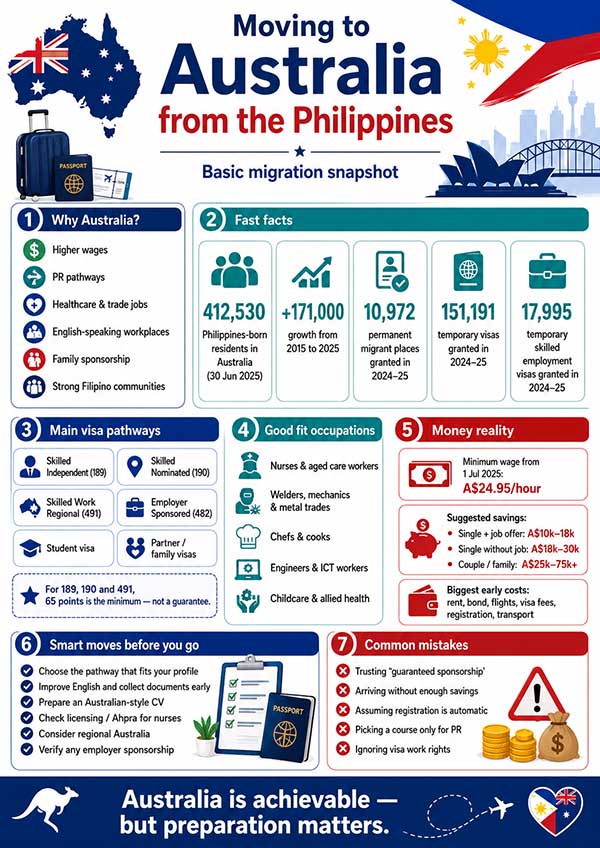
The pathway is real. At 30 June 2025, the Philippines was one of Australia’s top five overseas countries of birth, with an estimated 412,530 Philippines-born residents living in Australia. The Philippines-born population also increased by about 171,000 people between 2015 and 2025, making it one of the fastest-growing major migrant communities in Australia.
So, yes — moving to Australia from the Philippines is achievable.
But it rewards people who prepare early.
Why Are So Many Filipinos Moving to Australia?
Filipinos move to Australia for different reasons, but the big themes are clear:
- better wages
- safer long-term settlement options
- permanent residency pathways
- healthcare and aged care jobs
- skilled trade opportunities
- education for children
- family reunion
- English-speaking society
- strong Filipino communities
- lifestyle and stability
The official migration numbers show how active this route already is. In 2024–25, Australia granted 10,972 permanent migrant places to people from the Philippines, including employer sponsored, skilled independent, state or territory nominated, regional, partner and other categories.
Temporary migration from the Philippines is also significant. In 2024–25, Australia granted 151,191 temporary visas to migrants from the Philippines, including 113,039 visitor visas, 10,244 student visas and 17,995 Temporary Resident Skilled Employment visas.
That last number matters.
The Philippines is not only a student or partner migration story. It is a serious skilled-worker and employer-sponsored migration story.
Can Filipino Citizens Move to Australia?
Yes, Filipino citizens can move to Australia, but they need the correct visa.
The best pathway depends on your:
- age
- occupation
- qualifications
- English ability
- work experience
- savings
- family situation
- employer sponsorship options
- state nomination options
- long-term PR goal
The main visa pathways for Filipinos moving to Australia include:
| Visa pathway | Best for |
|---|---|
| Skilled Independent visa | Skilled workers with strong points and eligible occupations |
| Skilled Nominated visa | Skilled workers nominated by an Australian state or territory |
| Skilled Regional visa | Skilled workers open to regional Australia |
| Employer sponsored visa | Workers with an Australian employer willing to sponsor them |
| Student visa | Genuine students studying in Australia |
| Partner visa | Filipinos in a genuine relationship with an eligible Australian partner |
| Family visas | Eligible parent, child or family cases |
| Work and Holiday visa | Future/limited youth mobility route to monitor |
| Visitor visa | Short visits, not migration |
The mistake is asking:
“How can I go to Australia?”
The better question is:
“Which Australian visa pathway fits my profile and gives me the best chance of staying legally, working properly and building a future?”
That is the question that saves money.
Australia PR From Philippines: The Main Skilled Visa Pathways
For many Filipinos, the real goal is Australia PR.
Australia’s skilled migration system is based on occupation demand, points, English, experience, qualifications and invitation rules.
For points-tested skilled visas such as subclass 189, 190 and 491, the Department of Home Affairs says applicants need to meet or exceed the 65-point threshold, but it also makes clear that meeting the minimum does not guarantee an invitation. Points can come from age, work experience, qualifications and English language proficiency.
That means 65 points is not a victory.
It is the starting line.
If your occupation is competitive, you may need higher points, state nomination, regional strategy, employer sponsorship or a stronger English score.
Skilled Independent Visa Subclass 189
The Skilled Independent visa is attractive because it can let invited skilled workers live and work permanently anywhere in Australia. It does not require employer sponsorship or state nomination.
For Filipino applicants, this route may suit people with:
- high points
- strong English
- recognised qualifications
- an occupation Australia needs
- relevant work experience
- clean documentation
- successful skills assessment
This can be powerful, but it is competitive. If your points are not strong, you may need to look seriously at subclass 190, subclass 491 or employer sponsorship.
People Also Love: Moving to Australia: What It Means to Be Australian
Skilled Nominated Visa Subclass 190
The Skilled Nominated visa lets nominated skilled workers live and work in Australia as permanent residents.
This can be a realistic option for Filipino applicants whose occupation matches a state or territory need.
It may suit workers in areas such as:
- nursing
- aged care
- allied health
- engineering
- construction
- welding
- mechanical trades
- childcare
- teaching
- accounting
- ICT
- hospitality
But every state has its own nomination rules. Do not assume your occupation being “on a list” means you will be selected.
Ask:
Which Australian state actually wants my occupation, and what evidence do they require?
That is the practical question.
Skilled Work Regional Visa Subclass 491
The Skilled Work Regional visa can allow skilled workers to stay in Australia for five years and live, work and study in a designated regional area.
For Filipinos, this pathway can be especially important.
Why?
Because many Filipino applicants are open to regional work, healthcare, aged care, trades, agriculture-related work, hospitality and community services — all areas where regional Australia may need workers.
Regional Australia does not always mean the middle of nowhere. It can include large regional cities and lifestyle areas outside the biggest capital-city zones.
This may suit people who are willing to trade:
- Sydney prestige
- Melbourne popularity
- big-city comfort
for:
- better visa prospects
- lower competition
- local work experience
- stronger community demand
- a possible longer-term settlement route
But be careful. Do not choose a regional area only because someone online says it is “good for PR.” Choose it because your occupation, job prospects, family needs and visa strategy match the location.
Employer Sponsored Visa Subclass 482
The Skills in Demand visa subclass 482 allows Australian employers to sponsor skilled workers when they cannot source an appropriately skilled Australian worker.
This is one of the most important pathways for Filipinos.
Home Affairs data shows the Philippines ranked very strongly in Australia’s temporary skilled visa system in 2024–25, and the country profile shows 17,995 Temporary Resident Skilled Employment visa grants from the Philippines in that year.
This route can suit Filipino workers in occupations such as:
- registered nurse
- aged care worker
- nursing support worker
- chef
- cook
- motor mechanic
- welder
- structural steel worker
- metal fitter
- machinist
- panelbeater
- painter
- civil engineering professional
- software developer
- physiotherapist
- childcare worker
The challenge is that employer sponsorship must be genuine.
Do not pay illegal placement fees. Do not trust vague promises. Do not accept “guaranteed sponsorship” from someone who cannot show a real employer, real job, real nomination process and real compliance.
A good employer sponsorship opportunity should be specific:
- job title
- salary
- location
- employer name
- visa subclass
- nomination process
- contract terms
- licensing requirements
- English requirements
- family inclusion details
If it sounds too easy, slow down.
Filipino Nurses Moving to Australia
This deserves its own section because nursing is one of the strongest Philippines-to-Australia migration themes.
Home Affairs data shows registered nurses were a major occupation for Filipino migrants in both the skill stream and temporary skilled employment outcomes in 2024–25. Other related occupations included nursing support and personal care workers, physiotherapists and child carers.
But Filipino nurses need to understand something clearly:
Being a nurse in the Philippines does not automatically mean you can work as a registered nurse in Australia.
Australia has its own registration process.
The Nursing and Midwifery Board of Australia says all internationally qualified nurses and midwives need to complete a Self-check before applying for registration, and applicants are assigned to a stream depending on qualification assessment criteria.
The Board also says the English language skills registration standard applies to all nurses and midwives applying for initial registration, regardless of whether they qualified in Australia or overseas.
So before spending money on a migration pathway, Filipino nurses should check:
- Ahpra/NMBA registration pathway
- English test requirements
- qualification recognition
- work experience evidence
- identity documents
- good standing certificates
- possible bridging or assessment steps
- visa options
- employer sponsorship options
A nurse with a clean registration plan is much stronger than a nurse with only hope.
Skilled Jobs in Australia for Filipinos
The strongest Filipino migration outcomes are not random. They cluster around specific sectors.
Home Affairs data for 2024–25 shows major occupations for Philippines nationals included structural steel and welding trades workers, motor mechanics, chefs, metal fitters and machinists, registered nurses, software and applications programmers, painting trades workers, nursing support and personal care workers, mechanical engineering draftspersons and technicians, accountants, cooks, panelbeaters and child carers.
That makes the Philippines-to-Australia route especially relevant for:
- healthcare
- aged care
- nursing
- allied health
- automotive trades
- metal trades
- welding
- construction
- hospitality
- childcare
- engineering support
- software and ICT
- accounting
- regional services
Jobs and Skills Australia says its Occupation Shortage List provides a point-in-time assessment of shortages in the Australian labour market. Its 2025 shortage analysis highlighted continuing pressure in areas such as health, education, construction, trades, technicians and machinery-related roles.
That aligns well with many Filipino skill sets.
But opportunity does not remove competition. Australian employers still want:
- good English
- proper qualifications
- clean documents
- Australian-style CV
- proof of experience
- references
- licensing where required
- visa clarity
- interview confidence
Do not rely only on your title. Show what you can actually do.
Student Visa From Philippines to Australia
Many Filipinos use education as a pathway into Australia, but this needs careful planning.
A student visa is for genuine study. It is not a guaranteed PR visa.
The Department of Home Affairs says the Genuine Student requirement applies to student visa applications lodged on or after 23 March 2024, and applicants must show that studying in Australia is the primary reason for applying.
That means your course choice matters.
Strong course choices usually connect to your real education, work history and future employability. For Filipinos, practical fields may include:
- nursing
- aged care
- disability support
- early childhood education
- community services
- engineering
- construction management
- automotive
- cookery
- ICT
- cybersecurity
- accounting
- business analytics
Weak course choices can create problems. If the course does not make sense, visa officers may question whether you are a genuine student.
Do not choose a course only because an agent says it is “easy.”
Choose a course because it fits your actual future.
Work and Holiday Visa for Filipinos
This is one to watch carefully.
The Australian Government has announced a Work and Holiday arrangement with the Philippines. Home Affairs says Australia and the Philippines signed a Memorandum of Understanding on 8 September 2023, and the arrangement would allow up to 200 young Filipino and Australian passport holders to enjoy a 12-month holiday in each other’s country each year, with short-term work and study allowed.
However, this pathway should not be treated as your main migration plan unless current application instructions are clearly available.
Why?
Because Work and Holiday caps, ballot systems and application status can change. Home Affairs maintains a country cap/status page for first Work and Holiday visas, and the active cap list is the page to check before relying on this route.
So the practical advice is:
Monitor it, but do not build your entire Australia plan around it.
For most Filipinos, the stronger pathways are still:
- employer sponsorship
- skilled migration
- student visa
- partner visa
- family migration
- regional skilled pathways
Best Australian Cities for Filipinos
There is no single best city for Filipinos in Australia.
There is only the best city for your visa, job, budget and family.
Sydney
Sydney has a large Filipino community, strong healthcare jobs, hospitality, construction, professional services and family networks.
It is also very expensive.
Sydney can make sense if you have:
- a job offer
- family support
- high income potential
- nursing or healthcare work
- strong savings
- a clear suburb plan
But Sydney without savings or work can be brutal.
Melbourne
Melbourne is popular for healthcare, education, hospitality, professional services and multicultural living.
It can suit Filipino students, families and skilled workers who want a big city with strong community support.
But rent and competition are still serious.
Brisbane
Brisbane is attractive for lifestyle, weather, health jobs, aged care, construction and families.
It may feel closer to the tropical climate many Filipinos are used to, but it is no longer cheap. Rent has risen sharply.
Perth
Perth can be very strong for Filipino tradespeople, healthcare workers, mining support, construction, engineering and mechanics.
It is far from the east coast, but for the right worker, Perth can offer strong income potential and a good lifestyle.
Adelaide
Adelaide can suit families, students, healthcare workers and skilled migrants who want a calmer city.
It may be easier to manage than Sydney or Melbourne, but job depth varies by industry.
Canberra
Canberra can suit healthcare, aged care, public-sector-adjacent work, education, cleaning, hospitality and professional services.
It is organised and liveable, but not always cheap.
Regional Australia
Filipinos should take regional Australia seriously.
Regional areas may offer:
- healthcare jobs
- aged care jobs
- hospitality jobs
- trade roles
- lower competition
- community demand
- potential visa advantages
But check the reality first: jobs, rent, schools, transport, weather, community and healthcare access.
Do not move somewhere only because a visa pathway looks easier on paper.
Cost of Living in Australia for Filipinos
This is where many people get shocked.
Australia offers higher wages than the Philippines, but it also has much higher costs.
In the 12 months to March 2026, Australia’s CPI annual inflation rose to 4.6%, with major pressure from fuel, electricity, rents and other household costs.
The biggest cost shocks for Filipinos are usually:
- rent
- rental bond
- groceries
- transport
- car costs
- health insurance
- childcare
- school-related costs
- phone and internet
- furniture setup
- visa and document costs
- professional registration fees
The conversion from Philippine pesos to Australian dollars can make everything feel painful at first.
But once you are earning Australian wages, the equation changes.
The risky period is the beginning: before you have stable income.
That is why you need savings.
Rent in Australia: What Filipinos Need to Know
Australia’s rental market is very tight.
Domain’s March 2026 Rental Report said Australia’s rental vacancy rate fell to a record low of 0.7% nationally, showing how constrained supply remains.
Here were Domain’s March 2026 median weekly rents for major capital cities:
| City | Houses | Units |
|---|---|---|
| Sydney | $800 | $750 |
| Melbourne | $590 | $600 |
| Brisbane | $680 | $660 |
| Adelaide | $640 | $550 |
| Canberra | $700 | $580 |
| Perth | $740 | $695 |
| Hobart | $620 | $500 |
| Darwin | $720 | $600 |
Sydney house rents held at $800 per week and Sydney unit rents at $750 per week in the March 2026 quarter. Melbourne house rents were $590, Melbourne units $600, Brisbane houses $680, and Brisbane units $660.
Perth also became particularly expensive, with house rents reaching $740 per week and unit rents $695 per week in the March 2026 quarter.
Before applying for rentals, prepare:
- passport
- visa grant letter
- employment contract
- payslips if available
- bank statements
- proof of savings
- rental references
- character references
- Australian phone number
- short rental cover letter
- temporary accommodation booking
Do not arrive expecting to get a perfect rental immediately.
Book temporary accommodation first. Then inspect properties in person.
How Much Money Should You Bring From the Philippines?
There is no single correct number, but you need more than many people think.
As a practical guide:
| Situation | Suggested savings buffer |
|---|---|
| Single person with job offer | $10,000–$18,000 |
| Single person without job offer | $18,000–$30,000 |
| Couple with one job offer | $25,000–$45,000 |
| Family with children | $45,000–$75,000+ |
| Student | Tuition + health cover + rent setup + several months living costs |
These are not visa rules. They are survival numbers.
Your first costs may include:
- flights
- visa fees
- medical checks
- police clearances
- document certification
- English tests
- skills assessment
- professional registration
- temporary accommodation
- rental bond
- first rent payment
- transport
- furniture
- uniforms or work tools
- health insurance
- emergency fund
Do not move to Australia with only enough money for the first few weeks.
That is how people get trapped.
Wages and Work Rights in Australia
Australia has strong workplace laws, but you need to understand them.
From 1 July 2025, the National Minimum Wage is $24.95 per hour or $948 per week before tax for employees not covered by an award or registered agreement. Fair Work also notes that award or agreement rates may be higher and can include penalty rates and allowances.
This matters for Filipino workers because underpayment can happen, especially to new migrants who do not know the system.
Understand:
- your visa work rights
- minimum pay
- award wages
- penalty rates
- casual loading
- overtime
- payslips
- superannuation
- tax file number
- unsafe work rights
- employer sponsorship obligations
If you work in Australia, you generally need a Tax File Number. The Australian Taxation Office says permanent migrants and temporary visitors in Australia with work rights can apply for a TFN online.
Do not work cash-in-hand for less than legal rates just because someone says it is normal.
It is not.
Healthcare for Filipino Citizens in Australia
Healthcare depends on your visa status.
Services Australia says Medicare enrolment generally requires that you live in Australia and have a current passport or ImmiCard plus valid visa details if you are not an Australian citizen.
The Philippines is not listed among Australia’s Reciprocal Health Care Agreement countries. Services Australia lists agreements with Belgium, Finland, Italy, Malta, the Netherlands, New Zealand, Norway, Ireland, Slovenia, Sweden and the United Kingdom.
That means many Filipino temporary visa holders need private health cover.
Depending on your visa, you may need:
- Overseas Student Health Cover
- Overseas Visitor Health Cover
- employer-arranged health cover
- private family health insurance
- Medicare after permanent residency eligibility
Do not assume you can use Medicare just because you are living in Australia.
Check your exact visa.
Moving With Family From the Philippines
Many Filipinos do not move only for themselves. They move for their parents, spouse, children or future family security.
Before moving with family, check:
- whether dependants can be included
- whether your spouse can work
- school fees for your visa type
- childcare costs
- healthcare cover
- rent affordability
- suburb safety
- public transport
- community support
- remittance responsibilities
- emotional adjustment
- whether one income is enough
This last one is important.
If you are supporting family in the Philippines while starting from zero in Australia, your budget must account for both countries.
Australia may pay better, but your expenses will rise too.
Another Must-Read: Why Are People Moving to Western Australia?
Sending Money Back to the Philippines
Many Filipino migrants send money home.
That is understandable and often necessary.
But be careful in your first year.
Before committing to large monthly remittances, calculate:
- rent
- bills
- transport
- food
- insurance
- debt repayments
- visa costs
- emergency savings
- tax
- family costs in Australia
- future PR costs
A good rule:
Stabilise first. Increase remittances later.
If you send too much too early, you may end up financially stressed and unable to handle emergencies.
What to Bring From the Philippines
Bring documents first, possessions second.
Essential documents:
- passport
- visa grant notice
- birth certificate
- marriage certificate
- children’s birth certificates
- school records
- degree certificates
- transcripts
- employment certificates
- reference letters
- payslips
- tax records
- police clearance
- medical records
- vaccination records
- driver licence
- professional licences
- nursing documents if applicable
- English test results
- skills assessment documents
- digital copies of everything
Think carefully before bringing:
- large furniture
- old appliances
- too many clothes
- food
- plant products
- wooden items
- herbal products
- outdoor gear with soil
- anything hard to declare
Australia has strict biosecurity rules. When unsure, declare it.
Australian-Style CV Tips for Filipinos
Your CV should be direct and achievement-focused.
Avoid long personal statements and vague duties.
Weak:
Responsible for patient care and ward duties.
Better:
Provided direct patient care in a 40-bed medical-surgical ward, including medication administration, wound care, vital signs monitoring and patient education.
Weak:
Worked as mechanic.
Better:
Diagnosed and repaired petrol and diesel vehicles, including brake systems, suspension, transmission faults and engine servicing for 20–30 vehicles per week.
Australian employers want clarity.
Show:
- job title
- employer
- dates
- duties
- achievements
- tools/software
- certifications
- licence status
- visa/work rights
- references available
Make it easy for the employer to say yes.
Step-by-Step Checklist for Moving to Australia From Philippines
12 Months Before Moving
- identify your visa pathway
- check your occupation eligibility
- research skills assessment
- improve English if needed
- gather documents
- save aggressively
- research Australian cities
- check job demand
- review registration requirements
- compare employer sponsorship and skilled visa options
6 Months Before Moving
- prepare Australian-style CV
- contact recruiters
- complete English tests if needed
- begin skills assessment if relevant
- check Ahpra/NMBA if you are a nurse
- research rentals
- prepare family budget
- gather police and medical documents
- shortlist cities and suburbs
3 Months Before Moving
- book flights only when visa status allows
- arrange temporary accommodation
- prepare rental documents
- organise health insurance
- scan every important document
- research bank accounts
- prepare job applications
- sell or store unnecessary belongings
- plan first-month expenses
First Month in Australia
- get Australian SIM card
- activate bank account
- apply for TFN
- confirm health cover
- enrol in Medicare if eligible
- inspect rentals
- apply for jobs
- learn public transport
- connect with Filipino community groups
- avoid unnecessary spending
- build local references
Biggest Mistakes Filipinos Make When Moving to Australia
1. Trusting “Guaranteed Sponsorship”
No one can honestly guarantee sponsorship without a real employer and proper process.
2. Underestimating Rent
Rent can destroy your budget quickly. Check current rental prices before choosing a city.
3. Arriving Without Enough Savings
A visa gets you into Australia. Savings keep you safe.
4. Assuming Nursing Registration Is Automatic
It is not. Filipino nurses need to understand Ahpra/NMBA requirements.
5. Choosing a Course Only for PR
This is risky. Choose a course that fits your real background and future employability.
6. Ignoring Regional Australia
Regional areas may offer strong opportunities, especially in healthcare, aged care, trades and hospitality.
7. Sending Too Much Money Home Too Soon
Help family, but do not break your own Australian foundation.
8. Using a Weak CV
Australian employers want clear evidence, not vague descriptions.
9. Not Checking Work Rights
Your visa conditions matter. Do not risk your future by breaching them.
10. Believing Every Migration Agent or Online Group
Use official sources and qualified advice. Bad advice is expensive.
Is Moving to Australia From Philippines Worth It?
For the right person, yes.
Australia can be a life-changing move for Filipinos. It can offer better wages, stronger worker protections, healthcare jobs, skilled trade demand, education, family stability and long-term settlement options.
But it is not easy.
You need documents.
You need savings.
You need English.
You need patience.
You need a real visa pathway.
You need a job plan.
You need emotional strength.
Moving to Australia from the Philippines works best when you are not just chasing escape.
It works best when you are building a future.
A better career.
A safer family life.
A stronger income.
A pathway to PR.
A new home built carefully, legally and strategically.
Australia can reward Filipino migrants very well.
But only if you respect the process.
FAQ
Can Filipino citizens move to Australia permanently?
Yes. Filipino citizens can move permanently through skilled migration, employer sponsorship, partner visas, family visas, regional pathways and other eligible permanent routes. The right pathway depends on occupation, age, qualifications, English, experience and family situation.
What is the best visa for Filipinos moving to Australia?
There is no single best visa. Skilled workers may consider subclass 189, 190, 491 or employer sponsored visas. Students may consider subclass 500. Filipino partners of eligible Australians may consider partner visas. Nurses and tradespeople should also check registration, licensing and skills assessment rules.
Is Australia PR easy for Filipinos?
Australia PR is possible, but not easy. It depends on your occupation, points, English score, skills assessment, work experience, state nomination, employer sponsorship and documentation. Meeting the minimum points threshold does not guarantee an invitation.
Are Filipino nurses in demand in Australia?
Filipino nurses are strongly represented in Australia’s migration outcomes, and registered nurses appear as a major occupation in Home Affairs Philippines data. However, Filipino nurses still need to satisfy Australian registration requirements before working as registered nurses.
How much money do I need to move to Australia from the Philippines?
A single person with a job offer may need a smaller buffer, but someone arriving without work should consider several months of living costs. Families need much more because rent, healthcare, childcare, school costs, furniture and transport add up quickly.
Can Filipino citizens get Medicare in Australia?
Many Filipino temporary visa holders are not automatically eligible for Medicare. Eligibility depends on visa status. The Philippines is not listed among Australia’s Reciprocal Health Care Agreement countries, so private health cover may be needed.
Can Filipinos get a Work and Holiday visa for Australia?
Australia and the Philippines have signed a Work and Holiday arrangement intended to allow up to 200 young passport holders from each country to have a 12-month holiday with short-term work and study. However, applicants should check current Home Affairs instructions before relying on this route.
Which Australian city is best for Filipinos?
Sydney, Melbourne, Brisbane, Perth, Adelaide, Canberra and regional areas can all suit Filipino migrants. The best city depends on your job, visa, budget, family situation and community needs.
See Also: Why Are People Moving to Tasmania?