



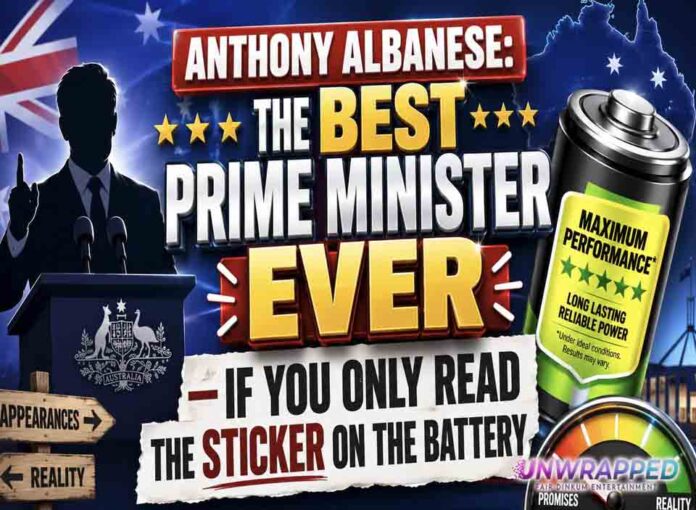
A satirical but serious deep dive into Labor’s real wins, Budget smoke, cost-of-living mirrors, and the awkward problem of facts
Anthony Albanese may not be the best Prime Minister Australia has ever had.
But he is a strong contender for best Prime Minister ever if the judging panel is made up of solar installers, Treasury PowerPoint designers, and people who stop reading Budget papers after the first page.
That sounds harsh. It is not meant to be lazy. Albanese has real achievements. His government has won a huge electoral mandate, driven a serious home battery rollout, moved into politically dangerous tax territory, kept unemployment relatively low, and delivered practical health, energy and household measures that many Australians can actually see, touch or claim.
But the “best ever” claim? That is where the sausage starts separating from the democracy sandwich.
The honest verdict is more interesting: Albanese has been more substantial than his critics admit, less transformative than his supporters claim, and much more dependent on future-tense accounting than a government with this much political power should be.
He is not a cartoon failure. He is not a miracle worker. He is something more Australian: a competent operator standing in front of a very expensive smoke machine, saying, “Nothing to see here, except possibly a $7.2 billion battery rebate.”
Anthony Albanese was sworn in as Australia’s 31st Prime Minister on 23 May 2022. In 2025, Labor won a thumping election victory, taking 94 House of Representatives seats while the Coalition fell to 43. That is not a modest political endorsement. That is the electorate walking into the polling booth, looking at the alternatives, and saying, “Fine, give the quiet bloke another go — and this time give him room to move.”
And yet, by 2026, the Albanese era has become a fascinating contradiction: the government has genuine policy wins, but many households still feel like the economy is mugging them in the cereal aisle.
The Albanese Pitch: Big Mandate, Modest Voice, Enormous Sticker Price
Albanese’s political brand is not revolutionary fire. It is not Gough Whitlam’s rolling thunder, Bob Hawke’s national charisma, or Paul Keating’s verbal flamethrower.
It is more like: “We have a spreadsheet, a rebate, and a minister who can explain it on breakfast television.”
That is not automatically a weakness. Australia often rewards governments that appear stable, practical and unexciting. Albanese’s 2025 election result was historically strong: ABC election analyst Antony Green described it as one of the more one-sided results in modern Australian electoral history, with Labor’s estimated two-party-preferred vote at 55.2 per cent and Labor becoming the only first-term government to record a swing in its favour after just one term.
That is the first serious point in Albanese’s favour. He did not just survive. He expanded.
The second point is that his government has done things. Actual things. Not just taskforces into frameworks for consultations about roadmaps.
The problem is that some of those things are immediate and useful, while others are delayed, conditional, grandfathered, backloaded, dependent on heroic savings assumptions, or wrapped in language so polished it could legally be sold as a mirror.
This is where the “best Prime Minister ever” argument becomes satire. Because Albanese’s government is at its strongest when it delivers something tangible, like a home battery subsidy. It is at its weakest when it asks Australians to applaud relief that arrives later, savings that may not arrive at all, and reforms that tiptoe around the people already winning.
The Undeniable Win: Home Batteries, Solar and the Great Garage Revolution
Let’s start with the bit that deserves genuine credit.
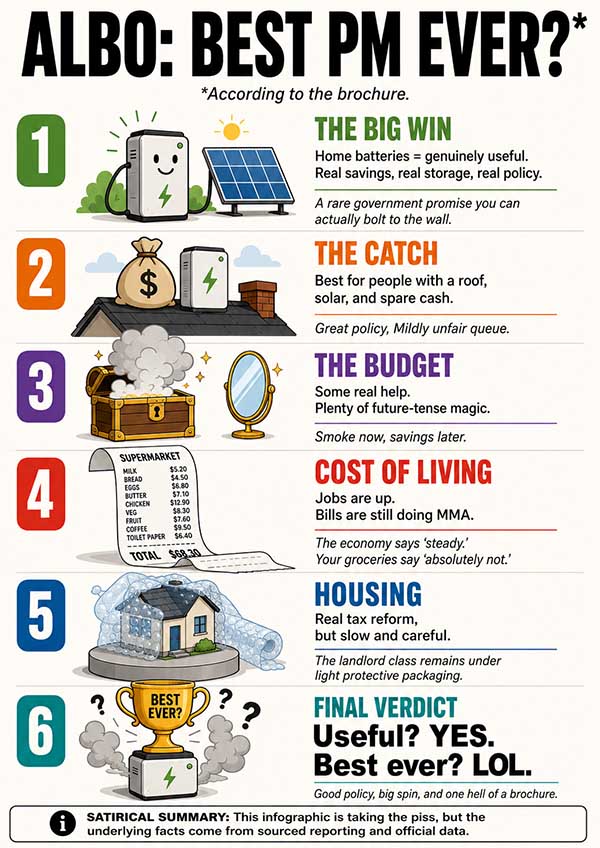
The Cheaper Home Batteries Program is one of the Albanese government’s clearest practical achievements. From 1 July 2025, eligible households, small businesses and community organisations could receive an upfront discount of around 30 per cent on eligible small-scale battery systems connected to rooftop solar. The program operates through the Small-scale Renewable Energy Scheme.
This is not abstract policy. This is not a 400-page national vision document called Powering Australia’s Future Together Through Collaborative Resilience Pathways. This is a battery on the wall.
The government expanded the program from an original estimate of $2.3 billion to $7.2 billion over four years, with the aim of supporting more than 2 million batteries by 2030 and adding around 40 GWh of storage capacity.
That is serious. It matters because Australia already has one of the world’s great rooftop solar stories, but rooftop solar without storage is like buying a ute and only being allowed to drive it at lunchtime. Batteries help households use more of their own solar, reduce pressure on the grid, and potentially lower bills for participating households.
By late April 2026, the government said more than 350,000 households, small businesses and community organisations had installed a battery under the scheme, with almost half also installing or upgrading solar. By mid-May, Energy Minister Chris Bowen said the number had passed 400,000 batteries, with around 11.2 GWh of additional storage.
That is a real achievement. It is probably the most “point to it in the garage” policy of the Albanese government.
And yes, that matters politically. A voter can look at a battery and say, “This exists.” That is more than can be said for many government announcements, which often evaporate somewhere between the press release and the procurement portal.
But here comes the catch, because democracy hates clean storylines
The home battery policy is good. But it is not equally accessible.
The Australian Energy Council found that battery installations skewed toward wealthier areas: the most advantaged SEIFA deciles 8–10 accounted for 41.0 per cent of installations, while the most disadvantaged deciles 1–3 accounted for only 17.8 per cent. Wealthier areas also tended to install larger systems.
That does not make the policy bad. It makes it very Australian.
The people who benefit first from a home battery rebate are often people who already have the holy trinity of modern household privilege: a detached roof, existing solar, and enough spare cash to still pay the gap after the rebate.
Renters? Apartment dwellers? Low-income households? People whose “battery storage system” is a phone charger behind the couch? They are not first in line.
So yes, the Albanese government deserves credit for a strong, practical, future-facing energy policy. But the satire writes itself: Australia has found a way to make even climate policy mildly property-class coded.
Electricity Bills: The Rebate Worked, Until the Mirror Stopped Working
The government’s energy story gets more complicated when you look at power prices.
The ABS reported that annual CPI inflation was 4.6 per cent in March 2026. Housing rose 6.5 per cent over the year, and electricity prices rose 25.4 per cent. The ABS said that electricity prices were pushed up mainly because government rebates had been used up by many households; excluding those rebates, electricity prices rose 3.9 per cent.
That is the Budget mirror in miniature.
The rebate helped. Then the rebate wore off. Then the bill looked ugly again.
This is the difference between relief and repair. Relief is a blanket. Repair is a better house. The government has handed out blankets and helped people install batteries. Both are useful. But if the power bill still punches households in the mouth once the temporary support fades, voters are allowed to ask whether the long-term system is fixed or merely wearing a very confident press release.
The best version of the Albanese energy argument is this: the government is accelerating household storage, supporting renewables, and building capacity for a cleaner, more resilient grid.
The worst version is this: the government is using rebates to soften the pain of a system that still leaves many Australians exposed to price shocks, while the biggest benefits of the battery boom flow first to people with the means to buy in.
Both versions contain truth.
That is why it is a good policy — and not a miracle.
See Also: Is the UK in Managed Decline Since 1984? The Honest Fact-Based Case
The 2026–27 Budget: Resilience, Reform, and a Smoke Machine with Treasury Branding
The 2026–27 Federal Budget is where the Albanese government’s strengths and weaknesses collide like two economists fighting over the last laser pointer.
Officially, the Budget offered cost-of-living support, tax reform, fuel security, health funding, energy measures, and a plan to improve the fiscal position. Unofficially, it also offered a masterclass in the ancient political art of announcing relief now, delivering some of it later, and hoping nobody notices that the spreadsheet is doing a lot of emotional labour.
The government announced a Working Australians Tax Offset worth up to $250 from 2027–28, changes to income tax rates, a $1,000 instant tax deduction for work-related expenses, and a temporary fuel excise cut. The Budget said the fuel excise package would reduce petrol and diesel excise from 52.6 cents per litre to 20.6 cents per litre for three months.
Those measures are not imaginary. They matter.
But some are delayed. ABC’s Budget analysis noted that the Working Australians Tax Offset would not land in people’s pockets until after July 2028.
That is a long time in household economics. If your rent, insurance, groceries, electricity and petrol are all hurting now, a tax offset in 2028 feels less like relief and more like a postcard from the future saying, “Wish you could afford to be here.”
The Budget’s core magic trick
The Budget forecast an underlying cash deficit of $31.5 billion for 2026–27, which the Treasurer said was $2.8 billion better than the mid-year update. The government also said the Budget position had improved by $44.9 billion over five years and that gross debt would be lower than previously expected.
That sounds responsible. And parts of it are.
But ABC’s analysis noted that the Budget was not expected to return to balance until 2034–35, that gross debt was still forecast to pass $1 trillion, and that the Budget benefited from an unexpected $41 billion over four years, helped by factors including commodity taxes, GST and higher inflation.
So the government improved the books, but not entirely through heroic discipline. Some of the improvement came because the economy found money behind the couch while inflation quietly stole money from everyone’s wallet.
This is the part of fiscal politics that should make voters suspicious. Inflation can improve government revenue while making households feel poorer. The Budget can look better while the weekly shop looks worse.
That is not a conspiracy. It is just the tax system wearing a balaclava.
CommBank’s Verdict: Not a Disaster, Not a Revolution, Definitely Not a Free Lunch
CommBank’s economists gave one of the more useful independent readings of the Budget. They said it tried to achieve a lot, but judged fiscal policy in 2026–27 as neutral-to-mildly expansionary and said the Budget did little to help the fight against inflation.
That is a polite economist’s way of saying: “This Budget is not setting the house on fire, but it is also not exactly helping the RBA put the fire out.”
CommBank also warned that the improved long-term Budget position relied heavily on ambitious NDIS savings, and judged those savings unlikely to be delivered in full.
This matters because every Budget has a magic cupboard.
In some Budgets, the magic cupboard is labelled “efficiency dividends”. In others, it is labelled “crackdown on multinational tax avoidance”. In this Budget, a very large label says NDIS savings.
Which brings us to the most delicate part of the whole Albanese fiscal story.
The NDIS Savings: The Budget’s Favourite Unopened Present
The Budget’s improved fiscal path leans heavily on NDIS reform. ABC reported that the government booked $37.8 billion in NDIS savings over the forward estimates, including through shifting more than 160,000 participants into state-run services.
There is a serious policy issue here. The NDIS has grown rapidly. The system needs reform. Costs matter. Sustainability matters.
But so does delivery. So do disabled Australians. So do families who rely on services. So do state governments, which may not be thrilled to discover they are starring in the Commonwealth’s savings plan.
If the savings are achieved carefully, fairly and competently, the government can claim real reform. If they are not, the Budget numbers begin to look less like prudence and more like optimism wearing a high-vis vest.
The honest line is this: NDIS reform is necessary, but counting huge savings before the politics, implementation and human consequences are fully resolved is Budget theatre of the highest order.
This is where the “smoke and mirrors” criticism is strongest. Not because the government invented the problem. It did not. But because the Budget asks Australians to accept very large future savings as if they are already safely in the bank.
They are not in the bank. They are in the plan.
And in Australian politics, “in the plan” is a dangerous place to keep money.
Housing: Real Reform, But With Bubble Wrap Around the Landlord Class
Housing is where Albanese’s government deserves both credit and a raised eyebrow.
The 2026 Budget announced significant tax changes. From 1 July 2027, negative gearing would be limited to newly built homes, with existing arrangements preserved for properties held before Budget night. The government also announced changes to capital gains tax, replacing the 50 per cent CGT discount with an inflation-based approach and a 30 per cent minimum tax on gains, plus a 30 per cent minimum tax on discretionary trusts from 1 July 2028.
This is not nothing. It takes political courage to touch negative gearing and capital gains tax in Australia, a country where housing policy is often treated like a sacred text written by auctioneers.
The government’s case is that the old tax settings disproportionately benefited the wealthy. Treasury said 83 per cent of the benefit of the current CGT discount went to the top 10 per cent of taxpayers by income, and that more than 90 per cent of private trust wealth was held by the wealthiest 10 per cent.
That is the reform case in one paragraph: the system has been tilted, and the government is trying to tilt it back.
But here is the problem: the changes are delayed, existing property investors are protected, and the housing affordability crisis is already a full-blown national emergency wearing a real estate agent’s blazer.
CommBank judged the negative gearing and CGT reforms likely to help at the margin, but not enough to fundamentally fix affordability.
That sounds right.
Because Australia’s housing market is not just a market. It is a retirement strategy, a family argument, a tax shelter, a barbecue talking point, and a national psychological disorder with a Domain login.
Albanese has moved further than many expected. That deserves credit. But if a young renter asks, “Will this help me buy a home soon?”, the honest answer is: possibly a little, eventually, around the edges, assuming supply improves, interest rates behave, investors adjust, and the economic gods stop laughing.
That is not a slogan. But it is closer to the truth.
Cost of Living: The Government’s Most Dangerous Opponent
Albanese’s biggest political enemy is not Peter Dutton, the Greens, the Teals, News Corp, Sky After Dark, or whichever think tank currently has the word “freedom” in its name.
It is the supermarket receipt.
By March 2026, annual CPI inflation was 4.6 per cent, while the Wage Price Index rose 3.3 per cent over the year to the March quarter. That means nominal wages were still growing, but inflation was eating a large chunk of the benefit.
The labour market was not collapsing. The ABS reported unemployment at 4.3 per cent in March 2026, with employment at about 14.77 million people.
That is one of the strongest arguments for giving the Albanese government some credit. Keeping unemployment relatively low while dealing with inflation, global shocks and structural pressures is not easy.
But here is the household reality: having a job is better than not having a job, but it does not make a $9 punnet of berries feel like nation-building.
The Reserve Bank raised the cash rate to 4.35 per cent in May 2026, saying the move was intended to help bring inflation down. The RBA’s May outlook also pointed to headline inflation peaking around the June quarter of 2026 and trimmed mean inflation remaining above 3 per cent until mid-2027.
That is a nasty political environment. The government can announce relief, but the RBA can tighten. The Treasurer can talk about wages, but households see bills. Ministers can say inflation is global, complicated and moderating over time, but voters still know what their mortgage, rent, insurance and groceries cost.
And that is why the “best Prime Minister ever” claim falls apart fastest at the checkout.
Best ever for whom? The battery owner? The full-time worker with stable employment? The renter whose pay rise has been swallowed by housing? The young person staring at a property market that appears to have been designed by a casino?
Albanese can claim achievements. He cannot claim universal relief.
Health: Useful Spending, Less Revolution
Health is another area where the Budget offered real money and real measures.
The government announced major health commitments, including $25 billion for hospitals, $6.5 billion for PBS medicines, $3.5 billion for Medicare, permanent urgent care clinics, aged care funding, and a $2 billion Commonwealth commitment for the Thriving Kids initiative.
Again, this is not fake. These are serious areas of public need.
But the best critique is that much of this is more “keep the system standing” than “transform the system”. Grattan’s health analysis argued the Budget contained important funding but less reform, noting that major issues such as dental care were not brought into Medicare.
That does not make the spending bad. Governments must fund hospitals, medicines, Medicare, aged care and disability services. But it does complicate the grand narrative.
A government can be useful without being historic.
A Budget can be expensive without being visionary.
And a health announcement can be necessary without deserving a statue.
Fuel Security: Sensible Policy, Slightly Apocalypse-Flavoured
The 2026 Budget also leaned into fuel security.
The government announced a $14.8 billion fuel resilience package, including measures to increase domestic fuel reserves and improve supply resilience. It also said Australia had secured more than 1 billion extra litres of fuel between March and June and aimed to lift reserves toward 50 days.
Fuel security is serious. Australia is vulnerable to global supply shocks. Recent global instability makes this more than a theoretical issue.
But politically, it is another example of the Albanese government doing something sensible while the messaging risks sounding like a survivalist bunker with a Treasury logo.
“Vote Labor: We have batteries on the wall and diesel in the cupboard” is not a bad national resilience platform. It is just not the sort of thing you say while pretending everything is fine.
CommBank noted that even with the fuel measures, Australia would still fall short of the International Energy Agency’s 90-day standard.
So the policy is practical. But again, not magic.
The Voice Referendum: The Big Moral Project That Lost Badly
No serious assessment of Albanese can skip the Voice referendum.
The 2023 referendum on an Aboriginal and Torres Strait Islander Voice to Parliament was Albanese’s signature moral and constitutional project. It failed nationally, with 39.94 per cent voting Yes and 60.06 per cent voting No. None of the six states recorded a Yes majority.
That does not erase the government’s other achievements. It does not prove Albanese is incompetent. It does not mean the cause was unworthy.
But it does matter.
The best Prime Minister ever does not usually misread the national mood so badly that the country returns a 60 per cent No vote and every state rejects the proposal.
The Voice defeat revealed a gap between moral intention and political persuasion. Albanese backed something he believed in. That deserves respect. But politics is not only about belief. It is about building consent, neutralising fear, explaining consequences, and knowing when the electorate is not where you wish it was.
The referendum was a historic failure of political judgment.
Not fatal. Not defining in isolation. But impossible to ignore.
The Tobacco Excise Problem: Actual Smoke in the Budget
The Budget’s “smoke and mirrors” theme even comes with actual smoke.
ABC’s Budget analysis reported that tobacco excise revenue was being revised down by about $8 billion, linked to the growth of illegal tobacco.
This is darkly perfect.
A government trying to present a disciplined Budget found billions disappearing into the illegal tobacco market, which is basically what happens when fiscal policy meets a dodgy shopfront with a handwritten sign and too many security cameras.
You could not invent a better metaphor if you gave a satirist three coffees and a Senate estimates transcript.
The Budget had smoke. The mirrors were optional.
Albanese’s Real Strength: He Is Better Than the Caricature
The lazy negative version of Albanese says he has done nothing.
That is false.
The home battery program is real. The tax reforms are real. The 2025 election mandate was real. Health funding is real. Fuel resilience measures are real. The government has kept employment relatively strong. It has moved into housing tax reform territory that previous governments often avoided after being frightened off by the property lobby’s sacred ghost stories.
The lazy positive version says he is one of the greats.
That is also false, or at least wildly premature.
A truly great Prime Minister changes the national trajectory in a way that becomes obvious even to critics. Albanese has not done that yet. He has delivered useful, sometimes bold, sometimes delayed, sometimes over-marketed reforms in a country still being squeezed by inflation, housing stress, energy costs and intergenerational unfairness.
The Albanese government is not empty. But it is often overpackaged.
It is not useless. But it often confuses “announced” with “felt”.
It is not dishonest in the cartoon sense. But the Budget presentation sometimes relies on exactly the kind of political optimism that makes voters cynical: relief later, savings later, reform later, trust us now.
That is not best-ever governing. That is competent governing with a very active communications department.
Scorecard: The Albanese Era So Far
| Category | Score | Honest Verdict |
|---|---|---|
| Election performance | 9/10 | The 2025 result was a monster win. A huge mandate, no question. |
| Home batteries and solar policy | 8/10 | Tangible, popular, useful, and genuinely forward-looking — but skewed toward households with roofs and capital. |
| Budget honesty | 5/10 | Real measures, but too much future relief, ambitious savings, and lucky revenue dressed up as discipline. |
| Cost-of-living relief | 4/10 | Some help exists, but inflation, power prices, housing and rates still dominate household reality. |
| Housing reform courage | 7/10 | Touching negative gearing and CGT is politically brave. Immediate affordability impact is much weaker. |
| Housing reform impact | 4/10 | Better than nothing, but not enough to fix a market this broken. |
| NDIS reform credibility | 5/10 | Reform is needed, but the savings assumptions look highly ambitious. |
| Health policy | 6.5/10 | Useful funding and support, less transformational than the headline suggests. |
| Political judgment | 6/10 | Strong election strategy, but the Voice defeat was a major failure. |
| Best Prime Minister ever claim | 2/10 | Excellent satire. Weak history. |
The Final Verdict: Best Ever? No. Better Than the Noise? Yes.
Anthony Albanese has not been the best Prime Minister Australia has ever had.
But he has also not been the do-nothing cardboard cut-out his harshest critics want him to be.
The truth is sharper.
Albanese has delivered one of the most practical household energy policies in recent memory. His government has pushed into serious tax reform. It has won a massive mandate. It has funded health, fuel security, batteries, hospitals, medicines and cost-of-living measures. It has taken some real swings.
But the latest Budget also asks voters to accept too much on trust. Trust that NDIS savings will land. Trust that delayed tax relief will matter when it arrives. Trust that housing reforms will improve affordability despite grandfathering and delay. Trust that inflation will ease before households run out of patience. Trust that a Budget improved by windfalls is the same as a Budget repaired by hard choices.
That is where the satire becomes serious.
The Albanese government’s best achievements are real. Its worst habits are also real. It has a gift for turning practical policy into over-polished marketing, and a habit of placing future benefits under present-tense headlines.
So no, Anthony Albanese is not the best Prime Minister ever.
He is something more believable: a politically successful, policy-active, occasionally brave, frequently overmarketed Prime Minister whose government has delivered genuine wins while asking Australians to squint very hard at the smoke and call it reform.
Best ever?
Only if the trophy is installed with rooftop solar, subsidised under the Small-scale Renewable Energy Scheme, grandfathered for tax purposes, and not delivered until 2028.
SEO FAQ
Has Anthony Albanese been the best Prime Minister ever?
No serious historical assessment can honestly say that yet. Albanese has major achievements, including Labor’s huge 2025 election win and the rapid expansion of home battery subsidies, but his record also includes high inflation pressure, delayed Budget relief, ambitious NDIS savings assumptions, housing affordability limits, and the failed Voice referendum.
What is Anthony Albanese’s biggest achievement so far?
The strongest practical achievement is arguably the Cheaper Home Batteries Program. It offers around a 30 per cent discount on eligible batteries connected to rooftop solar, was expanded to $7.2 billion over four years, and had reportedly supported hundreds of thousands of installations by 2026.
What is the strongest criticism of the 2026–27 Budget?
The strongest criticism is that it relies heavily on delayed relief and ambitious future savings, especially from NDIS reform. Independent analysis from CommBank said the Budget does little to help the inflation fight and relies heavily on NDIS savings that may be difficult to deliver in full.
Were Albanese’s housing tax reforms meaningful?
Yes, but with limits. The Budget’s negative gearing, CGT and trust tax changes are politically significant, especially because current tax benefits are heavily skewed toward higher-income Australians. But the reforms are delayed, existing property holdings are protected, and independent analysis suggests the measures will not fundamentally fix housing affordability.
Why is the home battery program both good and unequal?
It is good because it supports household storage, solar use and grid resilience. It is unequal because early uptake is concentrated in wealthier areas, where households are more likely to own homes, have rooftop solar, and afford the remaining cost after the rebate.
References
- Prime Minister of Australia — About Anthony Albanese. Confirms Albanese was sworn in as Australia’s 31st Prime Minister on 23 May 2022.
- Australian Electoral Commission — 2025 Federal Election Tally Room. Official 2025 House of Representatives result showing Labor on 94 seats and the Coalition on 43.
- ABC / Antony Green — 2025 Federal Election Analysis. Analysis of Labor’s 2025 landslide and estimated two-party-preferred vote.
- Budget 2026–27 — Cost of Living Measures. Details on the Working Australians Tax Offset, income tax changes, instant deduction and fuel excise cut.
- Budget 2026–27 — Tax Reform. Details on negative gearing, CGT changes, trust tax changes and related reforms.
- Treasurer Jim Chalmers — 2026–27 Budget Speech. Details on deficit forecasts, debt position and Budget improvement claims.
- Treasury Ministers — Housing and Tax Reform Release. Details on the distribution of CGT and trust tax benefits.
- ABS — Monthly Consumer Price Index, March 2026. CPI, trimmed mean inflation, housing, electricity and fuel price data.
- ABS — Wage Price Index, March Quarter 2026. Wage growth data showing 3.3 per cent annual growth.
- ABS — Labour Force, March 2026. Unemployment, employment and participation data.
- Reserve Bank of Australia — May 2026 Monetary Policy Decision. Cash rate increase to 4.35 per cent.
- Reserve Bank of Australia — May 2026 Economic Outlook. Inflation, unemployment and wages outlook.
- Energy.gov.au — Cheaper Home Batteries Program. Program details, eligibility and approximate 30 per cent discount.
- DCCEEW — Cheaper Home Batteries Program Expansion. Details on the expansion to $7.2 billion and target of more than 2 million batteries by 2030.
- Ministerial Release — Cheaper Home Batteries Rollout. Government statement that more than 350,000 households, small businesses and organisations had installed a battery by late April 2026.
- RenewEconomy — Home Battery Rollout Milestone. Report on the program passing 400,000 batteries and 11.2 GWh of additional storage.
- Australian Energy Council — Home Battery Equity Analysis. Analysis showing installations skewing toward wealthier areas.
- ABC — 2026 Federal Budget Winners and Losers. Budget analysis covering delayed tax relief, debt, deficits, NDIS savings, revenue windfalls and tobacco excise.
- CommBank — 2026 Federal Budget Economic Analysis. Independent analysis of fiscal stance, inflation impact, NDIS savings and housing reforms.
- Budget 2026–27 — Fuel Security and Energy Resilience. Details on fuel reserves, domestic gas reservation, renewables and home batteries.
- Health Minister — 2026–27 Health Budget Measures. Details on hospitals, PBS, Medicare, urgent care clinics, NDIS and aged care funding.
- Grattan Institute — Health Budget Analysis. Analysis of health spending and limits of reform.
- Australian Electoral Commission — 2023 Voice Referendum Results. Official national Yes/No result and state results.
Disclaimer
This article is a satirical opinion piece, which is a fancy legal-ish way of saying: we are taking the piss, but we brought receipts.
The commentary above is intended for political analysis, humour, public-interest criticism and the ancient Australian democratic tradition of pointing at powerful people and saying, “Yeah, nah, explain that one.”
All factual claims are based on publicly available sources linked in the references. Any jokes, sarcasm, metaphors, Budget smoke machines, economic side-eyes, suspicious mirrors, or references to national policy being held together with rebates and optimism are commentary, not allegations of personal wrongdoing.
This article does not claim that Anthony Albanese is literally the best Prime Minister ever, the worst Prime Minister ever, or a man personally hiding inside your electricity bill. It argues that his government has real achievements, real weaknesses, and a very impressive ability to make delayed relief sound like it has already arrived.
Readers are encouraged to check the sources, think critically, disagree loudly if they wish, and remember that in politics, as in home battery subsidies, the fine print often does a lot of heavy lifting.
No politicians were physically harmed in the making of this article. Several talking points may have been bruised.
Another Must-Read: Where Is the Other Side? The Berlin Wall, Western Freedom, and the New Creep of Control