

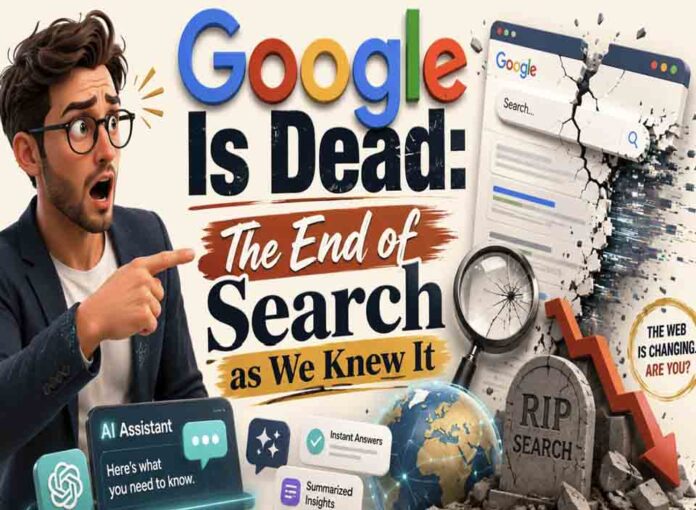
Google is dead.
Not the company. Not the stock. Not the empire of servers, ads, maps, phones, browsers, inboxes, videos, and invisible tracking systems. That Google is very much alive. In fact, Google still dominates global search, holding about 90.02% of the worldwide search-engine market as of April 2026.
But the old Google — the Google we once trusted as the clean doorway to the internet — is dead.
That Google was not merely a search engine. It was a promise. It promised that the chaos of the web could be organized. It promised that the best information would rise. It promised that authority, usefulness, and relevance could be measured by an algorithm more honest than any human editor.
For years, we believed it.
We typed our fears, desires, symptoms, arguments, products, questions, and private doubts into one white box. We asked Google what was true. We asked Google where to go. We asked Google what to buy, who to trust, what to think, and sometimes even who we were.
And Google answered.
At first, it answered with links.
That was the sacred bargain.
Google did not appear to speak for itself. It appeared to point beyond itself. It said: here are the sources, here are the pages, here is the web. Go and see.
That was the old faith.
Today, that faith is broken.
What Does “Google Is Dead” Really Mean?
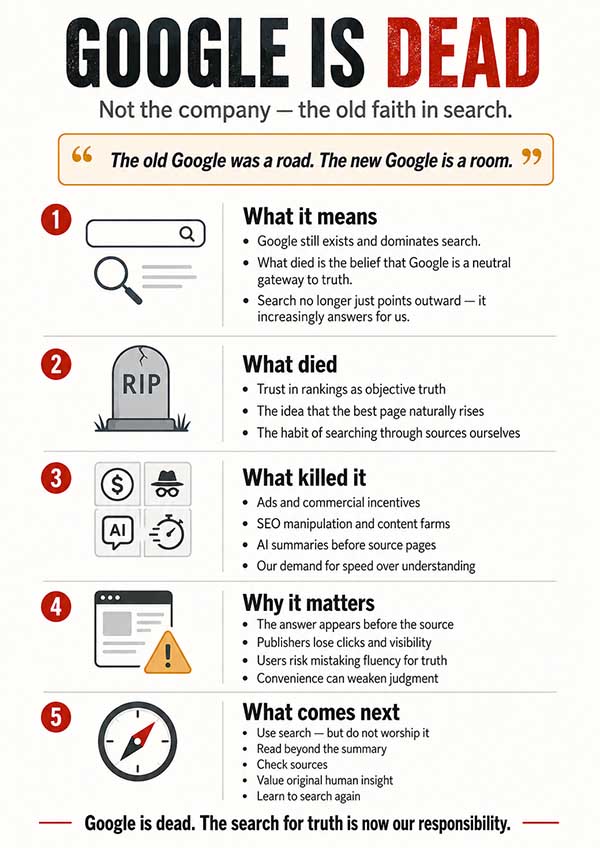
To say Google is dead is not to say Google has failed as a business. That would be foolish. Google remains one of the most powerful companies on earth.
The phrase means something deeper.
It means the idea of Google as a neutral, trustworthy gateway to human knowledge has collapsed.
The original Google sent users outward. The new Google increasingly keeps users inside its own world. With AI Overviews, Google says users can get an “AI-generated snapshot” of information directly in search results. With AI Mode, Google describes a more advanced AI search experience that can answer follow-up questions, reason across information, and provide a more conversational search journey.
This is not a small interface change.
It is a change in the structure of knowledge.
The old Google was a map.
The new Google wants to be the destination.
The Old Google Was a Road. The New Google Is a Room.
The old search engine gave you links. It asked you to move. To compare. To read. To judge.
The new search engine gives you answers.
That sounds convenient. And it is. But convenience is never innocent when it becomes the shape of thought.
When Google summarizes the web before you visit it, the source becomes secondary. The answer comes first. The journey disappears. The human act of searching becomes softer, faster, easier — and weaker.
This is the danger.
Not that Google gives no answers.
The danger is that Google gives answers so smoothly that users forget to ask where those answers came from.
A link requires action.
A summary invites surrender.
Who Killed Google?
Who killed the old Google?
Not one person. Not one executive. Not one update. Not one AI model.
We killed it.
We killed it because we wanted speed more than understanding.
We killed it because we clicked the easiest result, not the best one.
We killed it because we rewarded headlines written for algorithms instead of humans.
We killed it because businesses learned to manipulate search rankings, publishers learned to chase traffic, and users learned to mistake the first page for the truth.
Google did not become this alone.
It became this by obeying us.
We asked for faster answers.
We asked for less friction.
We asked for instant certainty.
We asked for the internet without the burden of searching it.
And now we have it.
The answer appears before the source.
The summary appears before the article.
The machine speaks before the human is heard.
This is why Google is dead.
AI Search and the New Crisis of Truth
AI search is not just a new feature. It is a new gatekeeper.
Google’s AI Overviews and AI Mode are part of a broader shift from search engines to answer engines. Instead of simply indexing the web, search platforms now interpret, summarize, and present information in their own voice.
That creates a serious problem.
If users no longer need to visit the original source, what happens to the people who create the knowledge?
What happens to journalists, researchers, bloggers, independent publishers, local businesses, reviewers, and experts?
What happens to the open web when the gatekeeper becomes the final page?
Google says AI Overviews include links to help users explore more deeply. But the deeper question remains: if the machine gives people “enough,” how many will still click?
The old web depended on movement.
Creators published.
Google indexed.
Users clicked.
Traffic flowed.
Knowledge circulated.
Now the machine digests the web and serves the answer at the gate.
The web still exists.
But it is being consumed by the very systems that once organized it.
Google Is Not Dead Because It Lost Power. It Is Dead Because It Has Too Much Power.
This is the paradox.
Google is not dead because it became weak.
Google is dead because it became too powerful to be trusted in the old way.
A tool can be trusted while it remains a tool. But when the tool becomes the environment, trust changes. Google is no longer only something we use. It is something we live inside.
It shapes what businesses get seen.
It shapes what information appears credible.
It shapes what questions are answered.
It shapes what questions are never asked.
That is why governments have turned their attention to Google’s power. The U.S. Department of Justice has described significant remedies in its monopolization case against Google in online search, while Reuters reported that the U.S. government and states pursued appeals after a federal judge ruled Google had a monopoly in online search but rejected some of the toughest remedies.
This matters because search is not only a market.
Search is memory.
Search is visibility.
Search is reality management.
To control search is not merely to control traffic. It is to control what becomes findable.
The New Nihilism of Search
Nietzsche warned that when an old source of meaning collapses, humanity does not immediately become free. First, it becomes lost.
That is what is happening to search.
The death of the old Google has produced a new kind of nihilism.
Not the nihilism that says, “Nothing is true.”
This one is more comfortable.
It says:
“What appears first is true enough.”
“What is summarized is understood.”
“What is convenient is authoritative.”
“What the machine says is probably right.”
This is the nihilism of passive knowledge.
It does not look like despair. It looks like efficiency.
It does not shout. It scrolls.
It does not deny truth. It replaces the hard work of finding truth with the soft pleasure of receiving an answer.
That is more dangerous than ignorance.
Ignorance knows it does not know.
AI-assisted certainty often does not.
Why This Matters for SEO
For marketers, publishers, writers, and business owners, the phrase Google is dead should not be read as a dramatic insult. It should be read as a warning.
The old SEO game is dying.
Ranking on page one is no longer enough. Getting indexed is no longer enough. Writing keyword-stuffed content is certainly not enough.
The future of SEO belongs to content that proves experience, authority, originality, and usefulness.
If AI search can summarize generic information, then generic information loses value.
The winners will be those who create what machines cannot easily fake:
Original insight.
First-hand experience.
Strong opinion.
Real expertise.
Human judgment.
Clear evidence.
Memorable language.
Trust.
The future is not simply SEO.
It is reputation.
It is authority.
It is becoming a source worth citing, not merely a page worth ranking.
The Death of Google Is Also an Opportunity
The old Google is dead.
But that does not mean search is dead.
It means searching must become more conscious.
Users must stop treating the first answer as final. Writers must stop creating empty content for machines. Businesses must stop chasing tricks and start building trust. Publishers must offer depth that cannot be reduced to a bland AI paragraph.
The future belongs to people who can use Google without worshipping it.
Use the answer. But question it.
Read the summary. But open the source.
Accept convenience. But do not surrender judgment.
The new digital citizen must become stronger than the interface.
See Also: Google Analytics vs. Google Search Console: The Ultimate Guide to Mastering Website Insights
What Comes After Google?
The question is not whether another company will replace Google.
The question is whether we will replace our dependence on Google with something better — or simply kneel before a new machine.
Chatbots, AI assistants, social platforms, recommendation engines, and answer engines are all competing to become the next gateway to reality.
But the danger remains the same.
If we let any system think for us, rank for us, summarize for us, and decide what matters for us, then we have not escaped Google.
We have only changed temples.
The real future of search is not another search box.
The real future of search is a more demanding human being.
A person who asks better questions.
A person who checks sources.
A person who values original work.
A person who knows that fluency is not truth.
A person who understands that an answer is not the same as understanding.
Google Is Dead. Now We Must Learn to Search Again.
Google is dead.
Not because it disappeared.
Because the old belief in Google has disappeared.
The belief that one algorithm could fairly organize the world.
The belief that visibility meant value.
The belief that the first result deserved obedience.
The belief that convenience was harmless.
The belief that search could replace judgment.
That belief is gone.
And now we stand in the strange light after its death.
Google remains. Google grows. Google answers more than ever.
But that is exactly why we must become more awake.
The old Google told us where to look.
The new Google tells us what to think we have found.
That difference is everything.
So do not ask only, “What does Google say?”
Ask:
Who benefits from this answer?
What source has been hidden?
What has been simplified?
What has been left out?
What would I know if I kept searching?
Google is dead.
Now the search begins.
SEO FAQ Section
Is Google really dead?
No. Google is not dead as a company. The phrase “Google is dead” means the old idea of Google as a neutral and trusted gateway to the open web is dying.
Why do people say Google is dead?
People say Google is dead because search has changed. Ads, SEO manipulation, AI-generated answers, zero-click results, and algorithmic control have weakened trust in the classic Google search experience.
How is AI changing Google Search?
AI is turning Google from a search engine into an answer engine. Instead of only showing links, Google now provides AI-generated summaries through features such as AI Overviews and AI Mode.
What does “Google is dead” mean for SEO?
It means old SEO tactics are not enough. Websites need original expertise, strong authority, first-hand experience, and genuinely useful content that AI systems and human readers can trust.
What replaces Google Search?
Google may not be replaced by one company. Instead, search is fragmenting across AI assistants, social platforms, chatbots, marketplaces, and specialized discovery tools.
Disclaimer: Please Do Not Alert the Coroner
When we say “Google is dead,” we are speaking metaphorically, philosophically, dramatically, and with just enough theatrical arm-waving to make Nietzsche nod from the grave.
Google has not literally died. No search engine was harmed in the making of this article. Alphabet Inc. remains very much alive, extremely wealthy, and probably aware of what you had for breakfast.
This piece is an opinionated commentary on the changing nature of search, AI answers, online trust, SEO, and the way modern humans now outsource half their thinking to glowing rectangles. It is not a claim that Google has ceased trading, collapsed as a company, or been found face-down in a server room clutching a broken algorithm.
All trademarks, brand names, logos, and corporate identities belong to their respective owners. This article is not affiliated with, endorsed by, sponsored by, whispered to, quietly approved by, or emotionally validated by Google, Alphabet, or any of their subsidiaries.
Nothing here should be taken as legal, financial, investment, technical, spiritual, medical, or life advice. Honestly, if you are getting life advice from a dramatic article called “Google Is Dead,” take a brisk walk and drink some water.
Readers are encouraged to check sources, think critically, click beyond the summary, and resist treating any search result, AI answer, or aggressively confident internet essay as holy scripture.
In short:
Google is not dead. The old faith in Google is.
Please direct all complaints to the nearest mirror, search bar, or existential void.
Another Must-Read: The Google Engineer Who Believes The Company’s Artificial Intelligence Has Come To Life